✈️ Aircraft Specifications
| Designation | Tu-144 |
| Manufacturer | Tupolev |
| Country of Origin | Russia/Soviet Union |
| First Flight | 1968 |
| Length | 65.7 m (215.6 ft) |
| Max Speed (Mach) | 2.15 |
| Max Speed (km/h) | 2,300 km/h |
| Service Ceiling | 20,000 m (65,620 ft) |
| Range | 6,500 km (4,037 mi) |
| Engine | 4× Kolesov RD-36-51A turbofans |
| Crew | 3 |
| Status | Retired |
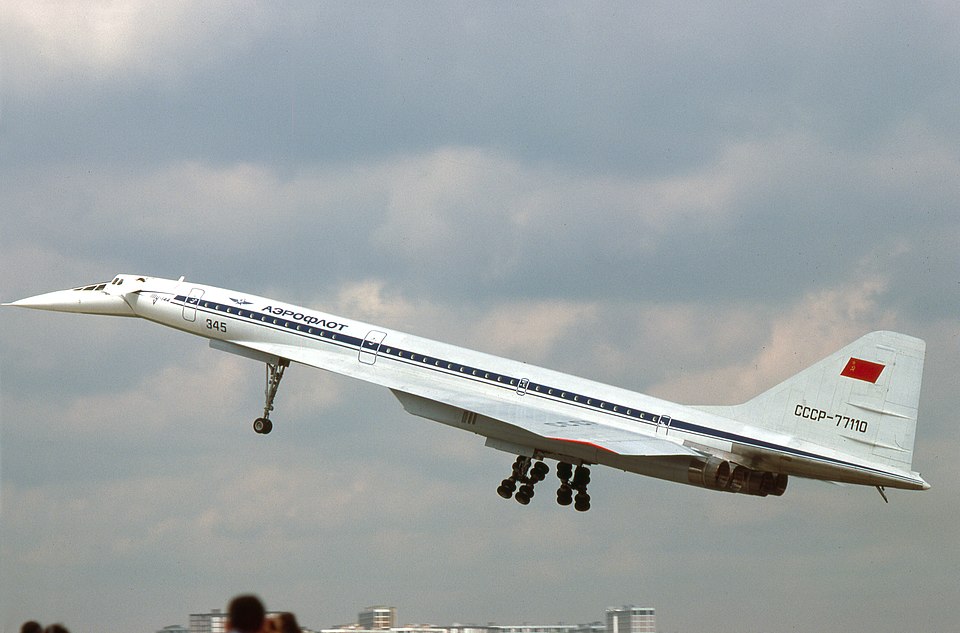
Overview
The Tu-144 was the world’s first supersonic transport (SST) to fly—beating Concorde by two months. Known in the West as ‘Concordski’ due to its superficial resemblance, the Tu-144 had a troubled history but represented an extraordinary Soviet engineering achievement.
Design & Development
The Tu-144 featured a distinctive ogival delta wing and retractable canard foreplanes for low-speed handling. At Mach 2.15, it was slightly faster than Concorde. However, its engines were less efficient and the cabin was notoriously noisy—passengers seated next to each other had to pass notes to communicate.
Operational History
Passenger service began on November 1, 1977, but was suspended after only 55 scheduled flights following a second crash in 1978. Only 16 Tu-144s were built. One aircraft was later used by NASA for supersonic research in the 1990s. Today, surviving Tu-144s are museum pieces.
Armament
The Tu-144 was a civilian supersonic transport and carried no weapons. It seated up to 140 passengers, though the cabin was notoriously noisy.
Video
Frequently Asked Questions
How fast is the Tu-144?
The Tu-144 had a top speed of Mach 2.15 (1,430 mph), slightly faster than Concorde.
Why was the Tu-144 called “Concordski”?
Western media nicknamed it due to its resemblance to Concorde. There were allegations of Soviet espionage regarding Concorde data.
How many Tu-144s were built?
16 Tu-144 aircraft were built.
Is the Tu-144 still in service?
No. It flew only 55 scheduled passenger flights in 1977-78. NASA later used one for research in the 1990s.