✈️ Aircraft Specifications
| Designation | J-11B |
| Manufacturer | Shenyang Aircraft Corporation |
| Country of Origin | China |
| First Flight | 1998 |
| Length | 21.9 m (71.9 ft) |
| Max Speed (Mach) | 2.35 |
| Max Speed (km/h) | 2,500 km/h |
| Service Ceiling | 19,000 m (62,339 ft) |
| Range | 3,530 km (2,192 mi) |
| Engine | 2x AL-31F / WS-10 Taihang turbofan |
| Crew | 1 |
| Status | Active |
Overview
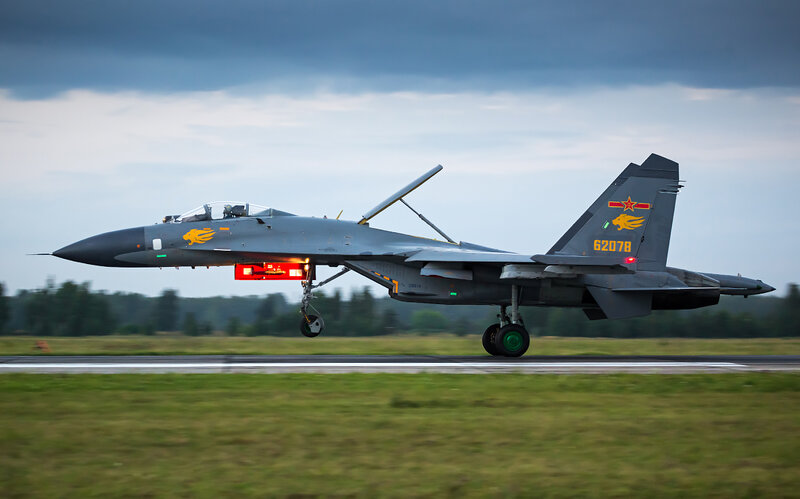
The Shenyang J-11 is a Chinese fourth-generation twin-engine air superiority fighter derived from the Soviet Sukhoi Su-27SK. Manufactured by the Shenyang Aircraft Corporation (SAC), the J-11 represents China’s evolution from licensed production of Russian aircraft to increasingly indigenous fighter development. The aircraft serves as a critical component of the People’s Liberation Army Air Force (PLAAF) and Naval Air Force, with approximately 440 units built as of 2019. Known by the NATO reporting name “Flanker-B+/Flanker-L,” the J-11 family has grown to include several advanced variants with domestically developed subsystems.
Design & Development
China became the Su-27’s first export customer following the Western arms embargo imposed after the 1989 Tiananmen Square protests. After acquiring 36 Su-27SKs and 42 Su-27UBKs in the 1990s, China signed a US$1.2 billion agreement with Russia in 1996 to produce 200 Su-27s under license at the Shenyang Aircraft Corporation facility.
Production began in 1997 using kits from Russia’s Komsomolsk-on-Amur Aircraft Plant. The first two aircraft were completed in December 1998 but required Russian assistance due to poor assembly quality. By 2003, production quality had improved significantly and began incorporating locally manufactured airframe components. The J-11A variant, featuring improved domestic avionics, entered production in 2000.
The J-11B, a major evolution, replaced Russian subsystems with Chinese-developed alternatives including the Type 1493 radar, digital flight control system, glass cockpit, and composite materials for a lighter airframe. This variant was conceived to eliminate dependency on Russian components and can carry indigenous PL-12 and PL-8B air-to-air missiles. The latest J-11BG upgrade adds compatibility with the advanced PL-15 beyond-visual-range missile and PL-10 short-range missile.
Operational History
The J-11 entered service with the PLAAF in 1998 and rapidly became one of China’s most important air superiority platforms. The aircraft was deployed to units across China’s military regions, providing a significant capability upgrade over older types like the J-7 and J-8.
While the J-11 has not seen combat, it has been extensively involved in intercept operations over the Taiwan Strait and the South China Sea. PLAAF J-11s have frequently been scrambled to intercept foreign military aircraft operating near Chinese airspace, and the type has participated in numerous large-scale military exercises.
The development of the J-11B caused diplomatic friction with Russia, as it was seen as a violation of the original co-production agreement’s intellectual property provisions. Despite this, China continued to evolve the platform, and the J-11 family has served as the basis for further developments including the Shenyang J-16 strike fighter and the J-15 carrier-based fighter.
Capabilities
- Twin-engine power — Two AL-31F or WS-10 Taihang turbofan engines providing excellent thrust-to-weight ratio
- Long range — Combat radius exceeding 1,500 km with internal fuel, extendable with external tanks
- Heavy weapons load — 10 hardpoints capable of carrying up to 8,000 kg of ordnance
- Advanced radar — Type 1493 pulse-Doppler radar with look-down/shoot-down capability on J-11B variants
- Supermaneuverability — Inherited Su-27 aerodynamic design enabling exceptional high-angle-of-attack performance
- Glass cockpit — Modern digital displays and Chinese-developed avionics suite on B variants
Armament & Weapons
- Internal gun: 1× GSh-30-1 30mm autocannon with 150 rounds
- Air-to-air missiles: PL-12 (SD-10) active radar-guided BVR missile, PL-8B infrared short-range missile, R-73 (AA-11 Archer), PL-15 and PL-10 on J-11BG
- Air-to-ground weapons: Various unguided bombs, rocket pods, and precision-guided munitions on multirole variants
- External stores: 10 hardpoints for missiles, bombs, rocket pods, and external fuel tanks
Video
Frequently Asked Questions
Is the J-11 a copy of the Su-27?
The original J-11 was a licensed copy of the Su-27SK, produced under a 1996 agreement with Russia. However, the J-11B and later variants have evolved significantly beyond the original Su-27 design, incorporating Chinese-developed radar, avionics, engines (WS-10), weapons systems, and composite materials. While the basic aerodynamic platform remains Su-27-derived, the subsystems are largely indigenous Chinese developments.
How does the J-11 compare to the Su-35?
The Su-35 is a significantly more advanced aircraft featuring thrust-vectoring engines (AL-41F1S), the Irbis-E PESA radar with a detection range of 400 km, and more advanced avionics. The J-11B is comparable to earlier Su-27SM variants. However, the J-11BG upgrade with PL-15 missiles narrows the gap in terms of weapons capability, though the Su-35 retains advantages in radar performance and maneuverability.
What is the difference between J-11, J-15, and J-16?
The J-11 is a single-seat air superiority fighter based on the Su-27. The J-15 “Flying Shark” is a carrier-based variant developed from the Su-33 for China’s aircraft carriers. The J-16 is a two-seat multirole strike fighter similar to the Su-30MKK, optimized for both air-to-air and precision ground attack missions with an AESA radar. All three share the basic Flanker aerodynamic design but serve different operational roles.