✈️ Aircraft Specifications
| Designation | Super Mystere B2 |
| Manufacturer | Dassault Aviation |
| Country of Origin | France |
| First Flight | 1954 |
| Length | 14.13 m (46.4 ft) |
| Max Speed (Mach) | 1.12 |
| Max Speed (km/h) | 1,195 km/h |
| Service Ceiling | 17,000 m (55,777 ft) |
| Range | 870 km (540 mi) |
| Engine | SNECMA Atar 101G-2 afterburning turbojet |
| Crew | 1 |
| Status | Retired |
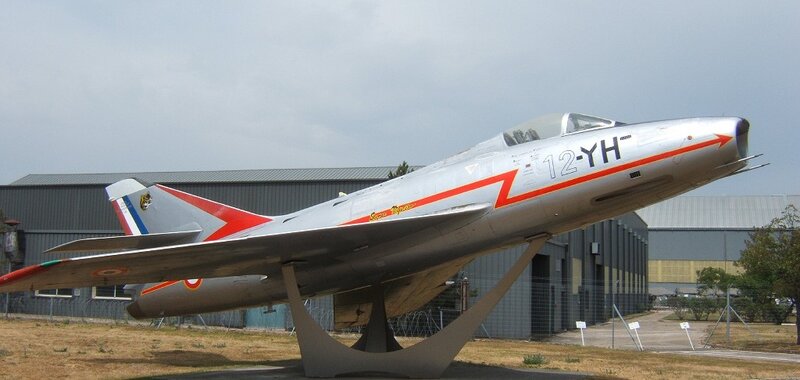
Overview
The Dassault Super Mystère is a French supersonic fighter-bomber that holds the distinction of being the first Western European supersonic aircraft to enter mass production. Developed by Dassault Aviation as the final evolution of the Ouragan-Mystère family, the Super Mystère could exceed Mach 1 in level flight — a breakthrough achievement for European aviation in the 1950s. A total of 178 aircraft were built between 1956 and 1959, serving with the French Air Force, Israeli Air Force, and Honduran Air Force across three decades of operational service.
Design & Development
The Super Mystère represented the culmination of a design lineage that began with the Dassault Ouragan and progressed through the Mystère II/III and Mystère IV. While earlier variants could only achieve supersonic speeds in a dive, the Super Mystère was designed from the outset for level supersonic flight. This was achieved through a new thin wing with 45° of sweep — compared to 41° on the Mystère IV — and the use of an afterburner-equipped turbojet engine.
The first prototype, the Super Mystère B.1 powered by a Rolls-Royce Avon RA.7R engine, first flew on 2 March 1954 and broke the sound barrier in level flight the very next day. The production version, designated Super Mystère B2 (SMB2), entered production in 1957 with the more powerful SNECMA Atar 101G engine. Two experimental B.4 prototypes with 48° swept wings and the Atar 9B engine achieved Mach 1.4, but production was abandoned in favor of the faster Dassault Mirage III.
In 1973, Israeli and Honduran Super Mystères were upgraded with the Pratt & Whitney J52-P8A engine, extended tailpipe, and new avionics. In Israeli service, these modernized aircraft were designated the IAI Sa’ar (“Storm”).
Operational History
The SMB2 entered French Air Force service in May 1958, equipping three fighter squadrons (5th, 10th, and 12th). The aircraft served France faithfully for nearly two decades until the last SMB2 of the 1/12 Cambrésis squadron made its final flight in November 1977.
The Israeli Air Force acquired 24 Super Mystères in 1958, and the aircraft became a key combat platform. Israeli Super Mystères saw extensive action during the 1967 Six-Day War and the 1973 Yom Kippur War, in which six aircraft were lost. The type was well-regarded by Israeli pilots and considered a good match against the MiG-19 in air-to-air combat. Israeli Super Mystères were also controversially involved in the USS Liberty incident of 1967.
Honduras purchased 12 Super Mystère airframes from Israel in 1976, followed by four more in 1979. These aircraft provided air support during border skirmishes with Sandinista Nicaragua and remained in service until 1996, when they were replaced by Northrop F-5Es.
Capabilities
- Supersonic flight — First Western European production aircraft capable of exceeding Mach 1 in level flight
- Mach 1.12 top speed — Maximum speed of 1,195 km/h at 11,000 meters altitude
- Fighter-bomber versatility — Capable of both air-to-air combat and ground attack missions
- Afterburning engine — SNECMA Atar 101G-2 providing 44.1 kN thrust with afterburner
- High ceiling — Service ceiling of 17,000 meters (56,000 feet)
- Rapid climb — Rate of climb of 89 m/s (17,500 ft/min)
Armament & Weapons
- Internal guns: 2× DEFA 552 30mm cannons with 150 rounds per gun
- Air-to-air missiles: 2× Rafael Shafrir infrared-guided AAMs
- Rockets: 2× Matra rocket pods with 18× SNEB 68mm rockets each
- Bombs: Up to 2,680 kg (5,000 lb) of ordnance on four external hardpoints including bombs, reconnaissance pods, or drop tanks
Video
Frequently Asked Questions
What made the Super Mystère significant in aviation history?
The Dassault Super Mystère was the first supersonic aircraft produced in Western Europe to enter mass production. While earlier aircraft could reach supersonic speeds in a dive, the Super Mystère was specifically designed to exceed Mach 1 in level flight, marking a major milestone for the European aerospace industry and establishing France as a leading producer of combat aircraft.
How does the Super Mystère compare to the North American F-100 Super Sabre?
Both aircraft were contemporaries and the first supersonic fighters of their respective nations. The F-100 was slightly faster at Mach 1.3 compared to the Super Mystère’s Mach 1.12, and had a longer range. However, the Super Mystère was lighter, had a better climb rate, and was considered more maneuverable. Both served primarily as fighter-bombers and saw combat in various regional conflicts.
Did the Super Mystère see combat?
Yes, the Super Mystère saw extensive combat service. Israeli Super Mystères fought in the 1967 Six-Day War and the 1973 Yom Kippur War, achieving air-to-air kills against Arab air forces. Honduran Super Mystères were used for air support during border conflicts with Nicaragua in the 1980s. French aircraft were not used in combat before their retirement in 1977.