✈️ Aircraft Specifications
| Designation | J-8II |
| Manufacturer | Shenyang Aircraft Corporation |
| Country of Origin | China |
| First Flight | 1969 |
| Length | 21.59 m (70.8 ft) |
| Max Speed (Mach) | 2.2 |
| Max Speed (km/h) | 2,340 km/h |
| Service Ceiling | 20,200 m (66,276 ft) |
| Range | 1,900 km (1,180 mi) |
| Engine | 2x Liyang WP-13A-II afterburning turbojet |
| Crew | 1 |
| Status | Active |
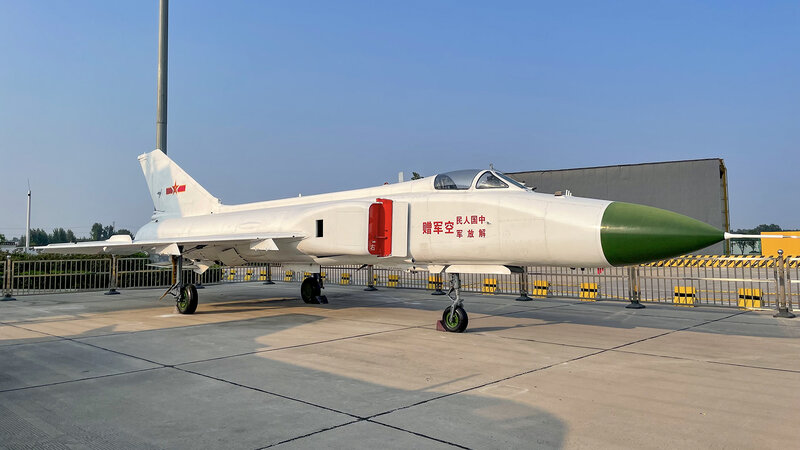
Overview
The Shenyang J-8 (NATO reporting name: Finback) is a Chinese high-altitude interceptor aircraft developed by the 601 Institute (Shenyang Aircraft Design Institute). Conceived in the early 1960s as a scaled-up twin-engine version of the MiG-21, the J-8 experienced one of the most protracted development histories in military aviation due to disruptions from China’s Cultural Revolution. The prototype first flew on 5 July 1969, but the design was not finalized until 1979, with the aircraft entering service in 1980. Over 408 J-8s were built in various variants, serving with both the PLAAF and the People’s Liberation Army Naval Air Force.
Design & Development
By 1964, the Chengdu J-7 (Chinese MiG-21) was inadequate for long-range, high-altitude interception missions. The Chinese Aeronautical Establishment considered two proposals: the twin-engine J-8 as a “scaled-up” J-7, and the more ambitious single-engine J-9. The J-8 was selected as the lower-risk option and received greater political support. Chief designer Huang Zhiqian and vice chief designer Gu Songfen led the program.
The original J-8 shared features with the J-7, including a nose air intake with a small inlet cone housing a radar rangefinder. It was powered by two Liyang WP-7B afterburning turbojets. Development suffered severe disruptions — chief engineer Huang was killed in an air crash in 1965, and the Cultural Revolution caused further delays. The first prototype, “001 Red,” was built almost clandestinely and made its maiden flight on 5 July 1969.
The J-8II (Finback-B), first flying on 12 June 1984, was essentially a new aircraft. It replaced the nose intake with a conventional radome and side air intakes, creating room for a modern fire-control radar. More powerful engines and upgraded avionics transformed the aircraft’s capabilities. The J-8II became the basis for all subsequent variants, including models intended for collaboration with the United States under the Peace Pearl program before its cancellation.
Operational History
The J-8 entered PLAAF service on 2 March 1980, already recognized as somewhat obsolescent. Despite this, the aircraft filled a critical gap in China’s air defense capabilities, serving as a high-altitude, high-speed interceptor in an era when the PLAAF lacked modern fighters.
The J-8 gained international attention on 1 April 2001 during the Hainan Island incident, when a PLAAF J-8II collided with a US Navy EP-3 ARIES II reconnaissance aircraft over the South China Sea. The J-8 pilot, Wang Wei, was killed, and the incident caused a significant diplomatic crisis between China and the United States.
Throughout its service life, the J-8 has been progressively upgraded with improved radar, avionics, and weapons systems. While it has been largely supplanted by more modern fighters like the J-11 and J-10, the J-8 continues to serve in diminishing numbers with both the PLAAF and PLANAF, primarily in reconnaissance and secondary interception roles.
Capabilities
- High-altitude interception — Service ceiling exceeding 20,000 meters for high-altitude target engagement
- Mach 2.2 top speed — Supersonic performance at altitude with twin WP-13A engines
- Twin-engine reliability — Two engines providing redundancy and improved thrust for high-altitude operations
- Modern radar (J-8II) — Type 208A/SL-8A pulse-Doppler radar with look-down capability
- BVR capability — Compatibility with PL-11 and PL-12 beyond-visual-range missiles on later variants
- Reconnaissance variant — JZ-8 photo-reconnaissance version for strategic intelligence gathering
Armament & Weapons
- Internal gun: 1× Type 23-III 23mm twin-barrel cannon (J-8) or 1× GSh-23L 23mm cannon (J-8II)
- Air-to-air missiles: PL-2B/PL-5 infrared short-range, PL-8 short-range, PL-11 semi-active radar-guided BVR, PL-12 active radar-guided BVR on late variants
- Air-to-ground: Unguided bombs up to 2,500 kg total, rocket pods
- External stores: 7 hardpoints (1 centerline, 4 underwing, 2 wingtip) with 4,500 kg capacity
Video
Frequently Asked Questions
What was the Hainan Island incident involving the J-8?
On 1 April 2001, a PLAAF J-8II piloted by Wang Wei collided with a US Navy EP-3 ARIES II signals intelligence aircraft approximately 110 km southeast of Hainan Island. The J-8 broke apart and Wang Wei was killed. The damaged EP-3 made an emergency landing at China’s Lingshui airfield, and its 24 crew members were detained for 11 days, causing a major diplomatic crisis between China and the United States.
How does the J-8 compare to the MiG-21?
The J-8 was designed as a twin-engine, scaled-up version of the MiG-21 (produced in China as the J-7). The J-8 is significantly larger and heavier, with two engines providing much greater power, a higher service ceiling, longer range, and more weapons hardpoints. The J-8II further diverged with its modern radar nose and side intakes, making it a substantially more capable platform than the single-engine MiG-21.
Is the J-8 still in service?
Yes, the J-8 continues to serve in diminishing numbers with the PLAAF and PLANAF as of the 2020s. However, it is being progressively retired as more modern types like the J-10, J-11, and J-16 enter service in greater numbers. Some J-8s have been converted to unmanned target drones, while JZ-8 reconnaissance variants continue to provide a niche capability.