✈️ Aircraft Specifications
| Designation | F-8E |
| Manufacturer | Vought |
| Country of Origin | United States |
| First Flight | 1955 |
| Length | 16.53 m (54.2 ft) |
| Max Speed (Mach) | 1.86 |
| Max Speed (km/h) | 1,975 km/h |
| Service Ceiling | 17,700 m (58,074 ft) |
| Range | 1,700 km (1,056 mi) |
| Engine | Pratt and Whitney J57-P-20A afterburning turbojet |
| Crew | 1 |
| Status | Retired |
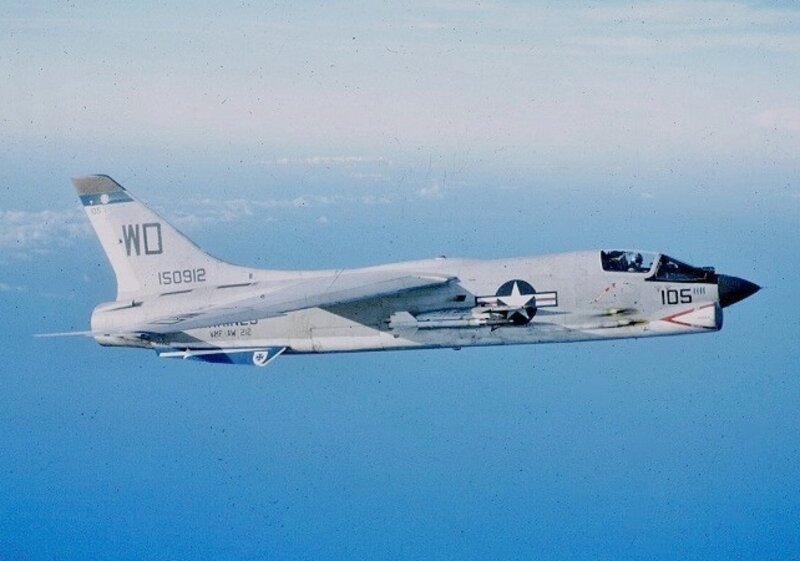
Overview
The Vought F-8 Crusader is a single-engine, supersonic, carrier-based air superiority fighter that earned the legendary nickname “The Last of the Gunfighters.” Designed and produced by Vought, the F-8 was the last American fighter with guns as its primary weapon system, and it became one of the most successful carrier-based fighters of the Cold War era. With 1,219 aircraft built, the Crusader served with the US Navy, US Marine Corps, French Navy, and Philippine Air Force from 1957 through 1999.
Design & Development
Development began after the US Navy released a requirement for a new fighter in September 1952, specifying Mach 1.2 top speed, a 25,000 ft/min climb rate, and a landing speed under 100 mph. Vought’s design team, led by John Russell Clark, produced the innovative V-383 design featuring a revolutionary variable-incidence wing — a high-mounted wing that could pivot upward by 7° during takeoff and landing.
This ingenious mechanism increased the wing’s angle of attack without requiring the aircraft to adopt an extreme nose-high attitude, providing excellent forward visibility during carrier approaches and enabling a suitably slow landing speed. The design also incorporated an area-ruled fuselage, all-moving stabilators, and liberal use of titanium throughout the airframe. The variable-incidence wing innovation won the Collier Trophy in 1956.
The first XF8U-1 prototype flew on 25 March 1955, and testing proved remarkably trouble-free. On 21 August 1956, Navy pilot R.W. Windsor achieved 1,015 mph, making the F-8 the first American fighter to reach 1,000 mph. Multiple variants were produced, including the RF-8 photo-reconnaissance version that played a crucial role during the Cuban Missile Crisis.
Operational History
The F-8 entered US Navy service in March 1957 and quickly earned a reputation as an outstanding dogfighter. While initially experiencing an above-average mishap rate due to its demanding handling characteristics, experienced pilots came to love the aircraft’s agility and gun-armed capability.
During the Vietnam War, F-8 Crusaders engaged in multiple dogfights with North Vietnamese MiG-17s, achieving an impressive kill ratio. Navy F-8 pilots scored 18 aerial victories, with many of these kills made using the aircraft’s four 20mm cannons — earning the “Last of the Gunfighters” title. The Crusader also performed ground attack missions in the theatre.
The RF-8 Crusader played a pivotal role during the 1962 Cuban Missile Crisis, providing essential low-level reconnaissance photographs of Soviet medium-range ballistic missiles in Cuba that could not be obtained by other means. The French Navy operated the F-8E(FN) variant from their carriers Clemenceau and Foch until 1999, making France the last military operator. NASA also used modified F-8s for experimental flights, including pioneering digital fly-by-wire technology testing.
Capabilities
- Variable-incidence wing — Revolutionary wing design pivoting 7° for optimal carrier landing performance
- Mach 1.86 top speed — Outstanding supersonic performance for a carrier-based fighter
- Gun-armed fighter — Four 20mm cannons providing devastating close-range firepower
- Carrier-capable — Designed for operations from US Navy fleet carriers
- Combat-proven — Excellent Vietnam War combat record with 18 aerial victories
- Photo-reconnaissance — RF-8 variant critical for Cuban Missile Crisis intelligence
Armament & Weapons
- Internal guns: 4× Colt Mk 12 20mm cannons with 144 rounds per gun (576 total)
- Air-to-air missiles: 2× (later 4×) AIM-9 Sidewinder infrared-guided missiles on fuselage cheek stations
- Rockets: 2× Zuni rocket pods or other rocket configurations
- Bombs: Up to 2,268 kg (5,000 lb) of bombs on underwing hardpoints including Mk 82, Mk 83, and napalm canisters
- External stores: 2 underwing hardpoints plus fuselage missile stations
Video
Frequently Asked Questions
Why is the F-8 called “The Last of the Gunfighters”?
The F-8 Crusader earned this nickname because it was the last American fighter designed with guns as its primary weapon system. Later fighters like the F-4 Phantom II were initially designed around missiles only (though guns were later added). During Vietnam, F-8 pilots demonstrated the continued importance of cannon armament, achieving kills with their 20mm guns when missiles proved unreliable — a lesson that influenced all subsequent fighter designs.
What is a variable-incidence wing?
The F-8’s variable-incidence wing is a unique mechanism that allows the entire wing to pivot upward by 7° relative to the fuselage during takeoff and landing. This increases the wing’s angle of attack without requiring the aircraft to adopt a steep nose-up attitude, providing the pilot with excellent forward visibility during carrier approaches. This is different from variable-sweep wings (like the F-14), which change the wing’s sweep angle rather than its incidence angle.
How does the F-8 compare to the F-4 Phantom?
The F-4 Phantom II was larger, twin-engined, and designed as a fleet defense interceptor with powerful radar and missile armament. The F-8 was smaller, single-engined, and optimized for close-range dogfighting with guns. In Vietnam, F-8 pilots achieved a better kill ratio than F-4 pilots partly because of their guns and superior training in air combat maneuvering. However, the F-4’s greater versatility and weapons capacity ultimately made it the more important aircraft.
What role did the RF-8 play in the Cuban Missile Crisis?
During the October 1962 Cuban Missile Crisis, RF-8 Crusader photo-reconnaissance aircraft from VFP-62 flew low-level missions over Cuba, providing the essential photographs that confirmed the presence of Soviet SS-4 and SS-5 medium-range ballistic missiles. These dangerous missions, flown at treetop height, produced evidence that President Kennedy used to confront the Soviet Union and justify the naval quarantine of Cuba.