✈️ Aircraft Specifications
| Designation | T-38C |
| Manufacturer | Northrop Corporation |
| Country of Origin | United States |
| First Flight | 1959 |
| Length | 14.14 m (46.4 ft) |
| Max Speed (Mach) | 1.23 |
| Max Speed (km/h) | 1,381 km/h |
| Service Ceiling | 16,340 m (53,612 ft) |
| Range | 1,835 km (1,140 mi) |
| Engine | 2x General Electric J85-GE-5A afterburning turbojet |
| Crew | 2 |
| Status | Active |
Overview
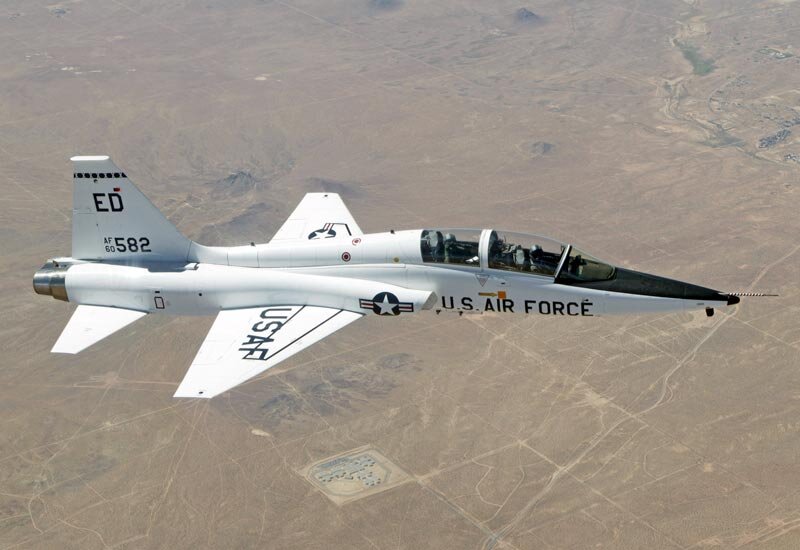
The Northrop T-38 Talon is the world’s first and most-produced supersonic jet trainer. Designed by Northrop Corporation, the T-38 has been the primary advanced trainer for the United States Air Force since 1961, training generations of fighter and bomber pilots over more than six decades of continuous service. With 1,189 aircraft built between 1961 and 1972, the T-38 has also been used by NASA as a companion trainer and chase aircraft, and has served with several allied air forces including Turkey, Portugal, and South Korea.
Design & Development
The T-38 traces its origins to Northrop’s 1954 N-156 lightweight fighter project, originally conceived by VP-Engineering Edgar Schmued and chief engineer Welko Gasich as a small, twin-engine “hot-rod” fighter powered by compact General Electric engines. When the Navy lost interest in equipping escort carriers with small fighters, Northrop adapted the N-156 design to meet a USAF requirement for a supersonic trainer to replace the aging Lockheed T-33.
Northrop’s bid succeeded largely due to compelling lifecycle cost comparisons against the competing North American F-100-derived proposal. The company received an initial contract in June 1956 to produce three prototypes. The first YT-38 made its maiden flight on 10 April 1959, and the aircraft demonstrated excellent handling qualities throughout testing.
The T-38’s twin-engine configuration using two General Electric J85 afterburning turbojets provided both adequate performance and engine-out safety for student pilots. The fighter variant of the same basic design became the highly successful Northrop F-5 Freedom Fighter/Tiger II, which served with dozens of air forces worldwide. The T-38C variant, upgraded with modern avionics and a glass cockpit, continues to serve as of the 2020s.
Operational History
The T-38 was introduced to USAF service on 17 March 1961 at Randolph Air Force Base, Texas. Since then, virtually every USAF fighter and bomber pilot has trained on the T-38 as part of the Undergraduate Pilot Training (UPT) and Introduction to Fighter Fundamentals (IFF) programs.
NASA has been a prominent T-38 operator since the early space program. Astronauts use T-38s as proficiency aircraft to maintain their flying skills and as transportation between NASA facilities. The distinctive white T-38s have become synonymous with the astronaut corps, and the aircraft has appeared in numerous photographs alongside space shuttles and launch vehicles.
The T-38 has also served in the aggressor role for dissimilar air combat training, where its small size and agility made it an effective stand-in for Soviet fighters. Some T-38s were modified as AT-38B weapons trainers with a gunsight and practice bomb/rocket capability. After over 60 years of service, the USAF plans to replace the T-38 with the Boeing-Saab T-7A Red Hawk, with the transition expected to begin in the late 2020s.
Capabilities
- Supersonic performance — Mach 1.23 top speed, making it the world’s first supersonic trainer
- Twin-engine safety — Two J85 engines providing redundancy for student pilot training
- Tandem seating — Instructor in rear seat with full duplicate controls and instruments
- Fighter-like handling — Responsive controls that prepare students for high-performance fighters
- Excellent climb rate — Able to reach 30,000 feet rapidly for training in all flight regimes
- Low operating cost — Economical to operate compared to using frontline fighters for training
Armament & Weapons
- Standard configuration: The T-38 is typically unarmed as a trainer aircraft
- AT-38B variant: Practice bomb dispenser and gunsight for weapons training
- Training stores: Practice bombs, rocket pods for weapons delivery training on AT-38B
- Note: The fighter version, the F-5, carries a full range of weapons including 20mm cannons and AIM-9 Sidewinder missiles
Video
Frequently Asked Questions
Why has the T-38 served for so long?
The T-38 has served for over 60 years due to its excellent design fundamentals — good handling qualities, twin-engine safety, supersonic capability, and low operating costs. The aircraft provides a suitable transition between basic trainers and frontline fighters, and the T-38C upgrade with modern avionics has kept it relevant. Multiple replacement programs were delayed or cancelled before the T-7A Red Hawk was finally selected in 2018.
What is the relationship between the T-38 and F-5?
The T-38 and F-5 share the same Northrop N-156 design origin. The T-38 was the trainer version, while the F-5A Freedom Fighter and later F-5E Tiger II were the fighter variants. They share similar aerodynamics and engines but differ in armament, avionics, and structural details. The F-5 has reinforced wings with hardpoints, an internal gun, and weapons delivery systems that the T-38 lacks. Both aircraft have been remarkably successful and long-lived.
Do NASA astronauts really fly T-38s?
Yes, NASA maintains a fleet of T-38N aircraft that astronauts use for proficiency flying and as high-speed transportation between NASA centers. Flying the T-38 helps astronauts maintain the skills of rapid decision-making, multitasking, and performing under stress that are essential for spaceflight. Every NASA astronaut class since the Gemini program has trained in T-38s, making the aircraft an iconic part of the space program.
What will replace the T-38?
The Boeing-Saab T-7A Red Hawk was selected in September 2018 to replace the T-38 Talon. The T-7A features a modern glass cockpit, embedded training systems, and a modular design for easy maintenance. However, the transition timeline has been subject to delays, and the T-38 is expected to continue serving until the T-7A achieves full operational capability, likely in the late 2020s to early 2030s.