✈️ Aircraft Specifications
| Designation | MiG-19S |
| Manufacturer | Mikoyan-Gurevich |
| Country of Origin | Soviet Union |
| First Flight | 1952 |
| Length | 14.64 m (48 ft) |
| Max Speed (Mach) | 1.35 |
| Max Speed (km/h) | 1,452 km/h |
| Service Ceiling | 17,500 m (57,418 ft) |
| Range | 685 km (425 mi) |
| Engine | Tumansky RD-9B afterburning turbojet |
| Crew | 1 |
| Status | Retired |
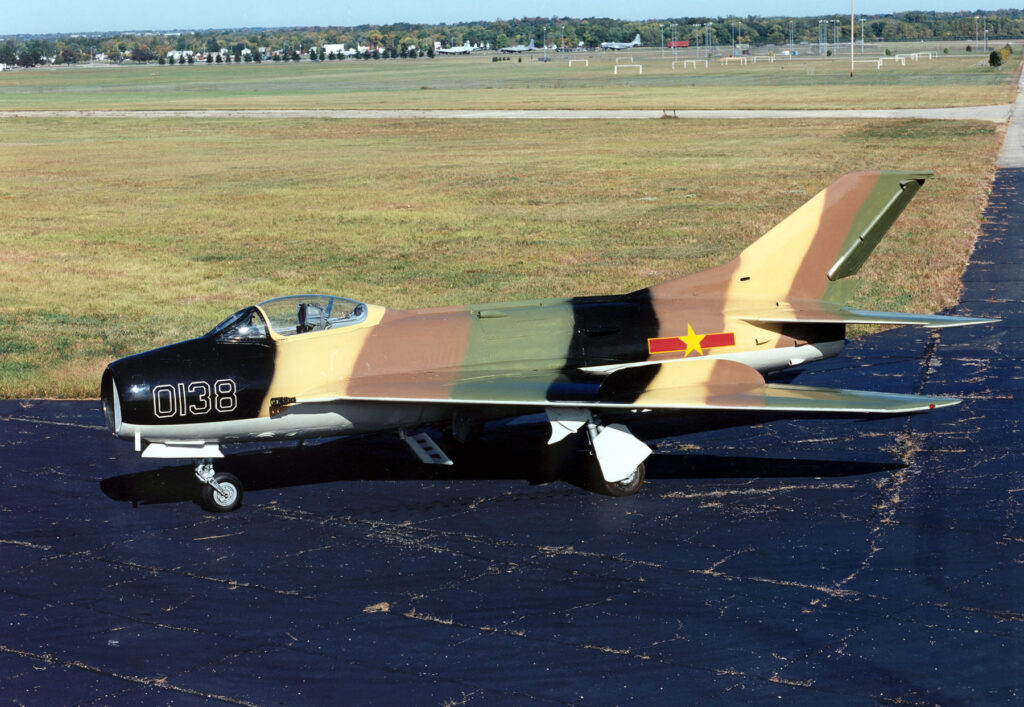
Overview
The Mikoyan-Gurevich MiG-19 (NATO reporting name: Farmer) is a Soviet second-generation, single-seat, twin-engine fighter aircraft that holds the distinction of being the first Soviet production aircraft capable of supersonic speeds in level flight. Entering service in March 1955, it represented a significant leap forward in Soviet aviation technology. Over 2,172 MiG-19s were built in the Soviet Union alone, with additional production in Czechoslovakia and China, where it was manufactured under license as the Shenyang J-6. The MiG-19 served as a frontline interceptor and fighter across the Soviet Air Forces and was widely exported to allied nations during the Cold War era.
Design & Development
Development of the MiG-19 began in 1950 at the Mikoyan-Gurevich design bureau (OKB-155), with the goal of creating a fighter with greater range than the existing MiG-15 and MiG-17, while being capable of exceeding the speed of sound in level flight. The design team chose to use two Mikulin AM-5 axial jet engines, and the SM-1 testbed first flew in late 1951 to validate this twin-engine configuration.
The true prototype, designated SM-2 (I-360), first flew on 24 May 1952 with test pilot G. A. Sedov at the controls. The aircraft featured wings swept at 55 degrees with a T-tail configuration. Early testing revealed that the AM-5A engines without afterburners could not exceed the speed of sound, leading to the adoption of AM-5F engines with afterburners. Handling problems at high angles of attack required modifications including lowering the horizontal tail and deepening the wing fences.
The definitive engine became the Tumansky RD-9B, and with this powerplant installed, the SM-9 prototype impressed Soviet authorities enough that the MiG-19 was ordered into production on 17 February 1954 — despite factory testing having barely begun. The rush to service caused early production aircraft to suffer serious problems, including in-flight fuel explosions traced to poor insulation between engines and fuel tanks. The major production variant, the MiG-19S, introduced an all-moving slab tail for improved supersonic control and upgraded armament.
Operational History
The MiG-19 entered service with Soviet Air Forces in March 1955 and quickly became a key component of the USSR’s air defense network. It was widely exported to Warsaw Pact nations and allied countries throughout Asia and the Middle East. The aircraft saw extensive combat during the Vietnam War, where North Vietnamese MiG-19s (and Chinese-built J-6s) engaged American F-4 Phantoms and F-105 Thunderchiefs with notable success in close-range dogfights.
Chinese-built J-6 variants saw combat in the Indo-Pakistani Wars of 1965 and 1971, where Pakistani Air Force J-6s proved effective against Indian aircraft. The type also served in various Middle Eastern conflicts. Despite being superseded by the MiG-21 in Soviet service relatively quickly, the J-6 variant continued to serve with numerous air forces well into the 21st century, with some countries retaining them in limited use until recently.
Capabilities
- Maximum Speed: Mach 1.35 (1,452 km/h) at altitude — the first Soviet fighter to achieve supersonic flight in level conditions
- Service Ceiling: 17,500 meters (57,400 feet)
- Combat Range: 685 km (426 miles) on internal fuel
- Rate of Climb: 180 m/s (35,400 ft/min) — exceptional climb performance for its era
- Twin-engine reliability: Two Tumansky RD-9B afterburning turbojets providing 25.5 kN dry / 31.9 kN with afterburner each
- All-moving tailplane: Slab tail for effective supersonic maneuvering (MiG-19S variant)
- Radar-equipped variant: MiG-19P featured RP-1 Izumrud radar for all-weather interception capability
Armament & Weapons
- Cannons: 3 × 30 mm Nudelman-Rikhter NR-30 cannons (MiG-19S), or 2 × NR-30 in earlier variants
- Air-to-Air Missiles: 2 × K-13 (AA-2 Atoll) infrared-guided missiles on the MiG-19PM variant
- Unguided Rockets: 2 × UB-16-57 rocket pods carrying 16 × S-5 57mm rockets each
- Bombs: Up to 500 kg of conventional bombs on two underwing hardpoints
Video
Frequently Asked Questions
Was the MiG-19 the first supersonic Soviet fighter?
Yes, the MiG-19 was the first Soviet production aircraft capable of achieving supersonic speeds in level flight, reaching Mach 1.35. Its American contemporary and counterpart was the North American F-100 Super Sabre, which was the first Western supersonic fighter in level flight.
How did the MiG-19 perform in combat during the Vietnam War?
The MiG-19 and its Chinese-built J-6 variant proved surprisingly effective in Vietnam, particularly in close-range dogfights against much more advanced American aircraft like the F-4 Phantom II. Its excellent maneuverability and powerful cannon armament made it a dangerous opponent in turning engagements.
What is the difference between the MiG-19 and the Shenyang J-6?
The Shenyang J-6 is a Chinese-built copy of the MiG-19, produced under license starting in 1958. China manufactured thousands of J-6 variants and exported them widely. The J-6 remained in Chinese service until 2010, far outlasting the Soviet original which was retired in the 1970s.
Why was the MiG-19 replaced so quickly by the MiG-21?
While the MiG-19 was a capable fighter, the rapid pace of Cold War aviation development meant the MiG-21 — with its higher speed (Mach 2.0), delta wing design, and improved avionics — quickly superseded it in Soviet service. However, the MiG-19/J-6 continued serving with export customers for decades.
References & Sources
- Wikipedia – Mikoyan-Gurevich MiG-19
- National Museum of the United States Air Force
- Gordon, Yefim. Mikoyan-Gurevich MiG-19: Famous Russian Aircraft. Midland Publishing, 2003.