✈️ Aircraft Specifications
| Designation | F-107A |
| Manufacturer | North American Aviation |
| Country of Origin | United States |
| First Flight | 1956 |
| Length | 18.45 m (60.5 ft) |
| Max Speed (Mach) | 2.0 |
| Max Speed (km/h) | 2,336 km/h |
| Service Ceiling | 16,154 m (53,001 ft) |
| Range | 3,885 km (2,413 mi) |
| Engine | 1× Pratt & Whitney J75-P-9 turbojet |
| Crew | 1 |
| Status | Cancelled |
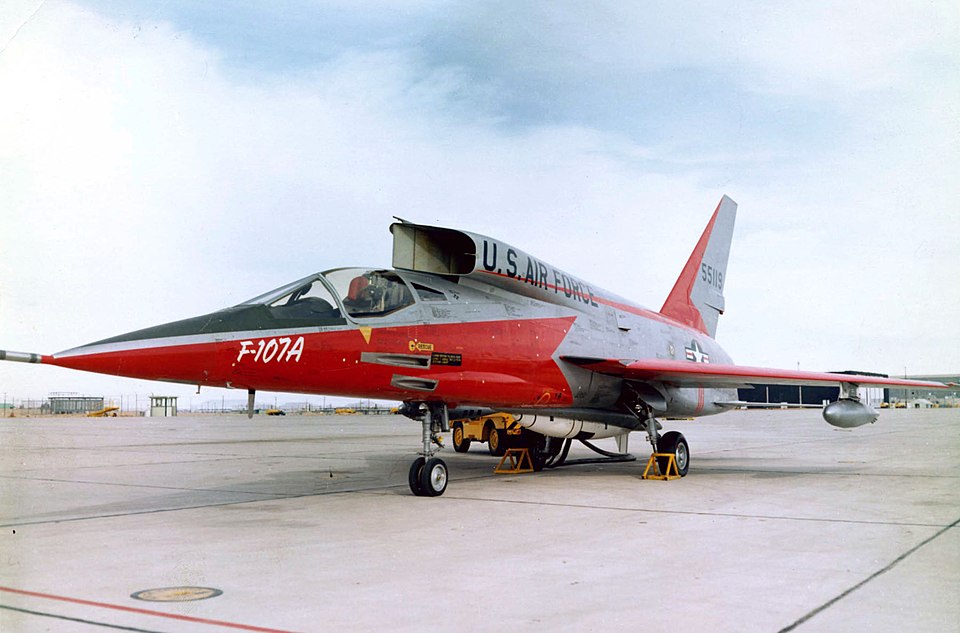
Overview
The North American F-107 is one of the most distinctive aircraft ever built, featuring an unprecedented dorsal-mounted air intake positioned directly above and behind the cockpit. Developed as an advanced tactical fighter-bomber based on the F-100 Super Sabre, the F-107 competed against the Republic F-105 Thunderchief but lost the competition. Only three prototypes were built, yet the aircraft achieved Mach 2 and pioneered innovative variable-area inlet technology used in later North American designs.
Design & Development
In June 1953, North American began studying advanced derivatives of the F-100 Super Sabre. The F-100B design incorporated a recessed weapons bay for nuclear weapons delivery, an all-moving vertical fin, and an automated flight control system. The most radical feature was the Variable Area Inlet Duct (VAID), positioned atop the fuselage because the Air Force required an underbelly semi-conformal nuclear weapon station.
The VAID automatically controlled airflow to the Pratt & Whitney J75 engine and proved highly efficient. The canopy opened by sliding vertically upward, and the ejection seat was designed to blast through the canopy in emergencies. Three prototypes were ordered in August 1954, with the first flying on 10 September 1956, achieving Mach 1.03 on its maiden flight and reaching Mach 2 by November 1956.
Operational History
Despite impressive flight test results, the F-107 lost the USAF tactical fighter-bomber competition to the Republic F-105 Thunderchief after a close fly-off evaluation. The three prototypes were subsequently used as test aircraft. In late 1957, two prototypes were leased to NACA (later NASA) for high-speed research, contributing valuable data on supersonic flight characteristics and inlet design.
Today, one F-107 is preserved at the National Museum of the United States Air Force in Dayton, Ohio, and another at the Pima Air and Space Museum in Tucson, Arizona. The innovative VAID inlet technology was later applied to North American’s A-5 Vigilante, XB-70 Valkyrie, and XF-108 Rapier designs.
Capabilities
- Maximum Speed: Mach 2.0 (2,336 km/h / 1,452 mph)
- Service Ceiling: 16,154 m (53,000 ft)
- Range: 3,885 km (2,414 miles)
- Engine: 1× Pratt & Whitney J75-P-9 afterburning turbojet, 24,500 lbf thrust
- Crew: 1
- Length: 18.45 m (60.5 ft)
- First Flight: 10 September 1956
- Units Built: 3 prototypes
Armament & Weapons
- Cannon: 4× 20 mm T-160 cannons
- Nuclear Weapons: Semi-conformal underbelly station for nuclear bombs
- Conventional: 6 underwing hardpoints for bombs, rockets, or missiles
- Weapons Bay: Recessed underbelly weapons bay
Video
Frequently Asked Questions
Why was the F-107’s air intake on top of the fuselage?
The Air Force required the aircraft to carry a semi-conformal nuclear weapon under the fuselage, which precluded a conventional chin or ventral intake. The dorsal position proved aerodynamically efficient.
Why did the F-107 lose to the F-105?
While the competition was close, Republic’s F-105 Thunderchief was selected as the USAF’s standard tactical fighter-bomber. The F-105 offered a larger internal weapons bay and was further along in development.
Where can I see an F-107 today?
One F-107 is displayed at the National Museum of the United States Air Force in Dayton, Ohio, and another at the Pima Air and Space Museum in Tucson, Arizona.