✈️ Aircraft Specifications
| Designation | X-2 |
| Manufacturer | Bell Aircraft |
| Country of Origin | United States |
| First Flight | 1955 |
| Length | 11.51 m (37.8 ft) |
| Max Speed (Mach) | 3.2 |
| Max Speed (km/h) | 3,370 km/h |
| Service Ceiling | 38,466 m (126,207 ft) |
| Engine | 1× Curtiss-Wright XLR25 rocket engine |
| Crew | 1 |
| Status | Retired |
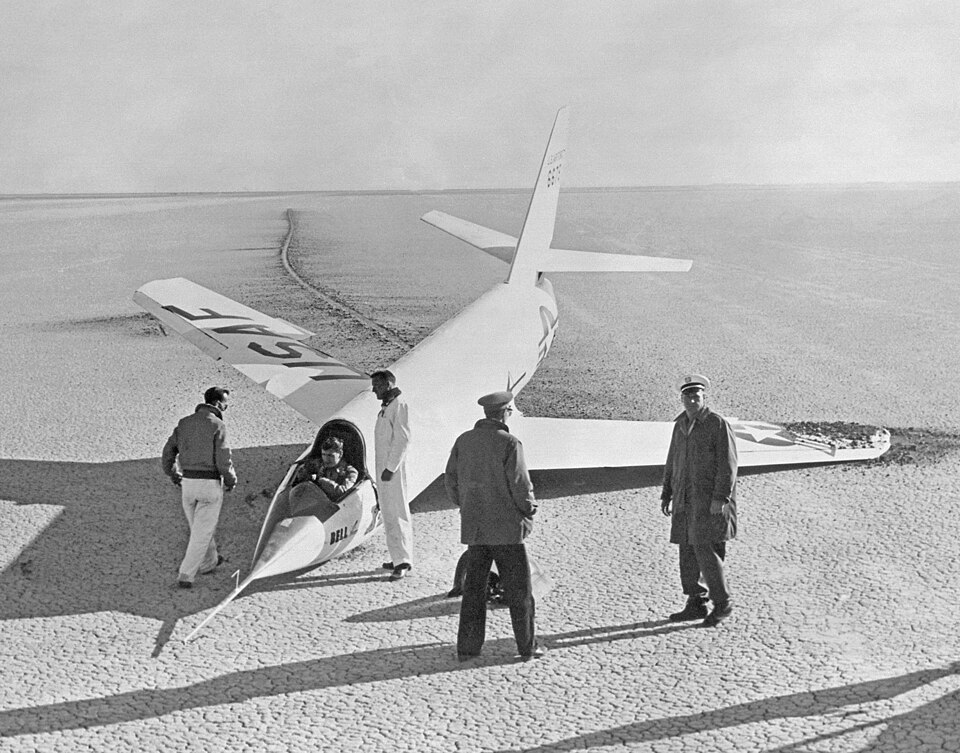
Overview
The Bell X-2 Starbuster was a rocket-powered swept-wing research aircraft built to explore flight at speeds between Mach 2 and Mach 3, venturing into the mysterious “thermal thicket” where aerodynamic heating became a critical challenge. The X-2 became the first aircraft to exceed Mach 3, reaching 2,094 mph on its final tragic flight on 27 September 1956. It also set an altitude record of 126,200 feet — the first time a pilot climbed above 100,000 feet.
Design & Development
Developed jointly by Bell Aircraft, the U.S. Army Air Forces, and NACA beginning in 1945, the X-2 was designed to extend the research boundaries established by the Bell X-1. The aircraft featured swept wings to reduce transonic drag, and was constructed of stainless steel and K-Monel (a copper-nickel alloy) to withstand the extreme temperatures of high-speed flight.
The X-2 was powered by a Curtiss-Wright XLR25 two-chamber rocket engine, producing 2,500 to 15,000 lbf of continuously throttleable thrust — one of the first throttleable rocket engines in American aircraft. The aircraft was air-launched from a modified Boeing B-50 Superfortress bomber. Two X-2 aircraft were built.
Operational History
The X-2 program was plagued by delays and tragedy. The first unpowered glide flight occurred on 27 June 1952. Tragically, the second aircraft and pilot Skip Ziegler were lost on 12 May 1953 in an inflight explosion during a captive flight, along with B-50 crew member Frank Wolko.
Lt. Col. Frank “Pete” Everest completed the first powered flight on 18 November 1955 and eventually reached Mach 2.87. Captain Iven Kincheloe became the first pilot to fly above 100,000 feet on 7 September 1956, reaching 126,200 feet. Just 20 days later, Captain Milburn “Mel” Apt became the first person to exceed Mach 3, reaching Mach 3.2 (2,094 mph). However, moments after achieving this milestone, Apt attempted a turn at high speed and the X-2 tumbled out of control due to inertia coupling. Apt was killed when the aircraft crashed, ending the X-2 program.
Capabilities
- Maximum Speed: Mach 3.2 (3,370 km/h / 2,094 mph)
- Maximum Altitude: 38,466 m (126,200 ft)
- Engine: 1× Curtiss-Wright XLR25 throttleable rocket, 2,500–15,000 lbf thrust
- Crew: 1
- Length: 11.51 m (37.8 ft)
- Launch Method: Air-launched from Boeing B-50 Superfortress
- First Powered Flight: 18 November 1955
- Units Built: 2
Video
Frequently Asked Questions
What was the Bell X-2 designed to do?
The X-2 was built to research flight characteristics at speeds between Mach 2 and Mach 3, and to investigate aerodynamic heating — the “thermal barrier” — encountered at extreme supersonic speeds.
Who was the first person to fly Mach 3?
Captain Milburn G. “Mel” Apt became the first person to exceed Mach 3 on 27 September 1956 in the Bell X-2, reaching Mach 3.2 (2,094 mph). Tragically, he was killed moments later when the aircraft went out of control.
What happened to the Bell X-2?
One X-2 was lost in an explosion in 1953. The remaining aircraft was destroyed in a crash on 27 September 1956 after achieving Mach 3, killing pilot Mel Apt. The program ended with this flight.