✈️ Aircraft Specifications
| Designation | X-3 |
| Manufacturer | Douglas Aircraft Company |
| Country of Origin | United States |
| First Flight | 1952 |
| Length | 20.35 m (66.8 ft) |
| Max Speed (Mach) | 1.208 |
| Max Speed (km/h) | 1,136 km/h |
| Service Ceiling | 11,580 m (37,994 ft) |
| Range | 800 km (497 mi) |
| Engine | 2x Westinghouse XJ34-WE-17 afterburning turbojets |
| Crew | 1 |
| Status | Retired |
Overview
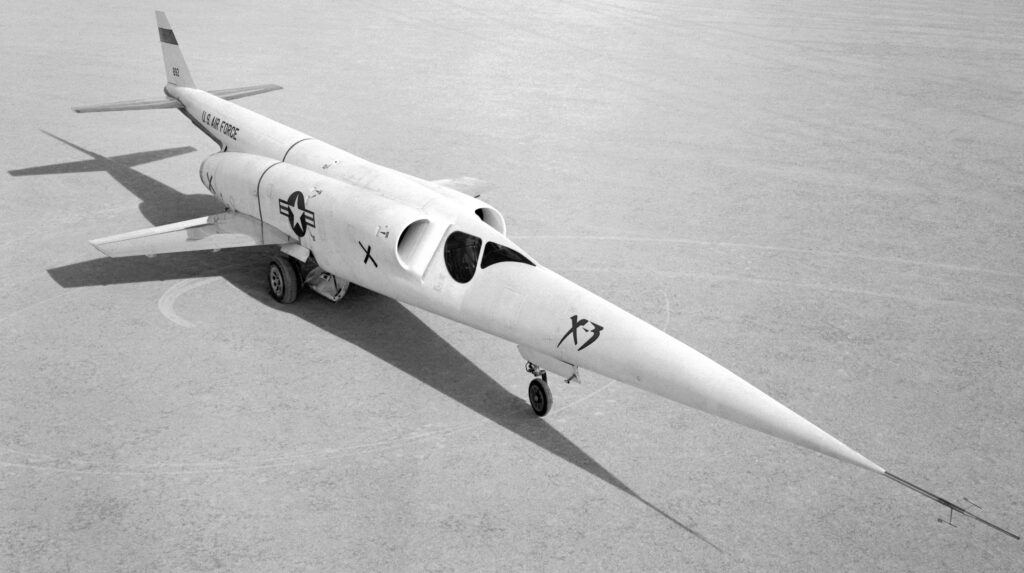
The Douglas X-3 Stiletto was a sleek, needle-nosed experimental jet aircraft built by the Douglas Aircraft Company in the early 1950s. Designed to investigate sustained supersonic flight, it became one of the most distinctive — yet ultimately underpowered — aircraft of the X-plane program. Despite never reaching its intended Mach 2 target, the X-3 made crucial contributions to understanding inertia coupling and pioneered the use of titanium in aircraft construction.
Design & Development
The X-3 was conceived as an ambitious aircraft that could take off under its own power, cruise at Mach 2, and land conventionally. Construction was approved on 30 June 1949, with a pair of aircraft ordered. The airframe featured an extremely slender fuselage with a long tapered nose and small trapezoidal wings designed for minimal supersonic drag.
A critical setback occurred when the planned Westinghouse J46 engines proved too large for the fuselage. Lower-thrust Westinghouse J34 turbojets were substituted, producing only 4,900 lbf (22 kN) of thrust with afterburner each — far short of the planned 7,000 lbf. The second aircraft was cancelled, and its parts were used as spares. Despite its shortcomings, the X-3 was the first aircraft to make extensive use of titanium for major structural components.
Operational History
Douglas test pilot Bill Bridgeman made the first hop on 15 October 1952. The official maiden flight followed on 20 October. Bridgeman completed 26 flights through December 1953, demonstrating that the aircraft was severely underpowered with an unusually high takeoff speed of 260 mph (420 km/h). The fastest flight reached only Mach 1.208 in a 30-degree dive on 28 July 1953.
After transfer to the USAF and NACA, legendary pilots Frank Everest and Chuck Yeager each flew three flights. NACA pilot Joseph Walker conducted the most significant research, discovering the dangerous phenomenon of roll inertia coupling on 27 October 1954 when the aircraft experienced violent uncommanded pitch and yaw motions during abrupt rolls. This discovery proved vital for understanding the handling characteristics of future supersonic fighters.
The X-3 completed 51 flights before retirement on 23 May 1956. It is now preserved at the National Museum of the United States Air Force.
Capabilities
- Maximum Speed: Mach 1.208 (in a dive); Mach 0.987 in level flight
- Service Ceiling: 38,000 ft (11,580 m)
- Range: 497 mi (800 km)
- Powerplant: 2x Westinghouse XJ34-WE-17 afterburning turbojets, 4,900 lbf each
- Pioneered: Titanium airframe construction, trapezoidal wing design
- Key Legacy: Data used for the Lockheed F-104 Starfighter wing design
- Crew: 1 pilot
Video
Frequently Asked Questions
Why could the X-3 Stiletto not reach Mach 2?
The planned Westinghouse J46 engines were too large to fit in the fuselage. Substitute J34 engines produced far less thrust, leaving the aircraft severely underpowered and unable to exceed Mach 1 in level flight.
What was the X-3 most important discovery?
The X-3 revealed the dangerous phenomenon of roll inertia coupling, where rolling maneuvers at transonic speeds caused violent uncommanded pitch and yaw motions. This discovery was critical for the safe design of future supersonic fighters.
How did the X-3 influence later aircraft?
Despite its disappointing performance, the X-3 trapezoidal wing design and aerodynamic data were directly used by Lockheed engineers in developing the highly successful F-104 Starfighter. It also advanced the use of titanium in aircraft construction.