✈️ Aircraft Specifications
| Designation | Su-47 |
| Manufacturer | Sukhoi |
| Country of Origin | Russia |
| First Flight | 1997 |
| Length | 22.6 m (74.2 ft) |
| Max Speed (Mach) | 2.21 |
| Max Speed (km/h) | 2,200 km/h |
| Service Ceiling | 18,000 m (59,058 ft) |
| Range | 3,300 km (2,049 mi) |
| Engine | 2× Aviadvigatel D-30F6 afterburning turbofans |
| Crew | 1 |
| Status | Retired |
Overview
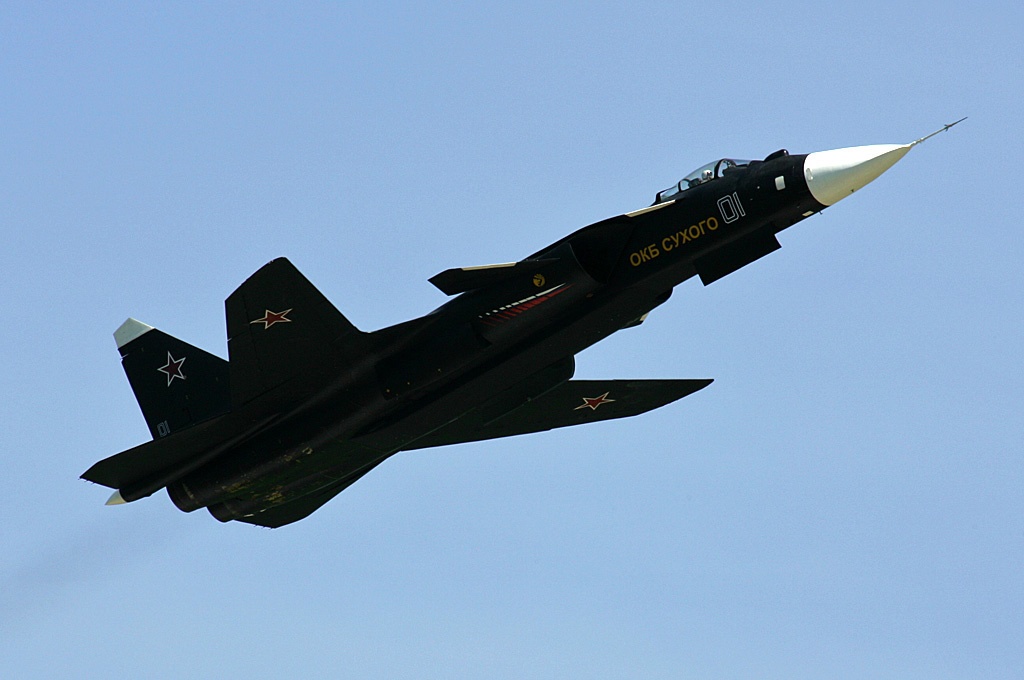
The Sukhoi Su-47 Berkut (Golden Eagle) was a forward-swept wing experimental fighter that served as a technology demonstrator for advanced aerodynamic concepts. Its dramatic appearance — with wings sweeping forward — made it one of the most visually striking aircraft ever built.
Design & Development
The Su-47’s forward-swept wings were made possible by carbon fiber composite construction that resisted aeroelastic divergence. The design offered superior maneuverability, better high-angle-of-attack performance, and improved low-speed handling compared to conventional swept-back wings. The aircraft also featured canard foreplanes and all-moving vertical tails.
Operational History
Originally designated S-37, the Su-47 first flew in 1997. Only one prototype was built. It served as a testbed for technologies later used in the Su-57 fifth-generation fighter, including internal weapons bays and advanced composite construction. The aircraft was retired after years of testing and is now preserved.
Capabilities
- Forward-swept wing design
- Exceptional maneuverability
- Carbon fiber composite construction
- Internal weapons bay (tested)
- Technology demonstrator for Su-57
Armament & Weapons
- Internal weapons bays tested
- Designed for R-77, R-73 missiles
- Specific armament details classified
Video
Frequently Asked Questions
Why do the wings sweep forward?
Forward-swept wings provide better maneuverability, improved stall characteristics, and better control at high angles of attack, though they require composite materials to prevent structural failure.
Was the Su-47 ever produced?
No, only one prototype was built. It served as a technology demonstrator, with lessons applied to the Su-57.
Why aren’t forward-swept wings more common?
They require expensive composite materials to prevent aeroelastic divergence, and the maneuverability advantage has diminished with thrust vectoring technology.