✈️ Aircraft Specifications
| Designation | T-4 |
| Manufacturer | Sukhoi |
| Country of Origin | Soviet Union |
| First Flight | 1972 |
| Length | 44.0 m (144.4 ft) |
| Max Speed (Mach) | 3.0 |
| Max Speed (km/h) | 3,200 km/h |
| Service Ceiling | 22,000 m (72,182 ft) |
| Range | 7,000 km (4,347 mi) |
| Engine | 4× Kolesov RD-36-41 afterburning turbojet |
| Crew | 2 |
| Status | Cancelled |
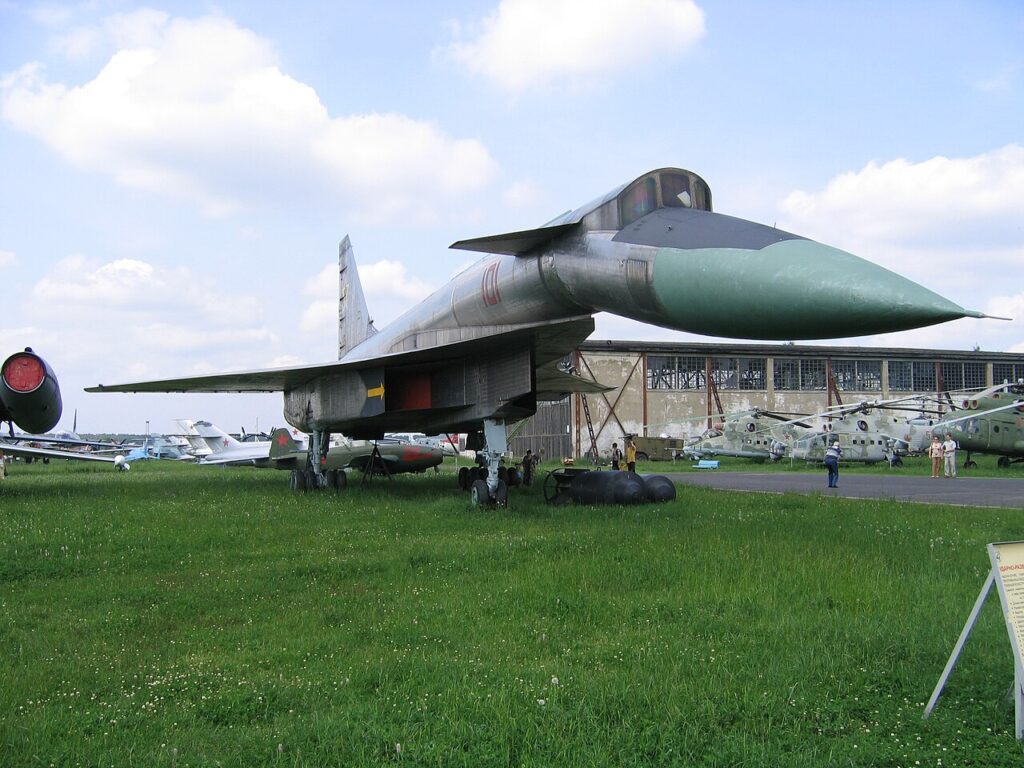
Overview
The Sukhoi T-4, also known as “Aircraft 100,” “Project 100,” or “Sotka,” was a Soviet high-speed reconnaissance, anti-ship, and strategic bomber prototype designed to cruise at Mach 3. Often compared to the American XB-70 Valkyrie, the T-4 represented an extraordinary leap in Soviet aerospace technology, generating nearly 600 patents during its development. Only one flight-worthy prototype was completed before the program was cancelled in 1975.
Design & Development
In 1963, the Soviet government held a competitive design review among aircraft bureaus for a Mach 3-capable strategic platform. Sukhoi’s proposal won over competing designs from Yakovlev and Tupolev, and after a preliminary review in June 1964, prototype construction was authorized. The T-4 required massive research efforts to develop manufacturing technologies for machining and welding titanium and steel alloys capable of withstanding sustained Mach 3 flight.
The aircraft featured four Kolesov RD-36-41 afterburning turbojet engines producing 157 kN each, a drooping nose for takeoff/landing visibility (with a periscope for cruise flight), and drogue parachutes supplementing conventional wheel brakes. The first flying prototype “101” was completed in autumn 1971.
Operational History
Aircraft “101” first flew on 22 August 1972, piloted by Vladimir Ilyushin (son of famed designer Sergei Ilyushin) with navigator Nikolai Alfyorov. Testing continued through 10 flights totaling 10 hours and 20 minutes, reaching Mach 1.3. However, in 1974 the Ministry of Aviation Industry ordered work suspended, and the project was officially scrapped on 19 December 1975 — a victim of inter-bureau politics and the prioritization of other programs.
The sole surviving prototype “101” is preserved at the Central Air Force Museum in Monino near Moscow. A second airframe “102” was partially built, while prototypes “103” through “106” never progressed beyond planning stages.
Capabilities
- Design Speed: Mach 3.0 (~3,200 km/h) — achieved Mach 1.3 in testing
- Service Ceiling: 20,000–24,000 m (66,000–79,000 ft)
- Ferry Range: 7,000 km (4,350 mi)
- Wingspan: 22 m (72 ft 2 in)
- Maximum Takeoff Weight: 135,000 kg (297,624 lb)
- Engines: 4× Kolesov RD-36-41 (157 kN each with afterburner)
- Nearly 600 patents attributed to the development program
Video
Frequently Asked Questions
Why was the Sukhoi T-4 cancelled?
The T-4 was cancelled due to a combination of factors including inter-bureau political rivalry (particularly from Tupolev, which pushed its own Tu-22M program), the enormous costs of sustained Mach 3 development, and shifting strategic priorities toward ICBMs and the Tu-160 program.
How does the T-4 compare to the XB-70 Valkyrie?
Both were Mach 3-capable strategic bomber prototypes from the 1960s-70s. The T-4 was somewhat smaller and lighter, with a different canard-delta configuration. Both programs were ultimately cancelled as ICBMs superseded the manned strategic bomber concept.
Did the T-4 ever reach Mach 3?
No. The T-4 only achieved Mach 1.3 during its 10 test flights before the program was cancelled. The design was intended to reach Mach 3, but testing never progressed to that stage.