✈️ Aircraft Specifications
| Designation | Mirage 4000 |
| Manufacturer | Dassault-Breguet |
| Country of Origin | France |
| First Flight | 1979 |
| Length | 18.7 m (61.4 ft) |
| Max Speed (Mach) | 2.3 |
| Max Speed (km/h) | 2,445 km/h |
| Service Ceiling | 20,000 m (65,620 ft) |
| Range | 2,000 km (1,242 mi) |
| Engine | 2x SNECMA M53 afterburning turbofan |
| Crew | 1 |
| Status | Cancelled |
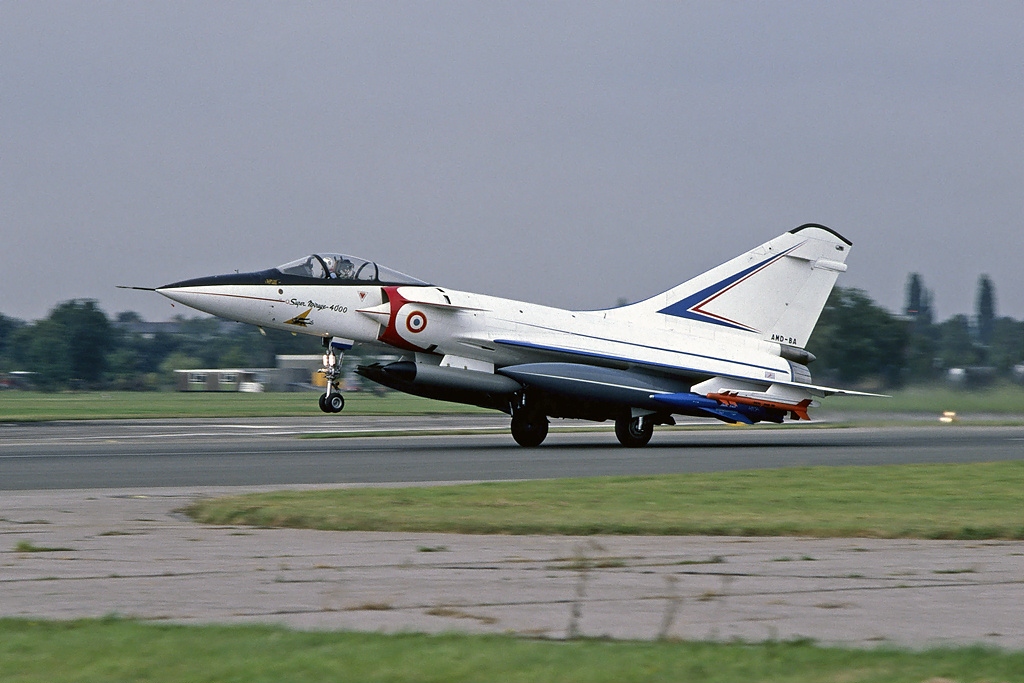
Overview
The Dassault Mirage 4000 (sometimes called the Super Mirage 4000) is a French prototype twin-engine fighter aircraft developed by Dassault-Breguet as a larger, more powerful derivative of the Mirage 2000. Comparable in size and capability to the American F-15 Eagle, the Mirage 4000 first flew on 9 March 1979 and demonstrated impressive performance with Mach 2.3 top speed and a thrust-to-weight ratio of 1.2. Despite its outstanding capabilities, no customers materialized and the program was cancelled in 1988 after 336 flights. The sole prototype now resides at the Musée de l’Air et de l’Espace in Paris.
Design & Development
The Mirage 4000 was financed entirely as a private venture by Dassault, developed in parallel with the single-engine Mirage 2000. The aircraft was noticeably larger and heavier, powered by two SNECMA M53-2 turbofans producing 95.1 kN each with afterburner. It featured small canards above the engine air intakes and a true bubble canopy — improvements over previous Mirage designs.
Despite the differences, the Mirage 4000 shared the Mirage 2000’s delta wing design, semi-conical Oswatitsch-type air intakes, and general configuration. The aircraft was designed as both a long-range interceptor and a capable fighter-bomber, with 11 hardpoints carrying up to 8,000 kg of ordnance and approximately 11,000 liters of internal fuel.
Operational History
The Mirage 4000 never entered operational service. After Saudi Arabia chose the Panavia Tornado over the Mirage 4000, and Iran was lost as a customer following the 1979 Revolution, Dassault found no buyers. India evaluated the aircraft but ultimately ordered additional Mirage 2000s and MiG-29s instead.
The French Air Force preferred to concentrate on the smaller, more affordable Mirage 2000, leaving Dassault without customers. The sole prototype made 336 flights before the last on 8 January 1988. Some of the expertise gained from the Mirage 4000 program later influenced the development of the Dassault Rafale. The prototype was transferred to the Paris Air and Space Museum in November 1992.
Capabilities
- Maximum speed of Mach 2.3 (2,445 km/h) — among the fastest fighters of its era
- Thrust-to-weight ratio of 1.2 for exceptional climb and acceleration
- Time to Mach 2 at 15,000 m: just 3 minutes
- Service ceiling of 20,000 m (66,000 ft)
- Rate of climb: 305 m/s (60,000 ft/min) — extraordinary performance
- 11,000 liters internal fuel for long-range intercept missions
- 11 hardpoints with 8,000 kg weapons capacity
- Canard foreplanes for improved maneuverability
Armament & Weapons
- Guns: 2× 30mm DEFA cannon (125 rounds per gun)
- Air-to-air missiles: 2× long-range AAM + 8-14 advanced AAMs
- Air-to-ground missiles: Up to 4× AGMs
- Bombs: Up to 27× 250 kg bombs
- Rockets: Up to 4× rocket pods
- Drop tanks: Up to 3× 2,500 L external tanks
- Targeting: ATLIS II laser designator pod, FLIR pod, reconnaissance pod
Video
Frequently Asked Questions
Why was the Mirage 4000 never produced?
Despite excellent performance, the Mirage 4000 failed to attract any customers. Saudi Arabia chose the Tornado, Iran was lost after the Revolution, and India opted for smaller Mirage 2000s. The French Air Force preferred the more affordable single-engine Mirage 2000, leaving Dassault — which had funded the entire program privately — with no path to production.
How does the Mirage 4000 compare to the F-15 Eagle?
The Mirage 4000 was deliberately designed as France’s answer to the F-15, with comparable size and twin-engine layout. Both offered Mach 2+ performance and impressive thrust-to-weight ratios. The Mirage 4000’s rate of climb (305 m/s) was competitive with the F-15, and its delta wing provided good high-altitude performance. However, the F-15 benefited from massive US military orders and became one of the most successful fighters in history.
Where is the Mirage 4000 today?
The sole prototype (serial 01) is preserved at the Musée de l’Air et de l’Espace (Paris Air and Space Museum) at Le Bourget, France, where it has been displayed since November 1992.