✈️ Aircraft Specifications
| Designation | F-1 |
| Manufacturer | Mitsubishi Heavy Industries |
| Country of Origin | Japan |
| First Flight | 1975 |
| Length | 17.86 m (58.6 ft) |
| Max Speed (Mach) | 1.6 |
| Max Speed (km/h) | 1,700 km/h |
| Service Ceiling | 15,240 m (50,002 ft) |
| Range | 2,870 km (1,782 mi) |
| Engine | 2x Ishikawa-Harima TF40-801A afterburning turbofan |
| Crew | 1 |
| Status | Retired |
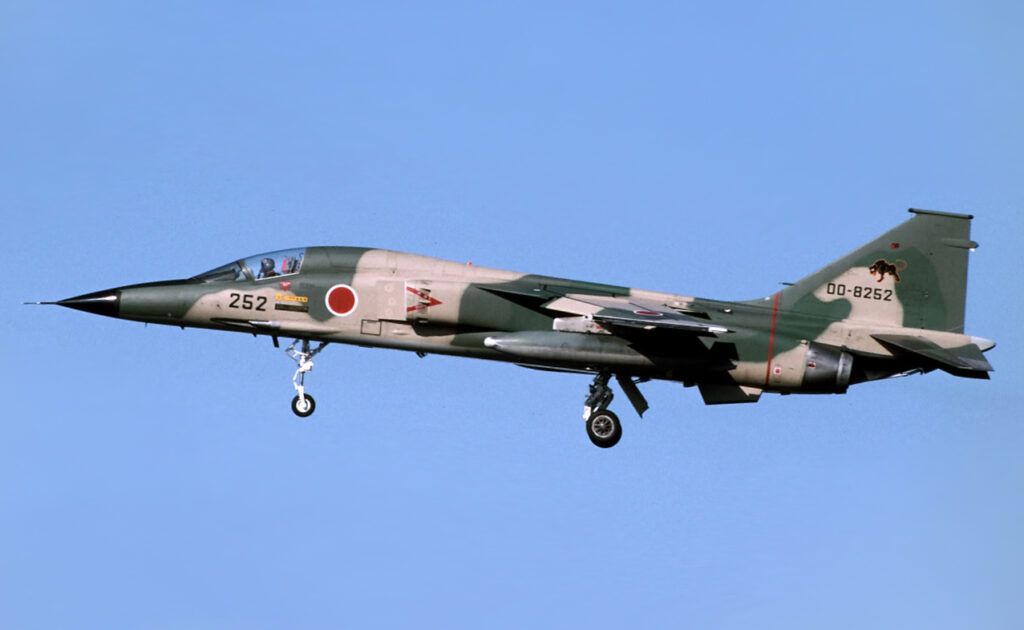
Overview
The Mitsubishi F-1 was Japan’s first domestically designed and built supersonic combat aircraft. A single-seat, twin-engine strike fighter developed from the Mitsubishi T-2 trainer, the F-1 served with the Japan Air Self-Defense Force (JASDF) from 1978 to 2006. Primarily designed for the anti-ship and ground attack role, 77 aircraft were built between 1975 and 1987. The F-1 represented a milestone in Japan’s postwar aerospace industry and its pursuit of indigenous defense capabilities.
Design & Development
In the mid-1960s, the JASDF began studies for an advanced jet trainer that could also serve in ground attack and anti-shipping roles. After evaluating the T-38 Talon and SEPECAT Jaguar for license production, Japan chose to develop its own supersonic trainer — the Mitsubishi T-2, which first flew on 20 July 1971.
The F-1 was a minimum-change derivative of the T-2, with the rear cockpit converted to an avionics bay housing the J/AWG-12 radar (similar to the AN/AWG-12 used in British RAF Phantoms). The canopy was replaced with an unglazed access hatch, and the airframe was strengthened for heavier weapons loads. Two additional underwing hardpoints were added, giving the F-1 seven total stations.
The aircraft was powered by two Ishikawa-Harima TF40-801A afterburning turbofans (license-built Rolls-Royce Turbomeca Adour engines) providing 35.6 kN thrust each with afterburner. The primary weapon was the ASM-1 (later ASM-2) long-range anti-ship missile, comparable to the American Harpoon.
Operational History
The F-1 entered JASDF service in April 1978, primarily assigned to anti-ship strike and coastal defense missions. The aircraft served for nearly three decades without seeing combat, consistent with Japan’s postwar defense posture. The F-1 was eventually replaced by the Mitsubishi F-2 (a joint Japan/US development based on the F-16) and upgraded F-4EJ Kai Phantoms.
The last six active F-1s, based at Tsuiki Air Base in Fukuoka Prefecture, were retired on 9 March 2006, having reached the 4,000-hour airframe life limit. Numerous examples are preserved as gate guards and museum exhibits at bases across Japan.
Capabilities
- Role: Anti-ship strike / Ground attack
- Max Speed: 1,700 km/h (Mach 1.6) at altitude
- Service Ceiling: 15,240 m (50,000 ft)
- Range: 2,870 km (ferry); 556 km (combat radius)
- Engines: 2× Ishikawa-Harima TF40-801A turbofans (35.6 kN each)
- Crew: 1
- Length: 17.86 m
Armament & Weapons
- 1× 20 mm JM61A1 Vulcan 6-barrel Gatling cannon (750 rounds)
- 7 hardpoints (2,700 kg total capacity)
- ASM-1 / ASM-2 anti-ship missiles (primary weapon)
- AIM-9 Sidewinder air-to-air missiles (wingtip rails)
- JLAU-3A 70 mm rocket pods
- Mk-82 (500 lb) and M117 (750 lb) bombs
- GCS-1 IR-guided bombs
Video
Frequently Asked Questions
Was the F-1 based on the SEPECAT Jaguar?
While the F-1’s parent design, the T-2 trainer, bears a resemblance to the Jaguar and uses similar Adour engines, Japan developed the T-2/F-1 independently as an indigenous design.
What was the F-1’s primary mission?
The F-1 was primarily an anti-ship strike aircraft, armed with ASM-1 and ASM-2 long-range missiles comparable to the Harpoon, defending Japan’s extensive coastline.
What replaced the F-1?
The Mitsubishi F-2, a larger fighter developed jointly with the US based on the F-16 platform, replaced the F-1 beginning in the early 2000s.