✈️ Aircraft Specifications
| Designation | Cheetah C/D/E |
| Manufacturer | Atlas Aircraft Corporation |
| Country of Origin | South Africa |
| First Flight | 1986 |
| Length | 15.6 m (51.2 ft) |
| Max Speed (Mach) | 2.2 |
| Max Speed (km/h) | 2,338 km/h |
| Service Ceiling | 17,000 m (55,777 ft) |
| Range | 1,200 km (745 mi) |
| Engine | 1x SNECMA Atar 9K50 turbojet (Cheetah C) |
| Crew | 1 |
| Status | Retired |
Overview
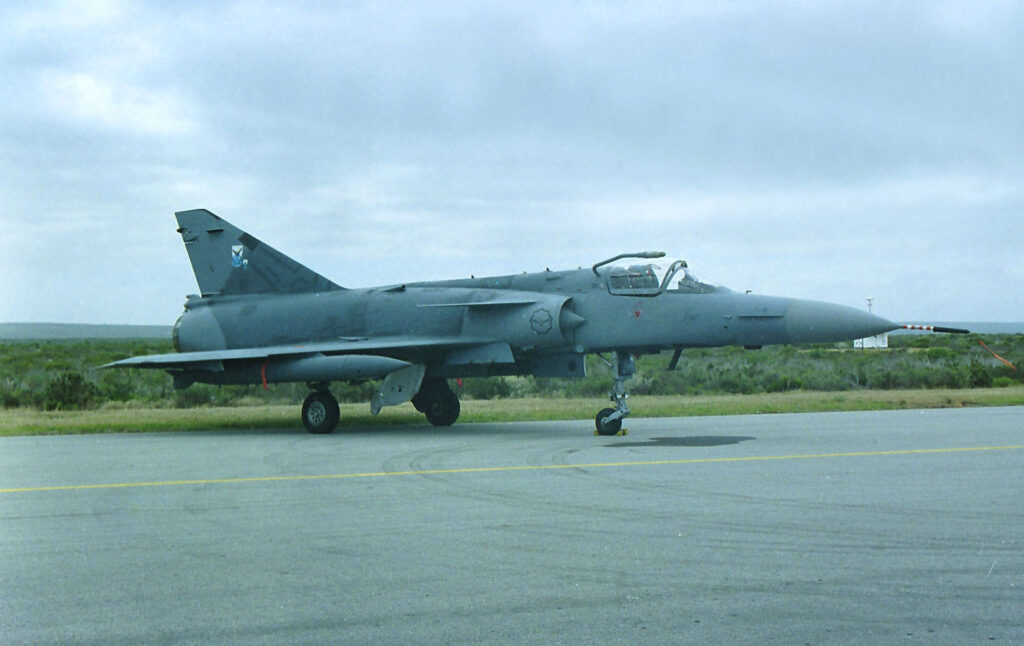
The Atlas Cheetah is a South African fighter aircraft designed and produced by Atlas Aircraft Corporation (later Denel Aeronautics) as a major upgrade of the Dassault Mirage III. Developed during the 1980s Border War under a UN arms embargo, the program integrated Israeli IAI Kfir technology to create a significantly more capable fighter. Three variants were produced: the two-seat Cheetah D (16 built), single-seat Cheetah E (16 built), and the advanced single-seat Cheetah C (38 built). The Cheetah served as the SAAF’s most capable fighter until replaced by the Saab Gripen in 2008.
Design & Development
Under Project Cushion, Atlas Aircraft Corporation undertook a comprehensive upgrade of the SAAF’s Mirage III fleet. The arms embargo under UN Security Council Resolution 418 prevented South Africa from purchasing new aircraft, making upgrading existing airframes the only viable option.
The upgrade involved roughly 50% airframe replacement, achieving zero flight hours condition. Key modifications included non-moving canards (similar to the IAI Kfir), additional stores pylons at wing roots, an aerial refuelling probe, new ejection seats, drooping leading edges with dog-tooth incisions, modern computer-controlled elevons, and nose strakes for improved high-angle-of-attack performance.
Electronics were completely overhauled with new avionics, pulse-Doppler radar, electronic warfare suite, missile approach warning system, indigenous helmet-mounted sight, and an oversized head-up display. The Cheetah C used the more powerful Atar 9K50 engine, while D and E models retained the Atar 9C. Israeli technicians and technology from the cancelled IAI Lavi program contributed to the development.
Operational History
The first Cheetah D was publicly unveiled on 16 July 1986, though several had already entered service with 89 Combat Flying School. The Cheetah E entered service with 5 Squadron, while the advanced Cheetah C joined 2 Squadron from January 1993. Despite being developed for the Border War, there is no evidence any Cheetahs conducted offensive operations in that conflict.
The Cheetah served through the post-Apartheid peacetime era until retirement in the 2000s. Surplus aircraft were exported to Ecuador, and Draken International acquired much of the fleet for use as adversary aircraft in US combat training. Chile also operated Cheetahs briefly.
Capabilities
- Maximum speed of Mach 2.2 (2,338 km/h) at altitude
- Three times the ordnance capacity of the original Mirage III by weight
- Canard foreplanes for improved maneuverability and lower landing speeds
- Pulse-Doppler radar with look-down/shoot-down capability
- Helmet-mounted sight for off-boresight targeting
- Electronic warfare suite with automatic chaff/flare dispensing
- Aerial refuelling probe for extended range operations
Armament & Weapons
- Guns: 2× 30mm DEFA cannon
- Air-to-air missiles: V3C Darter (South African IR missile), R.550 Magic, AIM-9 Sidewinder
- Air-to-ground weapons: Various bombs up to 500 kg, cluster munitions
- Rockets: 68mm SNEB rocket pods
- Reconnaissance pod (Cheetah R prototype only)
- Multiple hardpoints including wing-root pylons unique to the Cheetah
Video
Frequently Asked Questions
How is the Cheetah related to the Mirage III and Kfir?
The Cheetah is a heavily modified Mirage III that incorporates technology from the Israeli IAI Kfir (itself derived from the Mirage 5/Nesher). Key Kfir-derived features include the canard foreplanes, nose strakes, and various aerodynamic improvements. Israeli technicians and possibly complete Kfir/Nesher airframes contributed to the program.
Why was the Cheetah developed under secrecy?
South Africa was under a UN arms embargo (Resolution 418) during the Apartheid era, preventing the purchase of new military aircraft. The Cheetah program was the only way to maintain a capable fighter force, and much of the development — particularly the Israeli connection — was kept secret due to international political sensitivities.
Are any Cheetahs still flying?
Yes, several Cheetahs operate as privately owned flight test aircraft in South Africa, and Draken International acquired many ex-SAAF aircraft for use as adversary trainers in the United States. They are no longer in military service with any air force.