✈️ Aircraft Specifications
| Designation | CF-105 |
| Manufacturer | Avro Canada |
| Country of Origin | Canada |
| First Flight | 1958 |
| Length | 23.7 m (77.8 ft) |
| Max Speed (Mach) | 1.9 |
| Max Speed (km/h) | 2,337 km/h |
| Service Ceiling | 18,900 m (62,011 ft) |
| Range | 1,480 km (919 mi) |
| Engine | 2x Pratt & Whitney J75-P-3 (Mk.1) / Orenda Iroquois PS.13 (Mk.2) |
| Crew | 2 |
| Status | Cancelled |
Overview
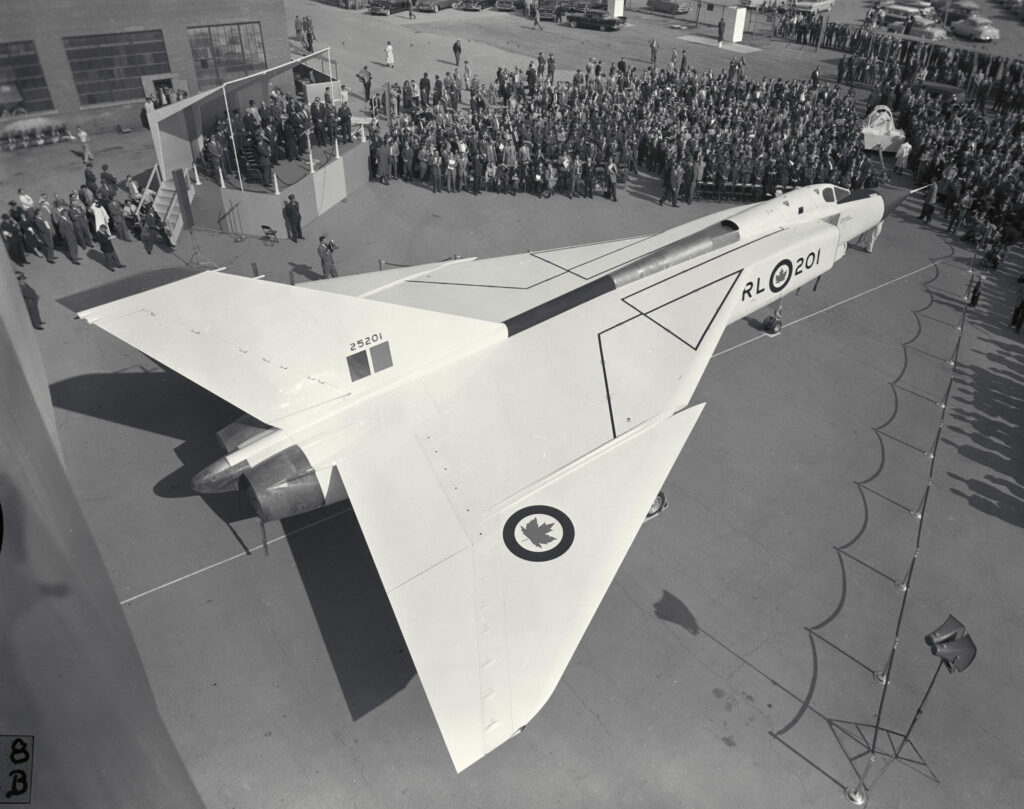
The Avro Canada CF-105 Arrow is one of aviation history’s most legendary and controversial aircraft. Designed as a supersonic all-weather interceptor for the Royal Canadian Air Force, the Arrow promised Mach 2 speeds at altitudes exceeding 50,000 feet. Only five were built before Prime Minister John Diefenbaker controversially cancelled the program on 20 February 1959, ordering the destruction of all aircraft, tooling, and plans — a decision that remains hotly debated in Canadian history.
Design & Development
The Arrow program originated from design studies begun in 1953 to replace the CF-100 Canuck interceptor against the growing Soviet bomber threat over the Arctic. Avro Canada selected a large delta-wing configuration that offered excellent high-altitude performance and internal fuel capacity.
Serious development began in March 1955 with CA$260 million funding. The aircraft adopted the innovative Cook-Craigie plan, building directly from the production line without traditional hand-built prototypes. The first Arrow Mk.1 (RL-201) was rolled out on 4 October 1957 — the same day as the Sputnik launch, which overshadowed the event.
The Arrow featured revolutionary technology for its era: a 4,000 psi hydraulic system (aviation’s first), a rudimentary fly-by-wire control system with artificial feel, and advanced materials including titanium and magnesium. The Mk.2 was planned with the Canadian-developed Orenda Iroquois engine, which promised even greater performance.
Operational History
Flight testing began on 25 March 1958 with test pilot Janusz Żurakowski at the controls. The Arrow demonstrated outstanding handling and performance, going supersonic on its third flight and reaching Mach 1.9 in level flight. The aircraft showed excellent stability throughout the flight envelope.
Despite the promising test results, rising costs and changing defense priorities led to cancellation. On 20 February 1959, the government halted the program. Two months later, all five completed aircraft, the nearly complete Mk.2 (RL-206 with Iroquois engines), tooling, plans, and production line were ordered destroyed. This decision effectively destroyed Avro Canada as a company, scattering its highly skilled engineering talent — many of whom went on to work for NASA and contributed to the Apollo program.
Capabilities
- Maximum speed of Mach 1.9+ (demonstrated) with Mach 2+ predicted for Mk.2
- Service ceiling of 18,900 m (62,000 ft) for high-altitude interception
- Time to 50,000 ft: approximately 4.1 minutes (Mk.2 estimate)
- Large internal weapons bay occupying one-third of the fuselage
- Revolutionary fly-by-wire flight control system with artificial feel
- All-weather capability with advanced fire control system
- 2g turns at Mach 1.5 / 50,000 ft without energy loss
Armament & Weapons
- Internal weapons bay designed for:
- Hughes Falcon guided air-to-air missiles
- Sparrow II semi-active radar homing missiles (planned)
- CARDE Velvet Glove missiles (considered, cancelled)
- 4× 1,000 lb general-purpose bombs (alternative load)
- Astra fire control system (planned) for radar-guided missile employment
Video
Frequently Asked Questions
Why was the Avro Arrow cancelled?
The Arrow was cancelled on 20 February 1959 by Prime Minister Diefenbaker, citing escalating costs and the belief that guided missiles (like the Bomarc) would replace manned interceptors. Political factors, pressure from the US, and shifting Cold War strategies all played roles. The decision remains one of the most controversial in Canadian history.
Were all the Arrows really destroyed?
Yes, the government ordered all five completed aircraft, the nearly finished Mk.2, all tooling, plans, and production equipment to be destroyed. Only the nose section of RL-206, some landing gear components, and the wing leading edge of RL-206 survived and are preserved in Canadian museums. Rumors of a surviving complete airframe persist but remain unconfirmed.
How fast could the Arrow really fly?
The Mk.1 with J75 engines achieved Mach 1.9 in level flight during testing. The Mk.2 with the more powerful Orenda Iroquois engines was estimated to achieve Mach 2+ at altitude. Avro believed the aircraft could eventually reach even higher speeds with further development.