✈️ Aircraft Specifications
| Designation | Kowsar |
| Manufacturer | HESA (Iran Aircraft Manufacturing Industrial Company) |
| Country of Origin | Iran |
| First Flight | 2018 |
| Length | 14.45 m (47.4 ft) |
| Max Speed (Mach) | 1.4 |
| Max Speed (km/h) | 1,700 km/h |
| Service Ceiling | 15,800 m (51,840 ft) |
| Range | 1,100 km (683 mi) |
| Engine | 2x Owj (Iranian J85 derivative) afterburning turbojet |
| Crew | 2 |
| Status | Active |
Overview
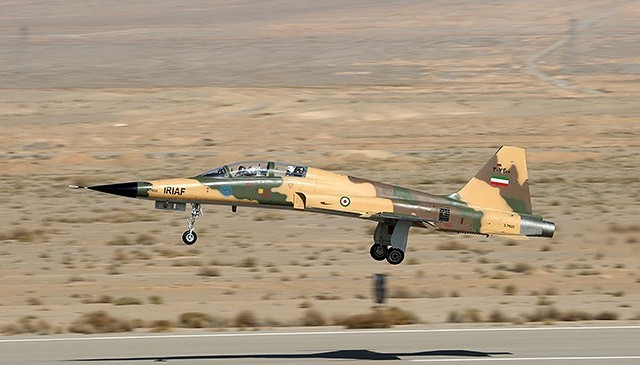
The HESA Kowsar is an Iranian fighter jet based on the American Northrop F-5, representing the latest evolution in Iran’s indigenous fighter development program. Equipped with fourth-generation avionics, an advanced fire control system, glass cockpit, and heads-up display, the Kowsar was unveiled in August 2018 and entered service in November 2018. It is produced in both single and two-seater variants at the HESA factory in Isfahan.
Design & Development
The Kowsar builds upon the HESA Azarakhsh and HESA Saeqeh programs, retaining the proven F-5 airframe while incorporating significant avionics upgrades. The aircraft features a modern glass cockpit with multifunction displays, a heads-up display (HUD), ballistic computers, and smart mobile mapping systems. It is equipped with an Italian-origin Grifo radar with a range of 93 km capable of engaging two targets simultaneously.
Iranian media described the Kowsar as “100-percent indigenously made,” though Western analysts note that the basic airframe remains essentially an F-5. The assembly line was inaugurated on 3 November 2018 at the HESA facility in Isfahan, with President Hassan Rouhani in attendance. The aircraft has seven hardpoints with a total weapons capacity of 3,200 kg.
Operational History
On 25 June 2020, three new Kowsar aircraft were delivered to the Islamic Republic of Iran Air Force in a ceremony in Isfahan. The images showed the aircraft in non-combat colors, suggesting a training role. Western media have described the Kowsar as potentially more valuable as a trainer for a new generation of Iranian fighter pilots rather than as a frontline combat aircraft.
In November 2018, Brigadier General Abdolkarim Banitarafi announced that Iran was ready to export the Kowsar, signaling Iran’s ambitions to become a military aircraft exporter.
Capabilities
- Role: Fighter / Advanced fighter trainer
- Max Speed: 1,700 km/h (Mach 1.4)
- Service Ceiling: 15,800 m (51,800 ft)
- Range: 1,100 km (combat); 2,900 km (ferry with 3 external tanks)
- Engines: 2× Owj afterburning turbojets (22 kN each with afterburner)
- Crew: 1 or 2
- Length: 14.45 m
Armament & Weapons
- 1× 20 mm cannon
- 7 hardpoints (3,200 kg total capacity)
- Up to 4× Fatir air-to-air missiles (Sidewinder derivatives)
- 12× 250 kg bombs or 5× 450 kg bombs or 2× 900 kg bombs
- Grifo radar (93 km range, 2-target engagement)
Video
Frequently Asked Questions
Is the Kowsar truly an indigenous Iranian design?
The Kowsar is based on the American F-5 airframe, which Iran has reverse-engineered and modified with new avionics, radar, and cockpit systems. The basic aerodynamic design remains F-5-derived.
What makes the Kowsar different from the Saeqeh?
The Kowsar features a modern glass cockpit, HUD, advanced fire control system, and Grifo radar — significant avionics upgrades over the earlier Saeqeh.
Can the Kowsar compete with modern fighters?
Western analysts consider the Kowsar more suitable for training and light combat duties than competing with true fourth or fifth-generation fighters.