✈️ Aircraft Specifications
| Designation | AMCA |
| Manufacturer | Aeronautical Development Agency / HAL |
| Country of Origin | India |
| First Flight | 2028 |
| Length | 17.0 m (55.8 ft) |
| Max Speed (Mach) | 2.0 |
| Max Speed (km/h) | 2,450 km/h |
| Service Ceiling | 16,000 m (52,496 ft) |
| Range | 3,000 km (1,863 mi) |
| Engine | 2x General Electric F414 (Mk1) / Kaveri derivative (Mk2) |
| Crew | 1 |
| Status | Development |
Overview
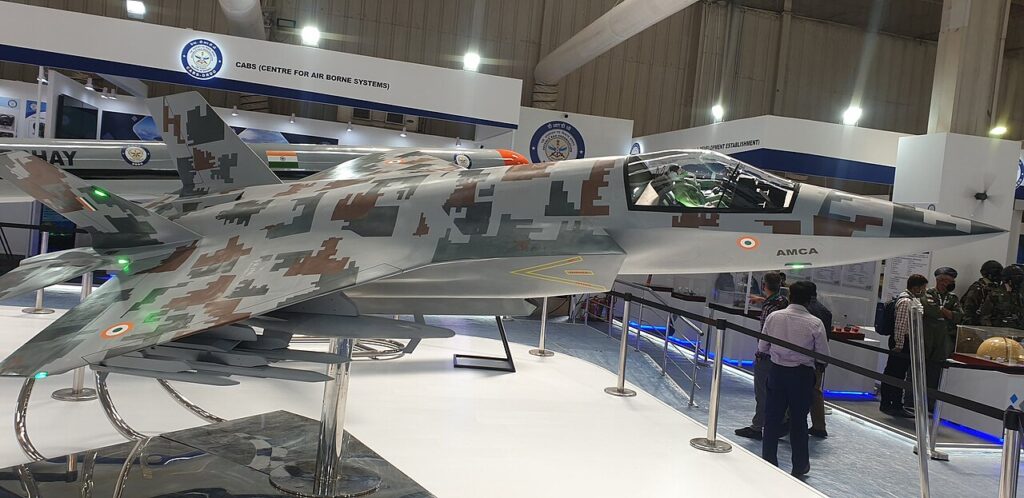
The Advanced Medium Combat Aircraft (AMCA) is India’s planned fifth-generation stealth multirole fighter being developed by the Aeronautical Development Agency (ADA) under the Ministry of Defence. Designed for the Indian Air Force and Indian Navy, the AMCA features a twin-engine, single-seat configuration optimized for low radar cross-section and supercruise capability. The program received government approval for prototype development in March 2024, with first flight expected in late 2028 and serial production planned to begin by 2035.
Design & Development
The AMCA program, originally known as the Medium Combat Aircraft (MCA) program, was launched in 2010 with an Air Staff Qualitative Requirement issued by the IAF. What began as a 20-tonne class concept has evolved into a 25-tonne class fighter. From 2013 to 2014, nine design configurations were studied using CAD modeling, wind tunnel testing, and radar cross-section evaluation, with configuration 3B-09 ultimately selected.
The design was finalized at Aero India 2015 and accepted by the IAF in 2016. The detailed design phase received ₹447 crore in 2018, and the prototype development phase was approved in March 2024 with ₹15,000 crore (US$1.8 billion). Five prototypes are planned, with the first three for developmental flight trials and the remaining two for weapon trials.
The AMCA Mk1 will be powered by General Electric F414 engines, while the Mk2 is expected to use a more powerful indigenous engine derived from the Kaveri program. A naval variant (NAMCA/AMCA-N) is also under consideration for the Indian Navy’s future aircraft carrier INS Vishal.
Operational History
As of 2025, the AMCA is in the prototype development phase. The first prototype is expected to roll out within three years of the 2024 approval, with first flight approximately one to one and a half years after rollout. The aircraft is intended to supplement and eventually replace the Sukhoi Su-30MKI as the IAF’s primary air superiority platform.
Capabilities
- Role: Stealth multirole / Air superiority fighter
- Max Speed: Mach 2.0+ (supercruise capable)
- Service Ceiling: ~16,000 m (estimated)
- Range: ~3,000 km (estimated)
- Engines: 2× GE F414 (Mk1) / Indigenous engine (Mk2)
- Crew: 1
- Stealth: Low RCS design with internal weapons bays
- Weight: 25-tonne class (MTOW)
Armament & Weapons
- Internal weapons bays for stealth operations
- Air-to-air missiles (Astra and beyond-visual-range missiles)
- Air-to-ground precision munitions
- Anti-ship missiles
- External hardpoints for non-stealth missions
Video
Frequently Asked Questions
When will the AMCA first fly?
The first flight is expected in late 2028, with serial production planned to begin by 2035.
How does the AMCA compare to other 5th-gen fighters?
The AMCA is designed as a 25-tonne class stealth fighter with supercruise capability, placing it in a similar category to the F-35 and J-20 in terms of generation, though specific performance details are still emerging.
Will there be a naval variant?
Yes, a naval variant designated NAMCA or AMCA-N is under consideration for the Indian Navy’s future carrier INS Vishal.