✈️ Aircraft Specifications
| Designation | MiG 1.44 |
| Manufacturer | Mikoyan |
| Country of Origin | Soviet Union / Russia |
| First Flight | 2000 |
| Length | 21.7 m (71.2 ft) |
| Max Speed (Mach) | 2.6 |
| Max Speed (km/h) | 2,500 km/h |
| Service Ceiling | 20,000 m (65,620 ft) |
| Range | 4,000 km (2,484 mi) |
| Engine | 2× Saturn AL-41F afterburning turbofan |
| Crew | 1 |
| Status | Cancelled |
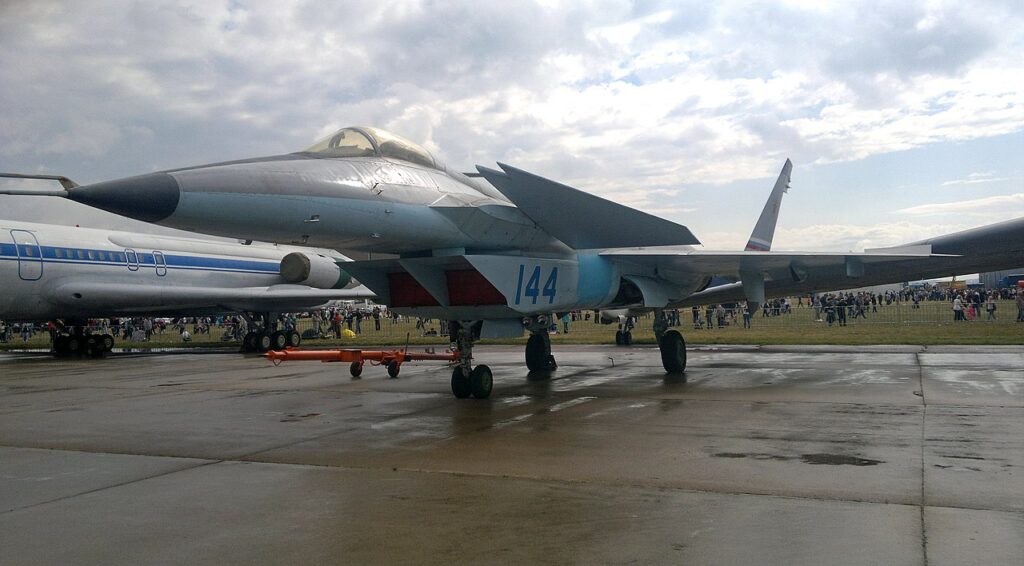
Overview
The Mikoyan Project 1.44 (NATO reporting name “Flatpack”) was a multirole fighter technology demonstrator developed by the Mikoyan design bureau as the Soviet Union’s answer to the American Advanced Tactical Fighter (ATF) program that produced the F-22 Raptor. Designed to incorporate fifth-generation fighter features including supermaneuverability, supercruise, and stealth, the MiG 1.44 made its maiden flight on 29 February 2000 — nine years behind schedule — before being cancelled and replaced by the PAK FA program that resulted in the Sukhoi Su-57.
Design & Development
The MiG 1.44 originated in the early 1980s I-90 program (“Fighter of the 1990s”), formally approved in 1983. While the US pursued air superiority with stealth emphasis, the Soviet approach focused on “multifunctionality” — a multirole fighter with exceptional air-to-ground capability alongside supermaneuverability and supersonic endurance. Mikoyan worked on two concurrent projects: the heavy MFI (Multifunctional Frontline Fighter) and light LFI designs.
TsAGI recommended canard foreplanes for the MFI design, providing excellent agility and lift for the statically unstable configuration. The delta wings had 40–45° leading edge sweep, and variable engine intake ramps were located under the forward fuselage. Two Saturn AL-41F afterburning turbofan engines with thrust vectoring provided the power. The production version (1.42) was intended to feature internal weapons bays for reduced radar cross-section, though the 1.44 demonstrator was not so equipped.
Operational History
Development of the MiG 1.44 was plagued by chronic funding shortages following the collapse of the Soviet Union. The demonstrator finally made its maiden flight on 29 February 2000, flown by test pilot Vladimir Gorbunov at the Zhukovsky flight test center. However, by this point the aircraft was already considered outdated, and the program was cancelled later that year after only a handful of flights.
The MFI project was replaced by the more modern and affordable PAK FA program, which eventually produced the Sukhoi Su-57 fifth-generation fighter. The sole MiG 1.44 prototype has been displayed at various Russian air shows including MAKS-2015.
Capabilities
- Estimated Maximum Speed: Mach 2.6 (~2,500 km/h)
- Estimated Service Ceiling: 20,000 m (65,600 ft)
- Estimated Range: 4,000 km (2,485 mi)
- Supermaneuverability: Canard-delta configuration with thrust vectoring
- Supercruise: Designed for sustained supersonic flight without afterburner
- Engines: 2× Saturn AL-41F (175 kN each with afterburner)
- Some stealth features including reduced radar cross-section shaping
Video
Frequently Asked Questions
Was the MiG-1.44 a stealth fighter?
The MiG 1.44 incorporated some radar cross-section reduction features in its shaping, and the production 1.42 version was designed with internal weapons bays. However, it was not a full stealth design like the F-22 Raptor, and its stealth capabilities were limited compared to true fifth-generation fighters.
Why was the MiG-1.44 cancelled?
The program suffered from chronic underfunding after the Soviet Union’s collapse, resulting in a nine-year delay. By the time it flew in 2000, the design was considered outdated, and Russia chose to pursue the more modern PAK FA program instead.
What is the difference between the 1.42 and 1.44?
The 1.42 designation refers to the proposed production fighter with full weapons systems and internal weapons bays. The 1.44 is the technology demonstrator that was actually built and flown, lacking weapons bays and many planned production features.