✈️ Aircraft Specifications
| Designation | MiG-27 |
| Manufacturer | Mikoyan |
| Country of Origin | Soviet Union |
| First Flight | 1970 |
| Length | 17.08 m (56 ft) |
| Max Speed (Mach) | 1.7 |
| Max Speed (km/h) | 1,885 km/h |
| Service Ceiling | 14,000 m (45,934 ft) |
| Range | 2,500 km (1,553 mi) |
| Engine | 1× Khatchaturov R-29B-300 afterburning turbojet |
| Crew | 1 |
| Status | Retired |
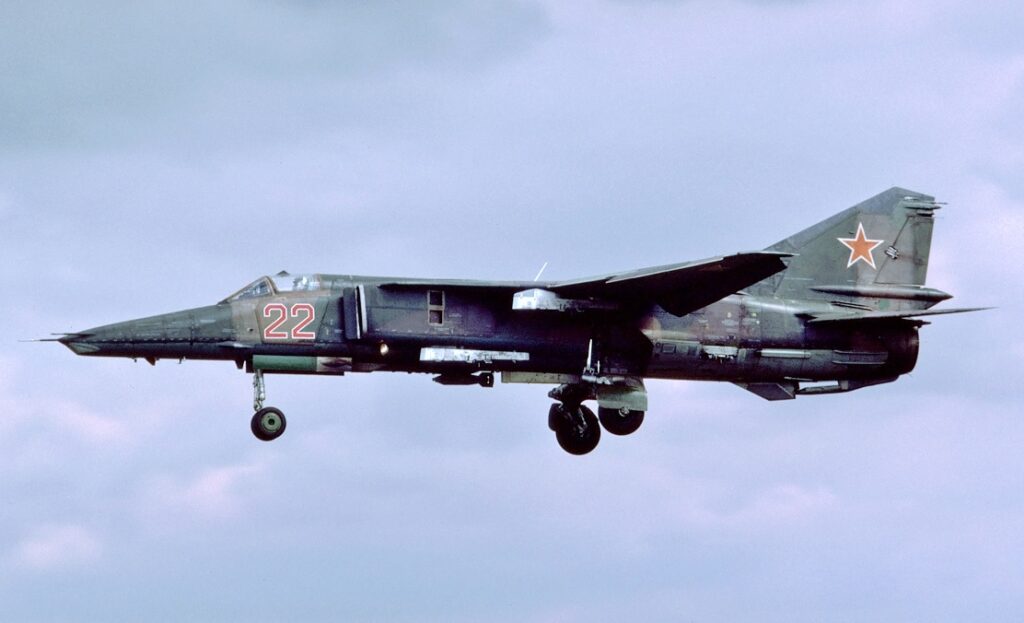
Overview
The Mikoyan MiG-27 (NATO reporting name “Flogger-D/J”) is a variable-sweep wing ground-attack aircraft derived from the MiG-23 fighter. Optimized for air-to-ground strike missions, the MiG-27 featured a distinctive duck-bill nose for improved pilot visibility, additional cockpit armor, and simplified engine intakes suited to low-altitude operations. With 1,075 built (including license production in India), the MiG-27 served the Soviet Union, India, and several other nations until 2023.
Design & Development
The MiG-27 shared the basic variable-geometry airframe of the MiG-23 but was extensively redesigned for the ground-attack role. The fighter’s nose-mounted radar was replaced with a downward-sloping profile — nicknamed “Utkonos” (Platypus) — housing a laser rangefinder and marked-target seeker instead. The variable intake ramps and exhaust nozzles of the MiG-23 were replaced with simpler fixed configurations, reducing weight and maintenance requirements.
Additional cockpit armor protected the pilot during low-level attack runs, and heavier-duty landing gear enabled operations from rough or unprepared airfields. The MiG-27M/D improved versions arrived in the 1980s, followed by the MiG-27K variant with its advanced Kayra-23 laser-television sighting system enabling precision-guided munition delivery.
Operational History
The MiG-27 entered frontline service in 1975 with the 722nd Regiment, eventually equipping 22 of 40 Soviet fighter-bomber regiments. Soviet MiG-27s deployed to East Germany, Hungary, Poland, Czechoslovakia, and Mongolia. The type saw combat during the Soviet–Afghan War in 1987–89, operating from Shindand Air Base where they conducted bombing of supply convoys, night attacks, and target illumination missions under a 5,000-meter minimum altitude restriction due to MANPAD threats.
India operated the MiG-27 extensively, license-producing it as the “Bahadur” (Valiant) through Hindustan Aeronautics. Indian MiG-27s saw action during the 1999 Kargil War. The last MiG-27s were retired by Kazakhstan in 2023, ending the type’s service globally.
Capabilities
- Maximum Speed: Mach 1.7 (~1,885 km/h) at altitude
- Service Ceiling: 14,000 m (45,930 ft)
- Range: 2,500 km (1,553 mi) with external tanks
- Variable-Sweep Wings: 16° to 72° sweep for optimized flight at all speeds
- Precision Strike: Kayra-23 laser-TV sighting system (MiG-27K)
- Engine: 1× Khatchaturov R-29B-300 (112 kN with afterburner)
Armament & Weapons
- Internal Gun: 1× GSh-6-30 six-barrel 30mm rotary cannon (260 rounds)
- Hardpoints: 7 pylons for up to 4,000 kg of ordnance
- Air-to-Surface: Kh-23, Kh-25, Kh-29 guided missiles; S-24 and S-8 rockets
- Bombs: FAB-250, FAB-500, cluster munitions, tactical nuclear weapons
- Air-to-Air (self-defense): R-60 (AA-8 Aphid) missiles
Video
Frequently Asked Questions
How is the MiG-27 different from the MiG-23?
While sharing the same basic variable-geometry airframe, the MiG-27 replaced the MiG-23’s radar with a laser rangefinder, added cockpit armor, simplified the engine intakes for low-altitude flight, and was optimized entirely for the ground-attack role rather than air-to-air combat.
Did the MiG-27 see combat?
Yes, Soviet MiG-27s saw action in Afghanistan (1987–89), and Indian MiG-27s participated in the 1999 Kargil War against Pakistan. The type also served in various regional conflicts with export operators.
When was the MiG-27 finally retired?
Kazakhstan retired its last MiG-27s in 2023, making it the final operator. Russia retired the type in 1993, and India in 2019.