✈️ Aircraft Specifications
| Designation | M-50 |
| Manufacturer | Myasishchev |
| Country of Origin | Soviet Union |
| First Flight | 1959 |
| Length | 57.48 m (188.6 ft) |
| Max Speed (Mach) | 1.59 |
| Max Speed (km/h) | 1,950 km/h |
| Service Ceiling | 16,500 m (54,137 ft) |
| Range | 7,400 km (4,595 mi) |
| Engine | 2× Dobrynin VD-7F + 2× Dobrynin VD-7 turbojet |
| Crew | 2 |
| Status | Prototype |
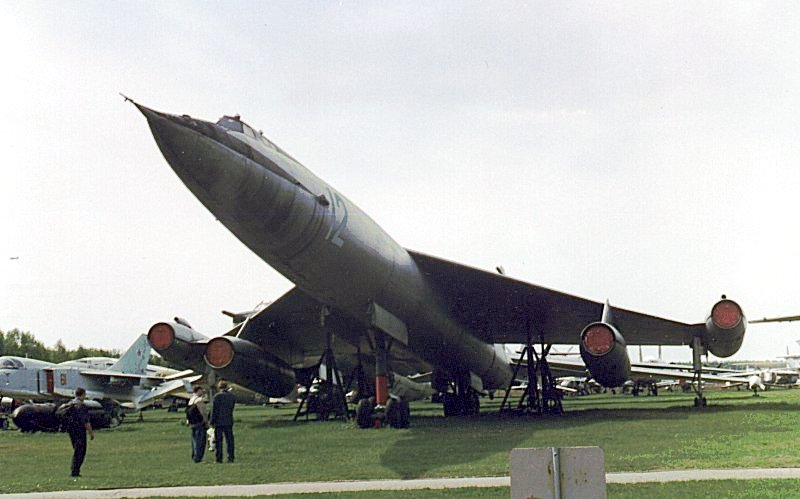
Overview
The Myasishchev M-50 (NATO reporting name “Bounder”) is a Soviet prototype four-engine supersonic strategic bomber that never entered service. First flown on 27 October 1959, this enormous aircraft — nearly 58 meters long — was designed to deliver nuclear weapons at supersonic speeds across intercontinental distances. Only one flight-worthy prototype was built before the program was terminated in favor of intercontinental ballistic missiles.
Design & Development
The M-50 was designed by the Myasishchev bureau as an intercontinental supersonic bomber. It featured four engines in an unusual configuration: two Dobrynin VD-7F afterburning turbojets mounted under the shoulder-mounted truncated delta wings, and two non-afterburning VD-7 turbojets at the wingtips. The shoulder-mounted delta wing design was optimized for supersonic cruise.
A second aircraft, designated M-52, was also developed with Zubets 16-17 turbofan engines and a redesigned wider cockpit with side-by-side seating replacing the M-50’s tandem arrangement. An unmanned M-51 intercontinental cruise missile variant was also proposed for delivering multiple warheads to targets in the United States.
Operational History
The M-50 made its first flight on 27 October 1959 and completed 19 flights in total. Its sole public appearance came on 9 July 1961 during a flypast at the annual Tushino air show — Soviet Aviation Day. This dramatic appearance stunned Western observers, who initially believed the bomber might be nuclear-powered based on a 1958 Aviation Week article. The M-52 was completed but never flight-tested.
Like most early 1960s supersonic strategic bomber programs worldwide, the M-50/52 was terminated as ICBMs proved more cost-effective and survivable for nuclear delivery. The Soviet space program also absorbed resources and political attention. The sole M-50 prototype survives on display at the Monino Museum outside Moscow.
Capabilities
- Maximum Speed: 1,950 km/h (Mach 1.59 / 1,210 mph)
- Service Ceiling: 16,500 m (54,100 ft)
- Range: 7,400 km (4,600 mi)
- Length: 57.48 m (188 ft 7 in) — massive airframe
- Maximum Takeoff Weight: 200,000 kg (440,925 lb)
- Engines: 2× VD-7F afterburning + 2× VD-7 non-afterburning turbojets
Armament & Weapons
- Internal Bomb Bay: Up to 30,000 kg (66,000 lb) of bombs or missiles
- Cruise Missiles: M-59 and M-61 long-range cruise missiles
- Nuclear Delivery: Designed primarily for nuclear weapon delivery
Video
Frequently Asked Questions
Was the M-50 nuclear-powered?
No. A 1958 Aviation Week article falsely claimed the Soviets were flight-testing a nuclear-powered bomber, and photographs of the M-50 were mistakenly associated with this claim. The M-50 was powered by conventional turbojet engines.
How big was the M-50?
The M-50 was enormous — nearly 58 meters (190 feet) long with a wingspan of 25 meters and a maximum takeoff weight of 200 tonnes. It remains one of the largest combat aircraft ever designed.
Why was the M-50 cancelled?
The development of reliable ICBMs made manned supersonic strategic bombers seem unnecessary and far more expensive per nuclear delivery capability. Resources were redirected to the Soviet missile and space programs.