✈️ Aircraft Specifications
| Designation | Tornado GR4/IDS |
| Manufacturer | Panavia (UK/Germany/Italy) |
| Country of Origin | International |
| First Flight | 1974 |
| Length | 16.72 m (54.9 ft) |
| Max Speed (Mach) | 2.2 |
| Max Speed (km/h) | 2,337 km/h |
| Service Ceiling | 15,240 m (50,002 ft) |
| Range | 3,890 km (2,416 mi) |
| Engine | 2× Turbo-Union RB199-34R turbofans |
| Crew | 2 |
| Status | Active |
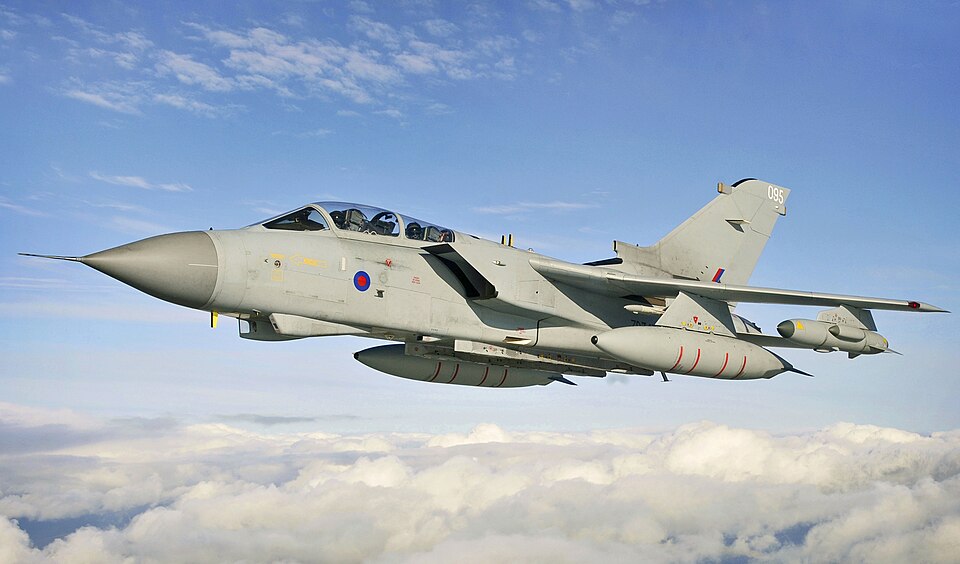
Overview
The Panavia Tornado was Europe’s most important Cold War combat aircraft—a variable-sweep wing, twin-engine, two-seat multirole aircraft designed to penetrate Soviet air defenses at ultra-low altitude and high speed. Over 990 were built for the UK, Germany, Italy, and Saudi Arabia.
Design & Development
The Tornado’s variable-sweep wings (25° to 67°) allow it to dash at Mach 2.2 at altitude or penetrate at high speed at tree-top level. The terrain-following radar enables automatic flight at 200 feet altitude in any weather. The ADV (Air Defence Variant) provided long-range interception capability for the RAF.
Operational History
The Tornado saw extensive combat in the Gulf War (1991), Kosovo, Iraq, Afghanistan, Libya, and Syria. RAF Tornados performed daring ultra-low-level attacks on Iraqi airfields in 1991. The type is being retired from most air forces as Typhoons and F-35s replace them, though Italy and Saudi Arabia continue operations.
Armament
- 2× BK-27 27mm Mauser cannons
- AIM-9 Sidewinder / IRIS-T
- AIM-120 AMRAAM
- Storm Shadow/SCALP cruise missile
- Brimstone anti-armor
- ALARM anti-radar missile
- JP233 airfield denial weapon
- Paveway II/III laser-guided bombs
- B61 nuclear bomb (IDS variant)
Video
Frequently Asked Questions
How fast is the Panavia Tornado?
The Tornado ADV reaches Mach 2.2 (1,453 mph / 2,338 km/h).
What are the Tornado variants?
IDS (ground attack), ADV (interception), and ECR (electronic combat/reconnaissance).
How many Tornados were built?
992 Panavia Tornados were built for the UK, Germany, Italy, and Saudi Arabia.
Is the Tornado still in service?
Partially. Germany and Italy still operate some. The UK retired theirs in 2019. Combat-proven in Gulf War, Kosovo, Afghanistan, Libya.