✈️ Aircraft Specifications
| Designation | F-84F |
| Manufacturer | Republic Aviation |
| Country of Origin | United States |
| First Flight | 1950 |
| Length | 13.23 m (43.4 ft) |
| Max Speed (Mach) | 0.92 |
| Max Speed (km/h) | 1,118 km/h |
| Service Ceiling | 14,000 m (45,934 ft) |
| Range | 1,304 km (810 mi) |
| Engine | Wright J65-W-3 turbojet |
| Crew | 1 |
| Status | Retired |
Overview
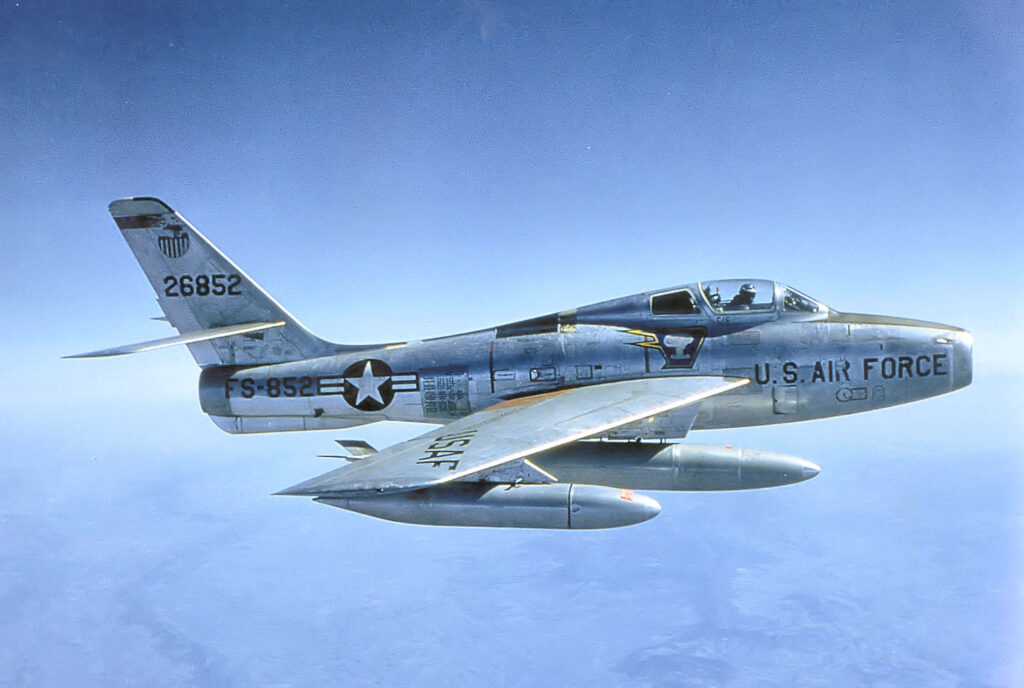
The Republic F-84F Thunderstreak is an American swept-wing turbojet-powered fighter-bomber that served as a backbone of NATO tactical air power during the 1950s and 1960s. Developed as a swept-wing evolution of the straight-wing F-84 Thunderjet, the Thunderstreak first flew on 3 June 1950 and entered service in May 1954. A total of 3,428 F-84F Thunderstreaks and RF-84F Thunderflash reconnaissance variants were built, making it one of the most widely produced Western jet fighters of the Cold War era. The type served with numerous NATO air forces and remained operational with some countries until 1991.
Design & Development
The F-84F originated in 1948 as a swept-wing modification of the F-84E Thunderjet, intended to bring performance closer to the F-86 Sabre. The last production F-84E was fitted with swept tail surfaces, a new wing with 38.5 degrees of leading edge sweep, and an Allison J35-A-25 engine. Originally designated XF-96A, it first flew on 3 June 1950 with Oscar P. Haas at the controls. Despite achieving 693 mph, the performance improvement over the straight-wing variant was considered minor.
The USAF arranged for the British Armstrong Siddeley Sapphire turbojet to be built in the United States as the Wright J65, providing significantly more power. To accommodate this larger engine, the fuselage was vertically stretched and the air intake modified to an oval cross-section. Production encountered serious difficulties — while 55% tooling commonality with the Thunderjet was planned, only 15% could actually be reused, making the F-84F effectively a new aircraft.
Early production aircraft suffered from pitch-up instability and poor turning ability at combat speeds. Beginning with Block 25, a hydraulically powered one-piece stabilator replaced the conventional tailplane, significantly improving handling. The F-84F was finally declared operational on 12 May 1954, years behind the original schedule.
Operational History
The F-84F Thunderstreak entered USAF service in 1954 but was quickly relegated to the fighter-bomber role as the F-86 Sabre had undergone many upgrades by that time. Its time as a front-line USAF design was brief, beginning to move to secondary roles as early as 1958. The aircraft was then offered to NATO member countries and allies, who adopted it in large numbers.
Operators included Belgium, Denmark, France, West Germany, Greece, Italy, the Netherlands, Norway, Republic of China (Taiwan), Turkey, and briefly Israel (using ex-French examples). The RF-84F Thunderflash photo reconnaissance variant proved particularly valuable, serving as NATO’s primary tactical reconnaissance platform. Greek Air Force F-84Fs served the longest, remaining operational until 1991. The U.S. Air National Guard operated the type until 1972.
Capabilities
- Maximum Speed: Mach 0.92 (1,118 km/h / 695 mph) at sea level
- Service Ceiling: 14,000 meters (46,000 feet)
- Range: 1,304 km (810 miles) with internal fuel
- Engine: 1 × Wright J65-W-3 turbojet producing 33.1 kN (7,220 lbf) of thrust
- Swept Wing: 38.5° leading edge sweep for improved transonic performance
- Nuclear Capability: Certified for tactical nuclear weapon delivery
- Reconnaissance Variant: RF-84F Thunderflash with nose-mounted cameras replacing guns
Armament & Weapons
- Guns: 6 × 12.7 mm (.50 cal) M3 Browning machine guns
- Bombs: Up to 2,722 kg (6,000 lb) of conventional bombs on underwing pylons
- Nuclear Weapons: 1 × Mk 7 tactical nuclear bomb
- Rockets: Various unguided rocket pods
- Hardpoints: 6 underwing pylons for mixed ordnance loads
Video
Frequently Asked Questions
What is the difference between the F-84 Thunderjet and the F-84F Thunderstreak?
While the F-84F was originally intended as a simple swept-wing upgrade of the straight-wing F-84 Thunderjet, it ended up being essentially a completely new aircraft. Only 15% of tooling could be reused, and it featured a different engine (Wright J65 vs Allison J35), swept wings and tail, and a redesigned fuselage. The “F” designation was retained to make it appear as a low-cost modification rather than an expensive new program.
Was the F-84F Thunderstreak used in combat?
The F-84F did not see significant combat during its service life. It arrived too late for the Korean War (where straight-wing F-84s did serve) and was primarily a Cold War deterrent aircraft. Israeli Air Force F-84Fs (obtained from France) may have seen limited action, but the type was primarily a peacetime NATO tactical aircraft.
What was the RF-84F Thunderflash?
The RF-84F Thunderflash was a photo reconnaissance variant of the Thunderstreak. It featured cameras mounted in the nose, replacing the machine guns, and wing root air intakes instead of the nose intake. It served as NATO’s primary tactical reconnaissance platform during the late 1950s and 1960s.
References & Sources
- Wikipedia – Republic F-84F Thunderstreak
- National Museum of the United States Air Force
- Knaack, Marcelle Size. Encyclopedia of US Air Force Aircraft and Missile Systems, Volume 1. Office of Air Force History, 1978.