✈️ Aircraft Specifications
| Designation | J-16 |
| Manufacturer | Shenyang Aircraft Corporation |
| Country of Origin | China |
| First Flight | 2011 |
| Length | 21.9 m (71.9 ft) |
| Max Speed (Mach) | 2.0 |
| Max Speed (km/h) | 2,120 km/h |
| Service Ceiling | 17,300 m (56,761 ft) |
| Range | 3,000 km (1,863 mi) |
| Engine | 2x Shenyang WS-10B afterburning turbofan |
| Crew | 2 |
| Status | Active |
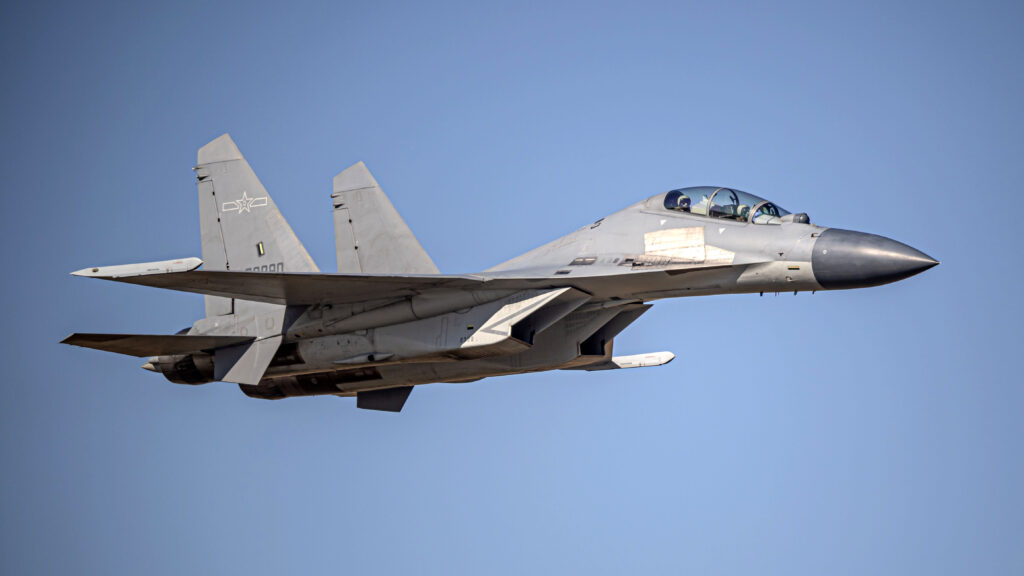
Overview
The Shenyang J-16 (NATO reporting name: Flanker-N), also known as “Qianlong” (Hidden Dragon), is a Chinese all-weather 4.5-generation tandem-seat, twin-engine multirole strike fighter built by Shenyang Aircraft Corporation. Developed from the Shenyang J-11 and based on the Su-30MKK design, the J-16 represents China’s most advanced Flanker derivative. With over 450 aircraft produced as of 2025, it is by far the most widely commissioned heavyweight fighter class by a single air force anywhere in the world since the turn of the century.
Design & Development
The J-16 was developed as the PLAAF found its JH-7 fighters becoming increasingly obsolete. Building upon the J-11BS airframe, the J-16 incorporates significant indigenous Chinese technology including an active electronically scanned array (AESA) radar and domestically produced Shenyang WS-10B turbofan engines, each producing 135 kN of thrust with afterburner.
Weight reduction is achieved through extensive use of composite materials. The aircraft features radar-absorbent paint to reduce its radar signature, a helmet-mounted display (HMD) system for improved situational awareness, and advanced electronic warfare capabilities. According to aviation experts, the J-16 holds clear advantages over Russian Flanker variants in composite materials, sensors, avionics, and missile technology.
An electronic warfare variant, the J-16D, was developed in the 2010s for suppression of enemy air defenses (SEAD), featuring internal jamming equipment and external EW pods. China is also testing an AI-controlled variant with the backseat pilot replaced by an artificial intelligence algorithm called “Intelligence Victory.”
Operational History
The J-16 entered service with the PLAAF in 2015 and was officially revealed during the PLA’s 90th anniversary parade in 2017. The aircraft has been involved in several high-profile incidents over the South China Sea and Taiwan Strait.
In May 2022, a J-16 intercepted an Australian P-8 Poseidon surveillance aircraft, releasing chaff that was ingested by the P-8’s engine. In May 2023, a J-16 performed a close intercept of a US RC-135 Rivet Joint reconnaissance aircraft. The J-16 is the most frequently deployed aircraft in Taiwan Strait operations, likely due to its electronic warfare capabilities.
Capabilities
- AESA radar providing superior detection, tracking, and electronic warfare capabilities
- 12 external hardpoints for a diverse range of air-to-air and air-to-surface weapons
- Maximum speed of Mach 2.0 (2,120 km/h) with 17,300 m service ceiling
- 3,000 km range with 4,000 km ferry range for extended operations
- Helmet-mounted display for off-boresight targeting and enhanced situational awareness
- Radar-absorbent coatings for reduced radar cross-section
- Rate of climb: 230 m/s (45,000 ft/min)
Armament & Weapons
- Gun: 1× 30mm GSh-30-1 cannon
- Air-to-air missiles: PL-9, PL-10 (short-range IR), PL-12, PL-15 (long-range active radar), PL-17 (very long-range)
- Anti-ship missiles: YJ-12, YJ-83K
- Air-to-surface missiles: AKF-98, KD-88
- Guided bombs: LS-500J laser-guided bombs
- Anti-radiation missiles for SEAD missions
- Targeting pod: YINGS-III precision targeting pod
Video
Frequently Asked Questions
Is the J-16 a copy of the Su-30?
While the J-16 is derived from the Su-30MKK/J-11 lineage, it has evolved far beyond its Russian origins. The J-16 features entirely Chinese-made engines (WS-10B), an indigenous AESA radar, advanced composite materials, and Chinese-developed weapons systems, making it significantly more capable than any Russian Flanker variant.
How many J-16s have been built?
As of late 2025, an estimated 450+ J-16 aircraft have been produced, making it the most widely produced heavyweight fighter class by a single air force since 2000. Production continues at a rate of 24-30 aircraft per batch.
What is the J-16D variant?
The J-16D is an electronic warfare variant designed for SEAD missions. It replaces the IRST sensor and cannon with internal jamming equipment and carries external EW pods on its wingtips, similar in concept to the US EA-18G Growler.