✈️ Aircraft Specifications
| Designation | Su-24M |
| Manufacturer | Sukhoi |
| Country of Origin | Soviet Union |
| First Flight | 1967 |
| Length | 24.53 m (80.5 ft) |
| Max Speed (Mach) | 1.60 |
| Max Speed (km/h) | 1,700 km/h |
| Service Ceiling | 11,000 m (36,091 ft) |
| Range | 3,000 km (1,863 mi) |
| Engine | 2x Saturn/Lyulka AL-21F-3A afterburning turbojets |
| Crew | 2 |
| Status | Active |
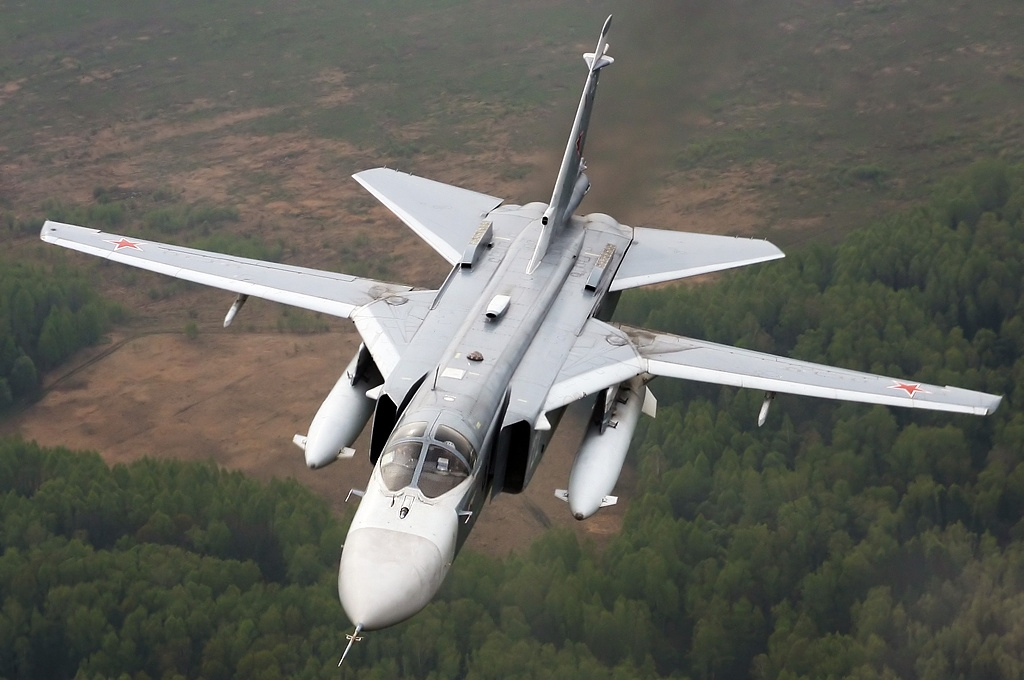
Overview
The Sukhoi Su-24 (NATO reporting name: Fencer) is a Soviet supersonic, all-weather tactical bomber and interdictor aircraft with variable-sweep wings and side-by-side crew seating. First flying in its definitive form on 17 January 1970, the Su-24 was the first Soviet tactical aircraft to carry an integrated digital navigation/attack system. Approximately 1,400 Su-24s were built between 1967 and 1993, and the type remains in active service with the Russian Aerospace Forces, as well as the air forces of Iran, Algeria, and several other nations. It is often compared to the American General Dynamics F-111 Aardvark.
Design & Development
Development of the Su-24 began in the early 1960s when the Soviet Air Force required an all-weather precision strike aircraft to replace the Su-7B. Initial designs explored delta wing configurations and even a radical six-engine STOL concept with four dedicated lift jets alongside two cruise engines. The first prototype, T-6-1, flew on 2 July 1967 with Vladimir Ilyushin at the controls using this unconventional layout.
However, testing confirmed that the lift jets consumed fuel space, eliminated under-fuselage hardpoints, and caused instability during transition to conventional flight. Inspired by the success of the American F-111’s variable-geometry wing, Sukhoi was officially tasked in August 1968 with investigating a swing-wing design. The resulting T-6-2I with variable-sweep wings first flew on 17 January 1970.
The Su-24’s groundbreaking Puma navigation/attack system featured twin Orion-A radar scanners, a dedicated Relyef terrain-following radar for automatic low-altitude flight, and an Orbita-10-58 onboard computer — enabling day, night, and all-weather capability for the first time in Soviet tactical aviation. The crew was equipped with Zvezda K-36D ejection seats allowing escape at any altitude and speed. The first production aircraft flew on 31 December 1971, and the Su-24 was formally accepted into service on 4 February 1975.
Operational History
The Su-24 has seen extensive combat throughout its service life. It was first used in combat during the Soviet-Afghan War in the 1980s, providing tactical bombing support. Russian Su-24s have subsequently been employed in the First and Second Chechen Wars, the 2008 Russo-Georgian War, and extensively during Russia’s intervention in the Syrian Civil War beginning in 2015.
The type has been heavily used in the ongoing Russo-Ukrainian conflict, conducting bombing missions against Ukrainian targets. Ukrainian forces have shot down multiple Su-24s during the conflict. The aircraft has also been forward-deployed to Syria and Iran at various times. Despite its age, upgraded Su-24M variants continue to form an important part of Russia’s tactical bomber fleet, with modernization programs adding GLONASS navigation, multi-function displays, and digital moving map systems.
Capabilities
- Maximum Speed: Mach 1.6 (1,700 km/h / 1,056 mph) at altitude
- Service Ceiling: 11,000 meters (36,000 feet)
- Range: 3,000 km (1,860 miles) with external fuel
- Payload: 8,000 kg (17,600 lb) of ordnance on 8 hardpoints
- Engines: 2 × Saturn/Lyulka AL-21F-3A afterburning turbojets, 75.0 kN dry / 109.8 kN with afterburner each
- Variable-Sweep Wings: Wing sweep adjustable from 16° to 69° for optimal performance across all flight regimes
- Terrain-Following Radar: Automatic low-altitude flight capability via Relyef radar system
- Side-by-Side Seating: Pilot and weapons systems officer seated side-by-side for improved crew coordination
Armament & Weapons
- Cannon: 1 × 23 mm GSh-6-23 six-barrel rotary cannon with 500 rounds
- Guided Missiles: Kh-25 (AS-10 Karen), Kh-29 (AS-14 Kedge), Kh-58 (AS-11 Kilter) anti-radiation missiles
- Air-to-Surface Missiles: Kh-59 (AS-13 Kingpost) stand-off missiles
- Guided Bombs: KAB-500Kr and KAB-1500Kr TV-guided bombs
- Unguided Ordnance: FAB-250, FAB-500 conventional bombs, S-25 rockets, various cluster munitions
- Nuclear Weapons: Tactical nuclear bombs (nuclear-capable variant)
Video
Frequently Asked Questions
How does the Su-24 compare to the F-111 Aardvark?
The Su-24 is often called the “Soviet F-111” due to their similar roles and variable-sweep wing configuration. The Su-24 is somewhat smaller and shorter-ranged than the F-111, with a range of 3,000 km versus the F-111’s 4,700 km. Both feature side-by-side crew seating, terrain-following radar, and all-weather strike capability. The Su-24 entered service about a decade after the F-111.
Is the Su-24 still in active service?
Yes, the Su-24 remains in active service with the Russian Aerospace Forces, though in declining numbers due to attrition and replacement by the more modern Su-34. It also serves with Iran, Algeria, and several other nations. Russia has used Su-24s extensively in the Syrian intervention and the Ukraine conflict.
Why did the Su-24’s original STOL design fail?
The initial six-engine concept (two cruise engines plus four lift jets) failed because the lift jets occupied space normally used for fuel, eliminated under-fuselage weapons hardpoints, and caused dangerous instability during the transition between vertical and conventional flight modes. The variable-sweep wing solution proved far more practical.
References & Sources
- Wikipedia – Sukhoi Su-24
- Sukhoi Company Official Website
- Gordon, Yefim. Sukhoi Su-24: Famous Russian Aircraft. Midland Publishing, 2005.