✈️ Aircraft Specifications
| Designation | Su-7B |
| Manufacturer | Sukhoi |
| Country of Origin | Soviet Union |
| First Flight | 1955 |
| Length | 16.80 m (55.1 ft) |
| Max Speed (Mach) | 2.04 |
| Max Speed (km/h) | 2,170 km/h |
| Service Ceiling | 15,150 m (49,707 ft) |
| Range | 480 km (298 mi) |
| Engine | Lyulka AL-7F-1 afterburning turbojet |
| Crew | 1 |
| Status | Retired |
Overview
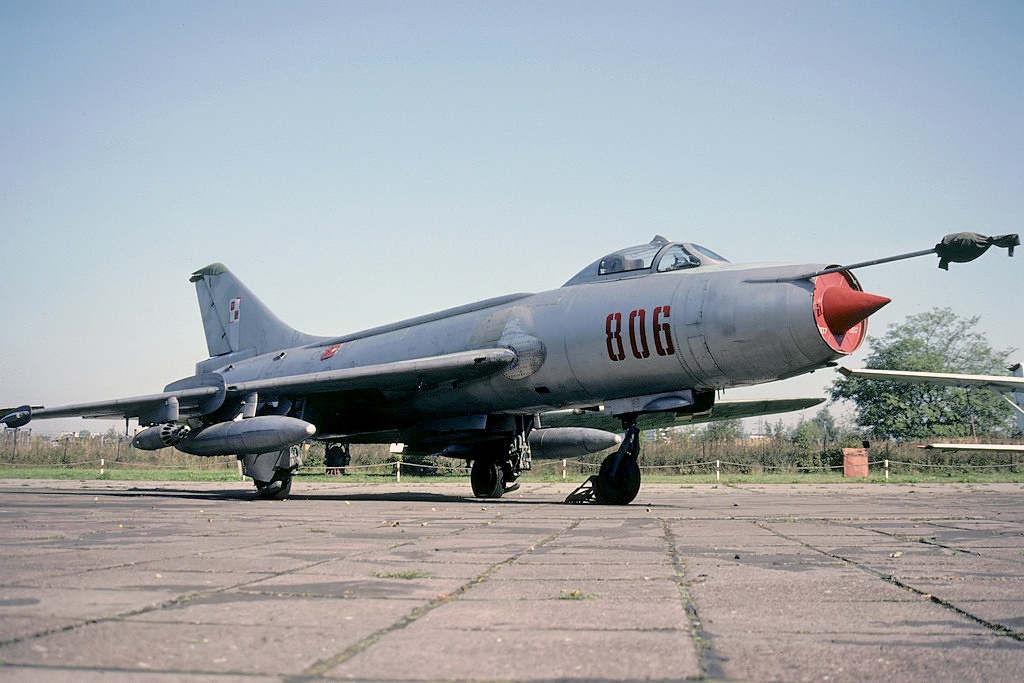
The Sukhoi Su-7 (NATO reporting name: Fitter-A) is a Soviet swept-wing, supersonic fighter-bomber and ground-attack aircraft that became the backbone of Soviet tactical aviation during the 1960s. First flying on 7 September 1955, the Su-7 was originally designed as a tactical dogfighter but found its true role as a fighter-bomber. A total of 1,847 Su-7s were built between 1957 and 1972, with the type being widely exported to Soviet-allied nations. The Su-7 saw extensive combat in the Indo-Pakistani Wars and Middle Eastern conflicts, earning a reputation for ruggedness and survivability despite its limited range.
Design & Development
After Stalin’s death, the Sukhoi OKB was reopened and began work on a swept-wing frontline fighter in the summer of 1953. The first prototype, designated S-1, was designed around the new Lyulka AL-7 turbojet engine and introduced several Soviet firsts: an all-moving tailplane and a translating centerbody (movable inlet cone) for managing airflow at supersonic speeds. The wing was swept at 60 degrees with irreversible hydraulically boosted controls.
The S-1 first flew on 7 September 1955 with A. G. Kochetkov at the controls. After receiving an afterburning version of the AL-7 engine, the prototype achieved Mach 2.04 in April 1956, setting a Soviet speed record of 2,170 km/h. However, the initial fighter variant saw limited production as the MiG-21 was prioritized instead. The Su-7B ground-attack variant, first flying in March 1959, proved far more successful and became the main Soviet fighter-bomber.
The Su-7 was hampered by the AL-7 engine’s extremely high fuel consumption, which severely limited payload and range — even short-range missions required at least two hardpoints for drop tanks rather than ordnance. Its high landing speed of 340-360 km/h, dictated by the highly swept wing, made operations difficult. These limitations eventually led Sukhoi to develop the variable-geometry wing Su-17 as a successor.
Operational History
The Indian Air Force used the Su-7 extensively in the 1971 Indo-Pakistani War, where six squadrons totaling 140 aircraft flew almost 1,500 offensive sorties. The IAF achieved a remarkable sortie rate of six per pilot per day, and the aircraft demonstrated exceptional survivability — multiple Su-7s returned safely despite severe battle damage.
Egyptian Su-7s saw combat in the 1967 Six-Day War, the War of Attrition, and the 1973 Yom Kippur War, attacking Israeli ground forces. Despite its limited combat radius, the Su-7 proved popular with pilots for its docile flight characteristics, simple controls, and considerable speed at low altitudes. The type was replaced in Soviet service between 1977 and 1986 by Su-17s and MiG-27s.
Capabilities
- Maximum Speed: Mach 2.04 (2,170 km/h / 1,350 mph) at altitude
- Service Ceiling: 15,150 meters (49,700 feet)
- Combat Range: 480 km (300 miles) with typical combat load — severely limited by fuel consumption
- Engine: 1 × Lyulka AL-7F-1 afterburning turbojet producing 66.6 kN dry / 94.1 kN with afterburner
- Wing Sweep: 60° leading edge sweep for high-speed performance
- Ruggedness: Exceptional battle damage tolerance and survivability demonstrated in combat
- High Sortie Rate: Simple maintenance enabled up to 6 sorties per pilot per day in wartime
Armament & Weapons
- Cannons: 2 × 30 mm Nudelman-Rikhter NR-30 cannons with 70 rounds each
- Bombs: Up to 2,000 kg of conventional bombs including FAB-250 and FAB-500
- Rockets: UB-16-57 rocket pods with S-5 57mm rockets, or S-24 240mm heavy rockets
- Hardpoints: 6 underwing pylons (though typically 2 carried drop tanks due to range limitations)
- Nuclear Capability: Certified for tactical nuclear weapon delivery
Video
Frequently Asked Questions
Why was the Su-7 considered limited despite being supersonic?
The Su-7’s main limitation was its extremely high fuel consumption from the Lyulka AL-7 engine. This meant that even on short-range missions, at least two of six hardpoints had to carry drop tanks instead of weapons. The resulting combat radius of only about 300 km severely limited its tactical usefulness as a ground-attack aircraft.
How did the Su-7 perform in the 1971 Indo-Pakistani War?
The Su-7 performed admirably, with the Indian Air Force flying nearly 1,500 offensive sorties. The aircraft demonstrated remarkable survivability — one Su-7 flown by Wing Commander H.S. Mangat returned safely despite being hit by a PL-2 missile. Between 14 and 19 Su-7s were lost during the war, mostly to anti-aircraft fire rather than aerial combat.
What replaced the Su-7 in Soviet service?
The Su-7 was replaced primarily by the Sukhoi Su-17 (a variable-geometry wing development of the Su-7) and the MiG-27 between 1977 and 1986. The Su-17’s swing-wing design directly addressed the Su-7’s takeoff, landing, and range limitations while maintaining its strengths.
References & Sources
- Wikipedia – Sukhoi Su-7
- Green, William. The World’s Fighting Planes. Macdonald, 1964.
- Gordon, Yefim. Sukhoi Su-7/-17/-20/-22 Fitter. Midland Publishing, 2004.