✈️ Aircraft Specifications
| Designation | Yak-141 |
| Manufacturer | Yakovlev |
| Country of Origin | Soviet Union |
| First Flight | 1987 |
| Length | 18.3 m (60 ft) |
| Max Speed (Mach) | 1.7 |
| Max Speed (km/h) | 1,800 km/h |
| Service Ceiling | 15,500 m (50,856 ft) |
| Range | 1,400 km (869 mi) |
| Engine | 1× Tumansky R-79V-300 + 2× Rybinsk RD-41 lift jets |
| Crew | 1 |
| Status | Cancelled |
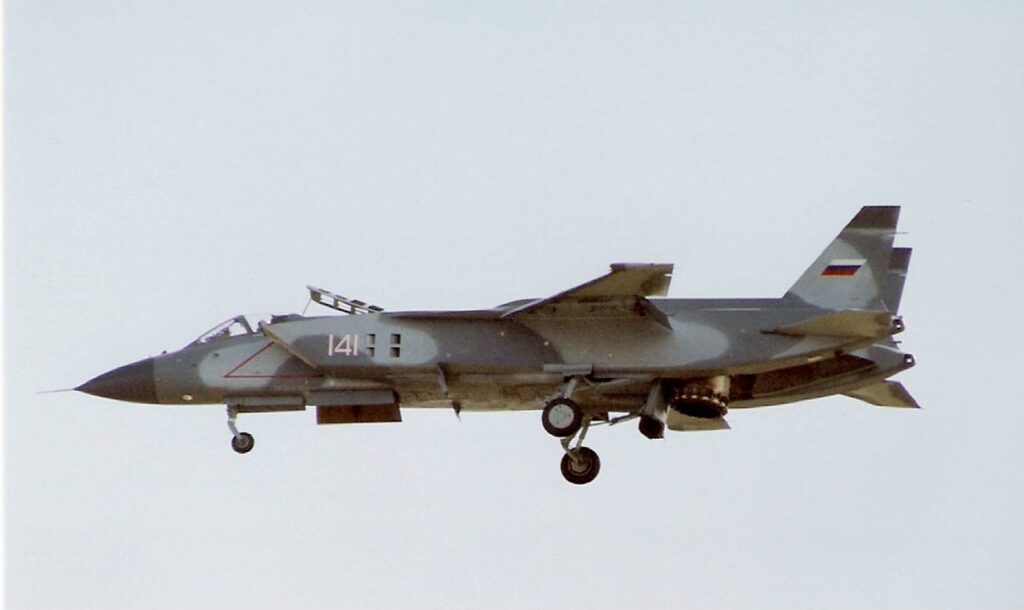
Overview
The Yakovlev Yak-141 (NATO reporting name “Freestyle”), also known as the Yak-41, is a Soviet supersonic vertical takeoff and landing (VTOL) fighter aircraft. Designed as a replacement for the subsonic Yak-38, the Yak-141 was intended to serve as a supersonic fleet defense fighter operating from Soviet aircraft carriers. It became the world’s first supersonic VTOL aircraft, setting 12 world records during flight testing before the program was cancelled in 1991 due to the collapse of the Soviet Union.
Design & Development
Known internally as “Product 48,” the Yak-141 underwent significant design evolution. Yakovlev studied multiple configurations before settling on a single main engine with separate lift jets. The powerplant consisted of a Tumansky R-79V-300 vectoring-thrust main engine producing 152 kN with afterburner, supplemented by two Rybinsk RD-41 lift jets installed at 85° behind the cockpit.
The engines were digitally controlled, and maneuverability during hover was provided by reaction control jets at the wingtips and under the nose. The high-mounted wing was foldable for compact carrier storage. The cockpit featured an automatic ejection seat that would arm when the engine nozzle rotated past 30° at speeds below 300 km/h. Four prototypes were built — one for static testing, one non-flying testbed, and two flight-test aircraft.
Operational History
The Yak-141 first flew on 9 March 1987 at Zhukovsky. Hovering flight was achieved on 29 December 1989, and the first full transition from vertical to horizontal flight occurred on 13 June 1990. Carrier deck trials began at Saky in April 1991, and the first landing aboard the carrier Admiral Gorshkov took place on 26 September 1991.
On 5 October 1991, a hard landing ruptured a fuel tank, causing a fire; the pilot ejected safely. The program was suspended later that month due to lack of funds. In 1991, Lockheed entered a partnership with Yakovlev for further development, though this was not publicly confirmed until 1994. The surviving prototype was displayed at the 1992 Farnborough Airshow, but no additional aircraft were ever built.
Capabilities
- Maximum Speed: Mach 1.7 (~1,800 km/h) at altitude
- Service Ceiling: 15,500 m (50,850 ft)
- Range: 1,400 km (870 mi)
- VTOL/STOVL Capability: Full vertical takeoff and landing from carrier decks
- World Records: 12 FAI records set during flight testing
- Engines: 1× R-79V-300 (152 kN) + 2× RD-41 lift jets (41 kN each)
Armament & Weapons
- Internal Gun: 1× GSh-30-1 30mm autocannon
- Hardpoints: 4 underwing pylons for up to 2,600 kg of ordnance
- Air-to-Air: R-73 (AA-11 Archer) and R-77 (AA-12 Adder) missiles
- Air-to-Surface: Kh-25ML, Kh-31 anti-ship missiles, unguided rockets and bombs
Video
Frequently Asked Questions
Was the Yak-141 the first supersonic VTOL aircraft?
Yes, the Yak-141 was the world’s first supersonic VTOL combat aircraft, achieving speeds up to Mach 1.7 while retaining full vertical takeoff and landing capability.
Did Lockheed work with Yakovlev on the Yak-141?
Yes, after the fall of the Soviet Union, Lockheed entered a partnership with Yakovlev in 1991 for potential further development. Some analysts believe technology from the Yak-141 influenced the design of the F-35B Lightning II’s lift system.
Why was the Yak-141 cancelled?
The program was cancelled primarily due to the economic collapse following the dissolution of the Soviet Union. Funding dried up, and despite the Lockheed partnership, no additional prototypes were ever completed.