✈️ Aircraft Specifications
| Designation | Saeqeh |
| Manufacturer | HESA (Iran Aircraft Manufacturing Industrial Company) |
| Country of Origin | Iran |
| First Flight | 2004 |
| Length | 14.45 m (47.4 ft) |
| Max Speed (Mach) | 1.5 |
| Max Speed (km/h) | 1,700 km/h |
| Service Ceiling | 15,500 m (50,856 ft) |
| Range | 3,000 km (1,863 mi) |
| Engine | 2x General Electric J85 (Iranian-built) afterburning turbojet |
| Crew | 1 |
| Status | Active |
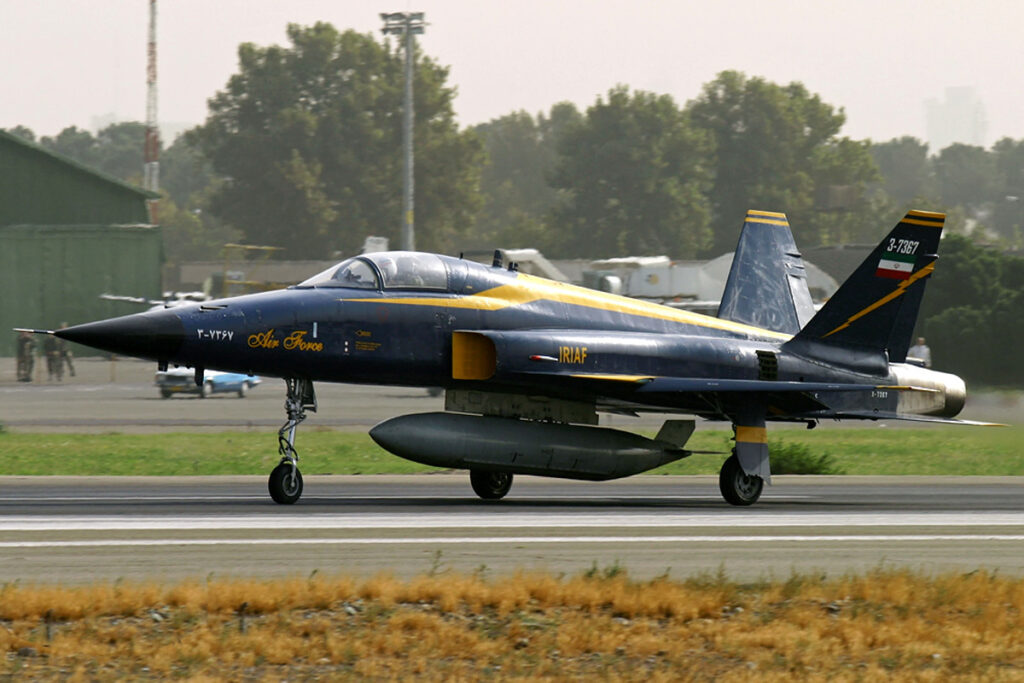
Overview
The HESA Saeqeh (“Thunderbolt”) is an Iranian-built single-seat jet fighter derived from the American Northrop F-5. Developed jointly by the Islamic Republic of Iran Air Force and the Iranian Ministry of Defence, it represents the second generation of Iran’s indigenous fighter program following the HESA Azarakhsh. The Saeqeh’s most distinctive feature is its twin vertical stabilizers, replacing the single tail of the original F-5. First flown in July 2004, the aircraft entered service in September 2007.
Design & Development
The Saeqeh program grew out of Iran’s efforts to maintain and upgrade its fleet of American-made F-5 Tiger II fighters, which were acquired before the 1979 Islamic Revolution. Cut off from spare parts and new aircraft due to international sanctions, Iran developed the HESA Azarakhsh as a first step toward indigenous fighter production, followed by the more advanced Saeqeh.
The most visible change from the F-5 is the adoption of twin canted vertical stabilizers, similar in concept to the F/A-18 Hornet layout. The aircraft also features altered jet intakes, additional wing strakes, and an upgraded Phazotron-NIIR N019 “Baaz” radar with 80 km range capable of tracking 10 targets and engaging two simultaneously. The first prototype was shown on Iranian state television making a test flight in July 2004.
Production included both the single-seat Saeqeh-1 and a twin-seat Saeqeh-2 variant introduced in 2015 with more advanced weapon systems and avionics. In total, approximately 5-6 Saeqeh-1 and one Saeqeh-2 were built before production shifted to the newer HESA Kowsar.
Operational History
Two prototypes conducted a fly-past at Tehran’s Mehrabad Airport on 20 September 2007, and three took part in a military parade two days later. In September 2010, Iran displayed what it described as the first squadron of Saeqeh fighter jets during Sacred Defence Week military parades. In May 2012, Defence Minister Ahmad Vahidi stated that three new-generation Saeqeh fighters had been manufactured and delivered to the Air Force.
The Saeqeh serves primarily with the Islamic Republic of Iran Air Force in both air defense and light attack roles. While Western analysts have questioned the aircraft’s true combat capabilities, Iran considers it an important step in achieving self-sufficiency in military aviation.
Capabilities
- Role: Light fighter / Attack aircraft
- Max Speed: Mach 1.5 (estimated ~1,700 km/h)
- Service Ceiling: 15,500 m (estimated)
- Range: 3,000 km (claimed)
- Engines: 2× Iranian-built General Electric J85 afterburning turbojets
- Radar: Phazotron N019 “Baaz” (80 km range)
- Crew: 1 (Saeqeh-1) or 2 (Saeqeh-2)
Armament & Weapons
- 2× 20 mm M39A2 cannons
- AIM-9 Sidewinder-type air-to-air missiles (Iranian copies)
- Various bombs and unguided rockets
- Air-to-ground munitions on underwing hardpoints
Video
Frequently Asked Questions
Is the Saeqeh just a modified F-5?
While based on the F-5 airframe, the Saeqeh features significant modifications including twin vertical stabilizers, upgraded radar, altered intakes, and new avionics systems.
How many Saeqeh aircraft were built?
Approximately 5-6 single-seat Saeqeh-1 and one twin-seat Saeqeh-2 were built before production transitioned to the HESA Kowsar.
What replaced the Saeqeh?
The HESA Kowsar, a further development of the F-5 lineage with a glass cockpit and fourth-generation avionics, succeeded the Saeqeh in production.