✈️ Aircraft Specifications
| Designation | X-59 |
| Manufacturer | Lockheed Martin Skunk Works |
| Country of Origin | United States |
| First Flight | 2025 |
| Length | 30.4 m (99.7 ft) |
| Max Speed (Mach) | 1.42 |
| Max Speed (km/h) | 1,510 km/h |
| Service Ceiling | 16,764 m (55,003 ft) |
| Range | 1,500 km (932 mi) |
| Engine | 1× General Electric F414-GE-100 turbofan |
| Crew | 1 |
| Status | Development |
Overview
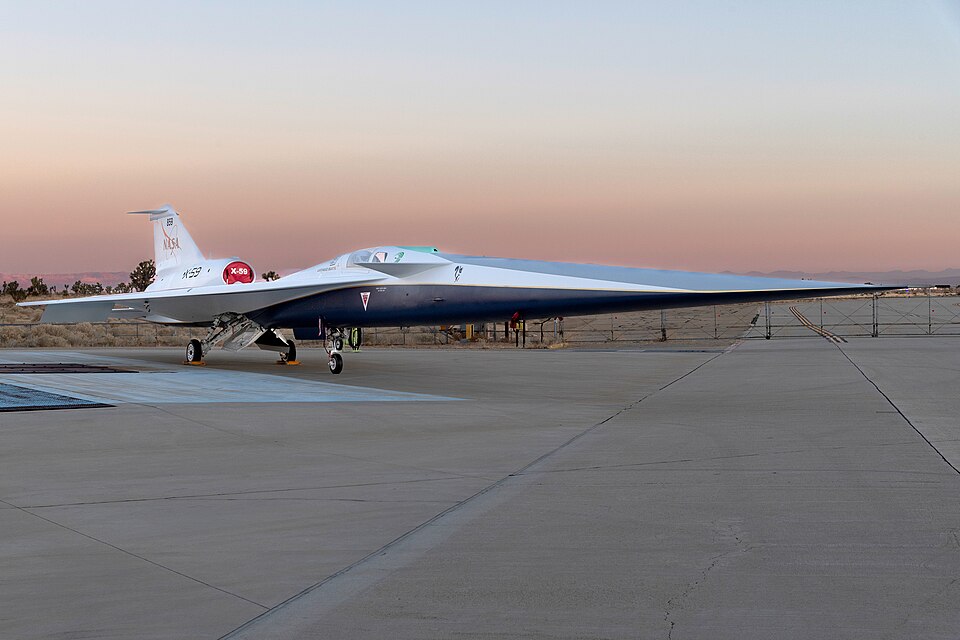
The Lockheed Martin X-59 Quesst (Quiet SuperSonic Technology) is a revolutionary experimental aircraft designed to solve one of aviation’s greatest challenges: the sonic boom. Built by Lockheed Martin’s legendary Skunk Works for NASA, the X-59 is shaped to produce only a quiet “thump” instead of the thunderous boom that banned supersonic commercial flight over land. Its first flight took place on 28 October 2025, marking a potential turning point for the future of commercial supersonic travel.
Design & Development
NASA awarded Lockheed Martin a preliminary design contract in February 2016 to develop a Low-Boom Flight Demonstrator. In April 2018, NASA awarded a $247.5 million contract to design, build, and deliver the X-59. The aircraft features an extremely long, slender nose that shapes shockwaves to prevent them from coalescing into a loud sonic boom. The nose is so long that forward visibility is provided by an External Vision System (XVS) using cameras and displays rather than a forward-facing windscreen.
The X-59 is powered by a single General Electric F414-GE-100 turbofan engine producing 22,000 pounds of thrust. At 30.4 meters (99.7 feet) long, the aircraft is designed to cruise at Mach 1.42 at 55,000 feet, producing a sound level of only 75 EPNdB on the ground — comparable to the sound of a car door closing.
Operational History
After years of development and construction at Skunk Works in Palmdale, California, the X-59 was publicly unveiled on 12 January 2024. Following extensive ground testing and taxi tests, the aircraft completed its first flight on 28 October 2025 from NASA’s Armstrong Flight Research Center at Edwards Air Force Base.
NASA plans to fly the X-59 over selected U.S. cities to measure community response to the quiet sonic thump. The data gathered will be provided to the International Civil Aviation Organization (ICAO) and the Federal Aviation Administration (FAA) to potentially revise regulations banning commercial supersonic flight over land.
Capabilities
- Cruise Speed: Mach 1.42 (1,510 km/h / 937 mph)
- Cruise Altitude: 16,764 m (55,000 ft)
- Noise Level: 75 EPNdB (quiet “thump” vs traditional sonic boom)
- Engine: 1× General Electric F414-GE-100 turbofan, 22,000 lbf thrust
- Crew: 1
- Length: 30.4 m (99.7 ft)
- First Flight: 28 October 2025
- Units Built: 1
Video
Frequently Asked Questions
What is the purpose of the X-59?
The X-59 is designed to demonstrate that supersonic aircraft can produce a quiet “thump” instead of a disruptive sonic boom. The data will help regulators decide whether to allow commercial supersonic flight over land.
Why is the X-59 so long and narrow?
The extremely elongated nose and carefully sculpted fuselage shape the shockwaves generated during supersonic flight, preventing them from merging into a loud boom.
Could the X-59 lead to a new Concorde?
If community response tests confirm that the quiet sonic thump is acceptable, regulators could lift the ban on commercial supersonic overland flight, enabling a new generation of supersonic airliners.
How does the pilot see forward without a windscreen?
The X-59 uses an External Vision System (XVS) with forward-facing cameras and cockpit displays that provide real-time forward visibility.