Checked September 8, 2026. This June milestone concerns speed and altitude. NASA’s September 4 update says dedicated acoustic validation still lies ahead; chase-aircraft booms masked X-59’s sound during initial testing.
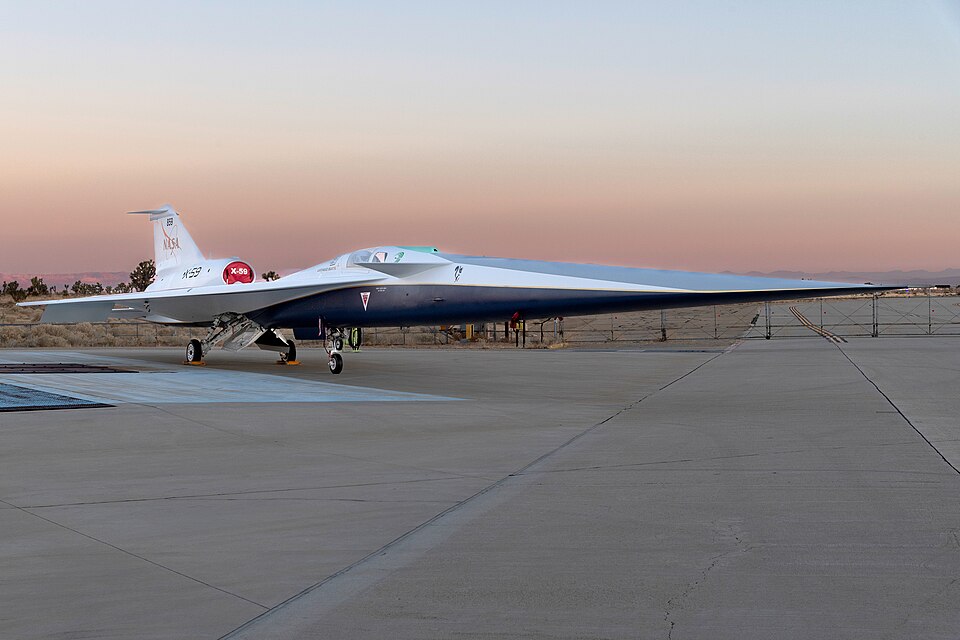
NASA’s X-59 has finally done the thing it was built to do: fly faster than sound. On June 5, 2026, Lockheed Martin’s needle-nosed quiet-supersonic demonstrator exceeded Mach 1 for the first time, reaching Mach 1.077 at 43,400 feet on an 81-minute flight from Edwards Air Force Base. A week later, on June 12, it hit its design target of Mach 1.4 at 55,000 feet.
A Boom Designed to Be a Thump
The whole point of the X-59 is not raw speed — the Concorde cruised faster decades ago — but the noise it makes getting there. Its long, slender fuselage and carefully shaped nose are engineered to spread out the shockwaves that normally collapse into a sharp sonic boom, softening them into a quiet “thump” no louder than a car door closing down the street.
The aircraft is so optimized for that shape that it has no forward-facing window. Test pilot Jim “Clue” Less flies it using an External Vision System — a high-resolution display fed by forward-facing cameras — rather than looking out through a canopy.
Why June’s Flights Matter
Mach 1.4 at 55,000 feet are the exact conditions NASA plans to use for upcoming community overflights, when the X-59 will fly above selected U.S. towns so researchers can measure how people on the ground actually perceive the sound. That data goes to the FAA and international regulators, who could use it to revisit the decades-old ban on overland supersonic flight.
It is a milestone with stakes well beyond one experimental jet. If quiet supersonic flight proves acceptable to communities below, it reopens the door to a new generation of fast civil aircraft — the same door companies like Boom Supersonic are now trying to walk through.