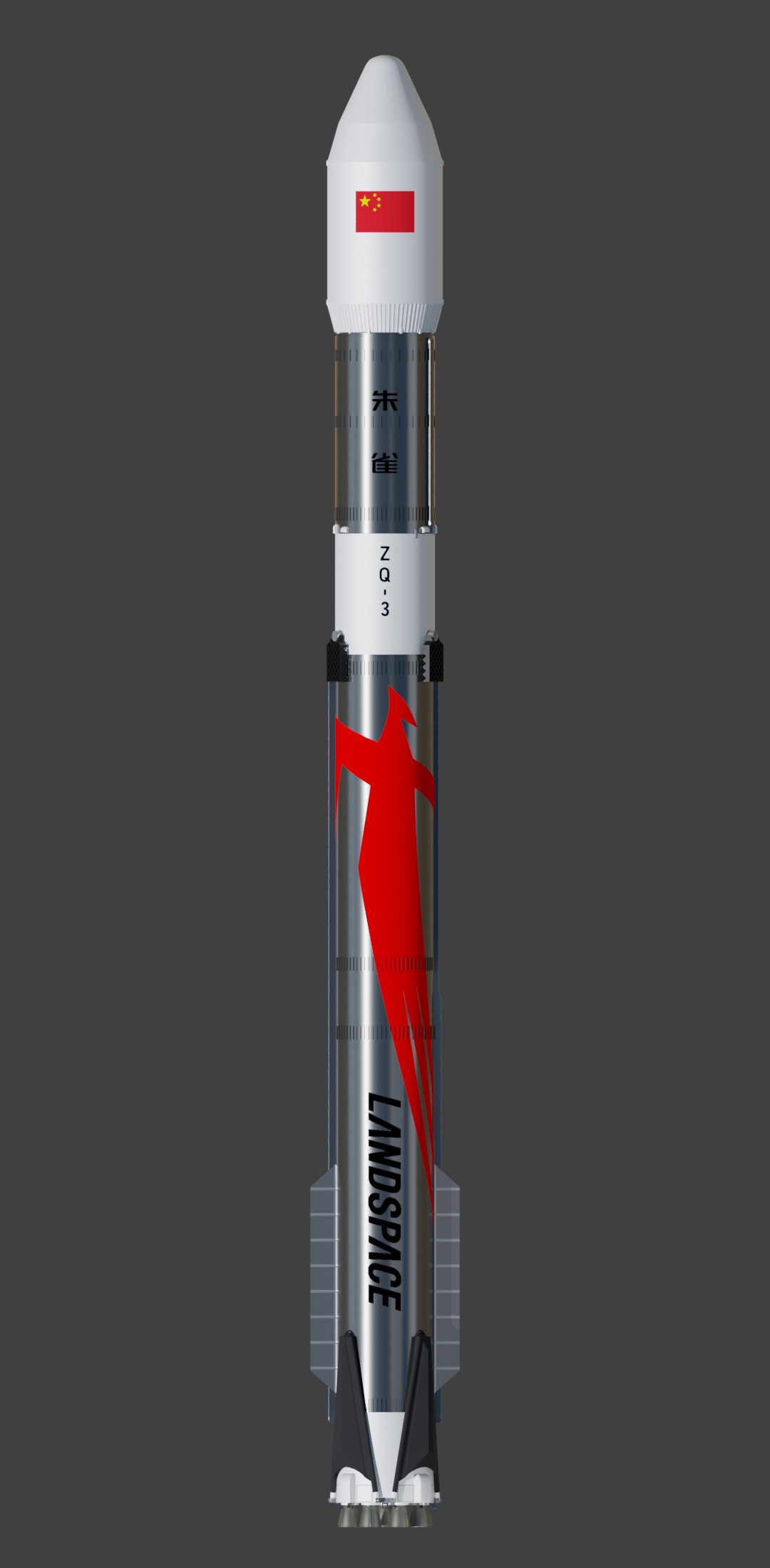
Chinese commercial launcher LandSpace landed the first stage of its stainless-steel Zhuque-3 after an orbital flight on August 18, then watched the booster tip over when a post-landing fire wrecked a leg. The touchdown itself is still a first: a private Chinese company recovered an orbital-class booster on landing legs, the same basic method used by SpaceX’s Falcon 9 and Blue Origin’s New Glenn.
Zhuque-3 Y2 lifted off from the Dongfeng commercial pad at Jiuquan at 23:35 UTC. Nine Tianque-12A methane-oxygen engines put the Honghu-03 satellite into low Earth orbit. After staging, the booster re-entered, flew grid-fin steering and landed about eight minutes after liftoff on a pad 390 km downrange in Minqin County, Gansu. It stood on four legs, near the centre of the pad — a clean correction from the December 2025 debut, when an abnormal landing burn put the stage into the ground.
Landing Is Not Reuse
Video from the site shows residual methane and oxygen catching fire at the base. One landing leg failed and the 66-metre-class steel stage toppled. NASASpaceFlight later reported the event as a partial success: orbit and landing, no intact booster to fly again on the next attempt. LandSpace had said it wanted to refly a recovered first stage within six months.
The company cut the number of engines used in the landing burn after the first failure, added a predicted landing point to the onboard abort logic and thickened thermal protection. Those changes got the vehicle onto the pad. Keeping it upright, draining propellant and turning a scorched stage into a flight article are the next problems, the same sequence SpaceX spent years on after its early landings.
Who Else Has Done This
Zhuque-3 is now one of a very short list of orbital rockets that have returned a first stage: Falcon 9, Falcon Heavy side boosters, New Glenn, China’s state-owned Long March 10B (caught at sea in July) and now LandSpace. It is the first Chinese land landing on legs. Payload is smaller than Falcon 9 — LandSpace quotes about 14 tonnes expendable to low Earth orbit on this vehicle — but the political point is cadence. Beijing wants commercial reuse, not just a state demonstration.