Facts summary and sources
General Dynamics F-111 Aardvark: Published F-111F maximum speed: 1,452 mph (about 2,337 km/h) (Published specification). F-111F museum figure; the RAAF’s Mach 2.5 F-111C figure is a different variant. First flight: 1964. 21 December 1964, F-111 prototype family; not the F variant’s first-flight date.
This is a secondary compilation. A source-check date applies only to the listed claim, not to the whole page or its translation. A page update is not a source check.
Sources and check records
- National Museum of the USAF: F-111F Aardvark — F-111F: two engines rated at 25,100 lbf each with afterburner; maximum speed 1,452 mph; range 2,971 miles; length 73 ft 6 in. [Use F-111F throughout the numeric table. Convert mph and miles to about 2,337 km/h and 4,781 km; no mission profile is specified for range, and no maximum Mach or ceiling is supplied.] · Source checked for this claim: 2026-10-19
- Royal Air Force Museum: F-111F-CF engines — The RAF Museum identifies the F-111F engine as the Pratt & Whitney TF30-P-100. [Use TF30-P-100 for the F-111F. The USAF museum page instead prints TF30-P-111; that conflicting engine suffix is not carried into the specifications.] · Source checked for this claim: 2026-10-19
- Lockheed Martin: F-111 development and production — The F-111 first flew on 21 December 1964. Lockheed Martin records 562 built, with production ending in 1976. [Manufacturer history gives 562 for the family; the former 563 figure is replaced and the total is not described as F-111F production alone.] · Source checked for this claim: 2026-10-19
- National Museum of the USAF: F-111F service and targeting system — The museum dates USAF F-111 service to 1967–1996 and describes the side-by-side crew and Pave Tack laser-targeting system. [The strike F-111 retirement timeline is distinct from the later EF-111 electronic-warfare variant. Pave Tack is a targeting system, not a weapon itself.] · Source checked for this claim: 2026-10-19
- Royal Australian Air Force: F-111C A8-142 history — The RAAF lists Mach 2.5 for its F-111C and records the final F-111C service flight on 3 December 2010. [Australian C-variant speed is not inserted into an F-111F numeric table. The Australian retirement is separate from USAF retirement.] · Event date: 2010-12-03 · Source checked for this claim: 2026-10-19
✈️ Full Specifications
Reference: F-111F. Museum maximum speed is 1,452 mph (about 2,337 km/h), and published range is 2,971 miles (about 4,781 km; mission profile unspecified). The record does not supply exact maximum Mach, ceiling or takeoff weight. The RAAF’s Mach 2.5 figure belongs to the F-111C and is discussed separately. Wingspan is fully extended; each TF30-P-100 has 25,100 lbf afterburning thrust (about 111.6 kN). Engine designation follows the RAF Museum: TF30-P-100; the USAF museum’s conflicting TF30-P-111 label is not used. Production of 562 follows Lockheed Martin’s family total, not F-111F-only production.
| Designation | F-111F (specification reference) |
| Manufacturer | General Dynamics |
| Country | 🇺🇸 United States |
| First flight | 1964 |
| First-flight context | 21 December 1964, F-111 prototype family; not the F variant’s first-flight date. |
| Retired | 1996 |
| Crew | 2 |
| Length | 22.4 m (73.5 ft) |
| Wingspan | 19.2 m (63 ft) |
| Height | 5.18 m (17 ft) |
| Published F-111F maximum speed | 1,452 mph (about 2,337 km/h) — F-111F museum figure; the RAAF’s Mach 2.5 F-111C figure is a different variant. |
| Speed evidence basis | Published specification |
| Max Speed | 2,337 km/h |
| Range | 4,781 km (2,969 mi) |
| Engine | 2 × Pratt & Whitney TF30-P-100 afterburning turbofans |
| Thrust (each) | AB 111.6 kN |
| Production | 562 |
🌐 Operators
🔁 Variants
- F-111A/D/E/F — USAF strike versions
- F-111C/G — Australian service
- FB-111A — strategic bomber
- EF-111A — electronic-warfare derivative
⚔️ Armament
Overview
The General Dynamics F-111 was a two-seat strike aircraft with variable-sweep wings and side-by-side seating. Extending the wings helped takeoff and landing; sweeping them back supported fast flight. Terrain-following equipment supported low-level missions.
F-111F specifications
This page uses the F-111F as its numeric reference. The National Museum of the USAF lists a maximum of 1,452 mph, about 2,337 km/h, and a range of 2,971 miles, about 4,781 km. The range entry does not identify a mission profile. The often-quoted Mach 2.5 is explicitly documented by the RAAF for its F-111C and is not automatically interchangeable with an F-111F specification.
The F model combined terrain-following navigation with Pave Tack, which designated ground targets for laser-guided bombs. The RAF Museum identifies its engines as TF30-P-100; the USAF museum lists 25,100 lbf of afterburning thrust per engine, but prints a conflicting P-111 suffix. This page follows the RAF Museum for the engine model.
Production and retirement
The F-111 family first flew on 21 December 1964. Lockheed Martin’s programme history gives a total of 562 aircraft. USAF strike-aircraft service ended in 1996; the EF-111 electronic-warfare derivative had a separate career. Australia’s final F-111C service flight took place on 3 December 2010.
Video
Frequently Asked Questions
How fast was the F-111F?
The museum’s F-111F specification lists 1,452 mph, about 2,337 km/h. The RAAF’s Mach 2.5 figure refers to the F-111C, so it is kept separate.
Why did the F-111 have swing wings?
The wings could extend for takeoff and landing and sweep back for faster flight, allowing one airframe to work across a wide speed range.
How many F-111s were built?
Lockheed Martin records 562 across the F-111 family. That total is not the number of F-111Fs alone.
When did the F-111 retire?
USAF strike F-111 service ended in 1996. Australia flew its last F-111C service mission on 3 December 2010; the EF-111 electronic-warfare variant had its own timeline.
Primary Sources
- National Museum of the USAF: F-111F Aardvark
- Royal Air Force Museum: F-111F-CF engines
- Lockheed Martin: F-111 development and production
- Royal Australian Air Force: F-111C A8-142 history
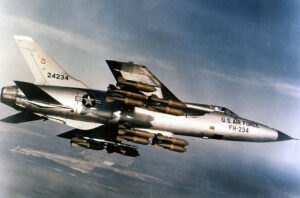 Republic F-105 Thunderchief
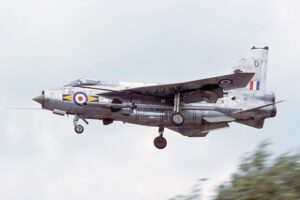 English Electric Lightning
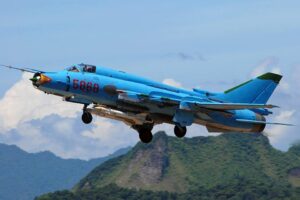 Sukhoi Su-17 Fitter (variable sweep)
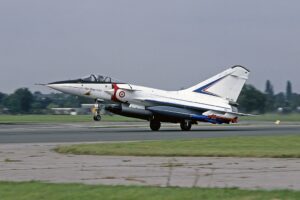 Dassault Mirage 4000