Facts summary and sources
Lockheed Have Blue: speed Mach 0.8 (source basis for this value has not been checked). First flight: 1977.
This is a secondary compilation. A source-check date applies only to the listed claim, not to the whole page or its translation. A page update is not a source check.
No claim-by-claim source checks are recorded yet.
✈️ Full Specifications
| Designation | XST (Have Blue) |
| Manufacturer | Lockheed Skunk Works |
| Country | 🇺🇸 United States |
| First flight | 1977 |
| Retired | 1979 |
| Crew | 1 |
| Length | 11.6 m (38.1 ft) |
| Wingspan | 6.9 m (22.6 ft) |
| Height | 2.3 m (7.5 ft) |
| Empty Weight | 4,082 kg (9,001 lb) |
| Max Takeoff Weight | 5,670 kg (12,502 lb) |
| Max Speed (Mach) | 0.8 |
| Speed evidence basis | Published specification |
| Max Speed | 982 km/h |
| Service Ceiling | 9,100 m (29,857 ft) |
| Range | 1,850 km (1,149 mi) |
| Engine | 2 × General Electric J85-GE-4A |
| Thrust (each) | Dry 13.1 kN |
| Production | 2 |
🌐 Operators
🔁 Variants
- HB1001 — First prototype, lost May 1978
- HB1002 — Second prototype, lost July 1979
⚔️ Armament
Overview
Lockheed Have Blue was the classified technology demonstrator that proved the faceted-surface approach to radar stealth was viable for combat aircraft. Designed by Skunk Works engineer Dick Scherrer based on the mathematical work of Denys Overholser and the Soviet physicist Pyotr Ufimtsev, the two Have Blue prototypes flew in 1977–1979 and led directly to the F-117 Nighthawk.
Design & Development
The Have Blue airframe was small — roughly 60 percent of the future F-117’s size — and built around two General Electric J85 engines, the same powerplants used in the T-38 Talon and F-5 Tiger. Surfaces were composed entirely of flat panels (facets) angled so that radar energy would be scattered away from the emitter rather than reflected back. This produced an aircraft with very low radar cross-section but poor natural aerodynamic stability; a quadruplex fly-by-wire system, derived from the F-16, kept it flyable.
The first prototype (HB1001) was completed at Burbank in late 1977 and shipped to Groom Lake (Area 51) for first flight on December 1, 1977. The second prototype (HB1002) was finished in 1978 and used to validate the radar signature in tests against operational Soviet-pattern radars at the China Lake range.
Operational History
HB1001 was lost on May 4, 1978, when test pilot Bill Park ejected after the aircraft failed to recover from a stall during landing approach. HB1002 was destroyed on July 11, 1979, after a hydraulic fire in flight; test pilot Ken Dyson ejected safely. Neither aircraft’s wreckage was publicly displayed for decades because of classification.
Despite the loss of both prototypes, the program had already accomplished its goal: validating that an operationally relevant combat aircraft could be designed with a radar cross-section orders of magnitude smaller than conventional fighters. The data fed directly into the Senior Trend program — what became the F-117A Nighthawk.
Legacy
Have Blue’s value to the United States is hard to overstate. The program produced the basic stealth doctrine, manufacturing techniques, and design language that defined every U.S. low-observable aircraft from the F-117 to the B-2 to the F-22 and B-21. Both surviving subsystems and lessons learned remain classified in part to this day.
References
- Ben R. Rich, “Skunk Works: A Personal Memoir of My Years at Lockheed” (1994)
- USAF Have Blue program declassified summary, 2014
- National Museum of the U.S. Air Force F-117 exhibit notes
Related Aircraft
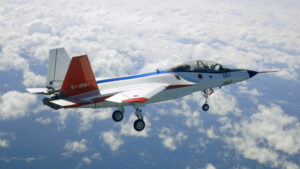 Mitsubishi X-2 ShinshinMach 1.6 · 2,000 km/h
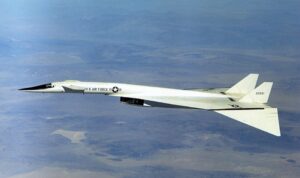 North American XB-70 ValkyrieMach 3.08 · 3,251 km/hBell X-5Mach 0.93 · 1,141 km/h
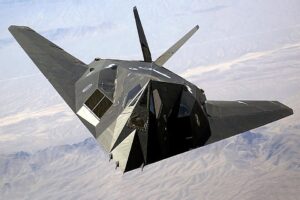 Lockheed F-117 NighthawkHow fast is the F-117? Compare its high-subsonic speed category with the museum’s 684...
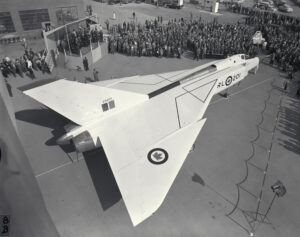 Avro Canada CF-105 ArrowHome › Aircraft › Lockheed Have Blue🇺🇸 UNITED STATESRETIREDLockheed Have BlueClassified stealth technology demonstrator...Boeing X-32Mach 1.6 · 1,931 km/h