Facts summary and sources
Northrop Tacit Blue: speed Mach 0.6 (source basis for this value has not been checked). First flight: 1982.
This is a secondary compilation. A source-check date applies only to the listed claim, not to the whole page or its translation. A page update is not a source check.
No claim-by-claim source checks are recorded yet.
✈️ Full Specifications
| Designation | Tacit Blue |
| Manufacturer | Northrop |
| Country | 🇺🇸 United States |
| First flight | 1982 |
| Retired | 1985 |
| Crew | 1 |
| Length | 17.07 m (56 ft) |
| Wingspan | 14.63 m (48 ft) |
| Height | 3.23 m (10.6 ft) |
| Empty Weight | 13,608 kg (30,006 lb) |
| Max Speed (Mach) | 0.6 |
| Speed evidence basis | Published specification |
| Max Speed | 463 km/h |
| Service Ceiling | 9,100 m (29,857 ft) |
| Engine | 2 × Garrett ATF3-6 turbofan |
| Thrust (each) | Dry 24 kN |
| Production | 1 |
🌐 Operators
🔁 Variants
- Single airframe — no variants built
⚔️ Armament
Overview
Tacit Blue was a highly classified Northrop technology demonstrator designed to validate that radar stealth could be achieved with curved surfaces rather than the faceted panels of Lockheed’s Have Blue. Built in a single airframe between 1978 and 1981, the unusual-looking aircraft (nicknamed “the Whale” by ground crew) flew 135 times between 1982 and 1985 in absolute secrecy. Its existence was not officially acknowledged until 1996.
Design & Development
Where Have Blue used flat facets to deflect radar, Tacit Blue used smoothly contoured “blended-body” surfaces and radar-absorbent skin — a fundamentally harder mathematical problem but one that promised better aerodynamics. The result was a slab-sided fuselage 56 feet long, with a flush dorsal air intake, twin Garrett ATF3-6 engines, and a straight wing of just 48 feet of span. The aircraft was deliberately ugly: every line existed to minimise its radar signature, not to look good.
The intended mission was airborne surveillance — to act as a battlefield reconnaissance platform that could orbit over enemy territory undetected, feeding targeting data to other assets. The technology proved out, but the operational mission was later folded into other (then-classified) programs.
Operational History
Tacit Blue’s first flight was on February 5, 1982, at Groom Lake, with Northrop test pilot Richard Thomas at the controls. The aircraft flew 135 sorties over the following three years, often three or four times per week. No accidents or major incidents occurred. The program ended in 1985 with all objectives met and the aircraft put into storage.
The single Tacit Blue airframe was declassified and publicly displayed for the first time on April 30, 1996, at Wright-Patterson AFB. It remains on permanent display at the National Museum of the U.S. Air Force.
Legacy
Tacit Blue’s curved-surface stealth approach directly informed the design of the Northrop Grumman B-2 Spirit bomber and, in modified form, the later B-21 Raider. The program demonstrated that stealth was not married to the faceted “diamond” aesthetic of Have Blue and F-117, opening the door to the cleaner, more aerodynamic stealth aircraft that would dominate the 1990s onward.
References
- USAF declassified Tacit Blue press release, 30 April 1996
- National Museum of the U.S. Air Force exhibit notes
- “Tacit Blue: Stealth’s Forgotten Whale” — Air & Space Magazine, 2014
Related Aircraft
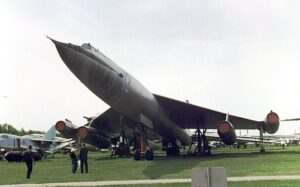 Myasishchev M-50 BounderMach 1.59 · 1,950 km/h
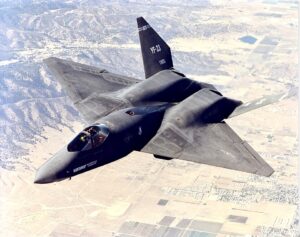 Northrop YF-23 Black Widow IIHome › Aircraft › Northrop Tacit Blue🇺🇸 UNITED STATESRETIREDNorthrop Tacit BlueClassified curved-surface stealth demonstrator...
 Sukhoi Su-75 CheckmateMach 1.8 [projected]
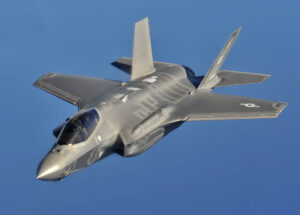 Lockheed Martin F-35 Lightning IIMach 1.6 · 1,931 km/hConvair KingfishConvair Kingfish never flew. Explore its Mach 3.2 design cruise, the difference from FISH...Bell X-5Mach 0.93 · 1,141 km/h