Facts summary and sources
Republic XF-91 Thunderceptor: speed Mach 1.18 (source basis for this value has not been checked). First flight: 1949.
This is a secondary compilation. A source-check date applies only to the listed claim, not to the whole page or its translation. A page update is not a source check.
No claim-by-claim source checks are recorded yet.
✈️ Full Specifications
| Designation | XF-91 |
| Manufacturer | Republic Aviation |
| Country | 🇺🇸 United States |
| First flight | 1949 |
| Retired | 1955 |
| Crew | 1 |
| Length | 13 m (42.7 ft) |
| Wingspan | 9.5 m (31.2 ft) |
| Height | 5.5 m (18 ft) |
| Empty Weight | 6,800 kg (14,994 lb) |
| Max Takeoff Weight | 12,600 kg (27,783 lb) |
| Max Speed (Mach) | 1.18 |
| Speed evidence basis | Published specification |
| Max Speed | 1,448 km/h (900 mph) |
| Service Ceiling | 17,800 m (58,402 ft) |
| Range | 1,175 km (730 mi) |
| Engine | 1 × General Electric J47-GE-3 + Reaction Motors XLR11 rocket |
| Thrust (each) | Dry 24.1 kN · AB 53 kN |
| Production | 2 |
🌐 Operators
🔁 Variants
- XF-91 #1 (46-680) — Original wing+rocket configuration
- XF-91 #2 (46-681) — V-tail test variant
⚔️ Armament
Overview
The Republic XF-91 Thunderceptor was a 1950s mixed-power point-defence interceptor designed to climb very fast to intercept incoming Soviet bombers. It combined a conventional General Electric J47 turbojet for sustained flight with a four-chamber Reaction Motors XLR11 rocket for boost — and was the only U.S. fighter aircraft ever flown with reverse-taper wings (wider at the tip than at the root). Only two prototypes were built before the program was cancelled in favour of all-jet interceptors like the F-102.
Design & Development
The XF-91 emerged from an Army Air Forces 1946 requirement for a point-defence interceptor that could match Soviet jet bombers entering service in the late 1940s. Republic’s response was bold: rather than rely on a single engine, the XF-91 paired a J47 turbojet (4.4 kN thrust) with a 26.7 kN four-chamber rocket motor in the tail, fed by liquid oxygen and high-test peroxide.
The wings were the most unusual feature: reverse taper, with the leading edge sweeping forward toward the tips. This counterintuitive shape was chosen to alleviate the tip-stall problem common to swept wings at low speeds. The wings could also be adjusted in incidence in flight — the entire wing pivoted on its main spar to change angle of attack relative to the fuselage. Both features were unique to the XF-91.
Operational History
The first XF-91 (46-680) flew on May 9, 1949, with Republic test pilot Carl Bellinger at the controls. The rocket was first lit in flight on December 9, 1952 — at which point the aircraft became the first U.S. fighter to exceed Mach 1 in level flight (briefly held against the F-100 Super Sabre). The second prototype (46-681) tested an alternative V-tail configuration before being scrapped.
The mixed-power concept proved its physics but failed the practicality test. The rocket fuel was dangerous to handle, the engines had radically different operating procedures, and overall jet-engine improvements were making rocket boost unnecessary. By 1955 the program was wound down. Both airframes ultimately ended up in storage; one is on display at the National Museum of the U.S. Air Force.
Legacy
The XF-91 is the closest the United States ever came to fielding a rocket-boosted interceptor of the kind the Soviet Union actually deployed (MiG-19, MiG-21 derivatives with rocket boosters, plus the unique Mikoyan SM-50). Its real importance was negative: by demonstrating that mixed-power configurations were too operationally complex, the XF-91 cleared the way for the all-jet Convair F-102 and F-106 to dominate U.S. air defence into the 1980s.
References
- USAF flight test reports, 1949–1955
- “Republic XF-91 Thunderceptor” — Aerofax Datagraph series
- National Museum of the U.S. Air Force exhibit notes
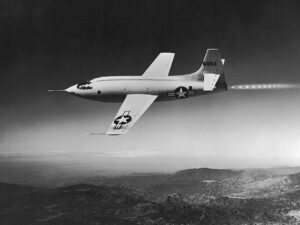 Bell X-1
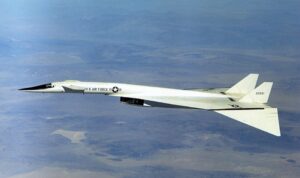 North American XB-70 Valkyrie
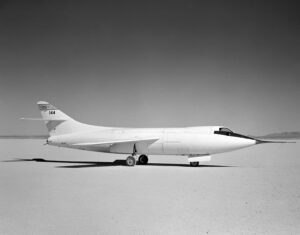 Douglas D-558-II Skyrocket
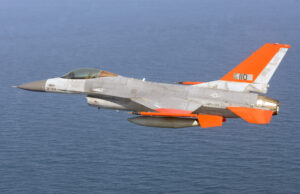 Boeing QF-16
 Yakovlev Yak-28 Brewer