Facts summary and sources
Northrop YF-17 Cobra: speed Mach 1.95 (source basis for this value has not been checked). First flight: 1974.
This is a secondary compilation. A source-check date applies only to the listed claim, not to the whole page or its translation. A page update is not a source check.
No claim-by-claim source checks are recorded yet.
✈️ Full Specifications
| Designation | YF-17 Cobra |
| Manufacturer | Northrop |
| Country | 🇺🇸 United States |
| First flight | 1974 |
| Retired | 1980 |
| Crew | 1 |
| Length | 17.1 m (56.1 ft) |
| Wingspan | 10.6 m (34.8 ft) |
| Height | 4.6 m (15.1 ft) |
| Empty Weight | 7,800 kg (17,199 lb) |
| Max Takeoff Weight | 11,340 kg (25,005 lb) |
| Max Speed (Mach) | 1.95 |
| Speed evidence basis | Published specification |
| Max Speed | 2,092 km/h (1,300 mph) |
| Service Ceiling | 15,240 m (50,002 ft) |
| Range | 1,480 km (919 mi) |
| Engine | 2 × General Electric YJ101-GE-100 |
| Thrust (each) | Dry 32.5 kN · AB 67 kN |
| Production | 2 |
🌐 Operators
🔁 Variants
- YF-17 — Lightweight Fighter prototype
- Seed for the F/A-18 Hornet program (1976+)
⚔️ Armament
Overview
The Northrop YF-17 Cobra was developed in the early 1970s as Northrop’s entry in the U.S. Air Force’s Lightweight Fighter (LWF) competition. The YF-17 lost the contest to General Dynamics’ YF-16 in January 1975, but in losing it found a new life: the U.S. Navy adopted a developed version of the design as the F/A-18 Hornet, eventually becoming one of the most prolific naval fighters of the late 20th century and the basis for today’s Super Hornet and EA-18G Growler.
Design & Development
The YF-17 grew out of Northrop’s P-530 Cobra studies of the late 1960s — an attempt to apply the lessons of the F-5 Tiger II into a higher-performance day fighter. Northrop chose a twin-engine layout (two General Electric YJ101 turbojets) for redundancy at the cost of complexity. The design featured leading-edge root extensions (LERX) blended into the wing, twin canted vertical stabilisers, and a relatively conventional fuselage.
Two prototypes were built and flew in 1974. While both the YF-16 and YF-17 met the LWF performance requirements, the YF-16 was faster, lighter, and (controversially) used a derivative of the same F100 engine as the F-15 Eagle — a powerful logistics argument. The YF-17 was selected by the Navy in May 1975 for further development into a carrier-capable strike fighter, becoming the F/A-18.
Operational History
The first YF-17 (72-1569) flew on June 9, 1974, with Northrop test pilot Hank Chouteau at the controls. The aircraft demonstrated supersonic performance on its second flight and exceeded Mach 1 in a climb during the LWF flyoff. Both prototypes accumulated over 280 test flights before the LWF down-select to the F-16 in January 1975.
The two YF-17 airframes were transferred to NASA’s Dryden Flight Research Center, where they served as testbeds into the early 1980s. Both are now in museums — one at the Western Museum of Flight in Torrance, California, the other at NASA Dryden / Edwards AFB.
Legacy
The YF-17 lost its battle but won its war. As the F/A-18 Hornet, the design entered service in 1983, was the foundation of the F/A-18E/F Super Hornet (which entered service in 2001), and gave rise to the EA-18G Growler electronic attack aircraft. As of 2026, more than 1,500 Hornet-family aircraft have been built across the Hornet and Super Hornet families — vastly more than the F-16-line production numbers would suggest from the LWF source-selection decision.
References
- USAF Lightweight Fighter program documentation, 1974–1975
- Northrop YF-17 Cobra program history, Northrop archives
- “Hornet: McDonnell Douglas F/A-18” by Robert F. Dorr
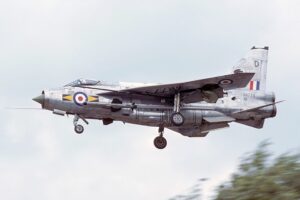 English Electric Lightning
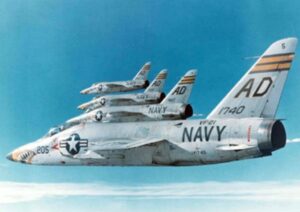 Grumman F-11 Tiger
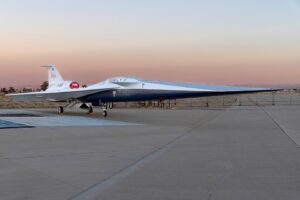 Lockheed Martin X-59 QueSST
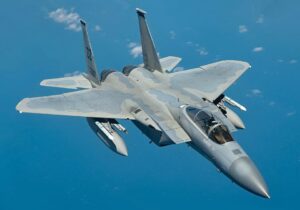 McDonnell Douglas F-15 Eagle
 Dassault Mirage 4000