Facts summary and sources
Tupolev Tu-123 Yastreb: speed field: Mach 2.3 (database value; evidence basis not recorded). First flight: 1960.
This is a secondary compilation. A source-check date applies only to the listed claim, not to the whole page or its translation. A page update is not a source check.
Sources and check records
- Wikipedia reference · Source-check date not recorded
✈️ Full Specifications
| Designation | Tu-123 (DBR-1) |
| Manufacturer | Tupolev (built at Voronezh Aviation Factory No. 64) |
| Country | 🇷🇺 Soviet Union |
| First flight | 1960 |
| Service Entry | 1964 |
| Retired | 1979 |
| Length | 27.84 m (91.3 ft) |
| Wingspan | 8.41 m (27.6 ft) |
| Height | 4.78 m (15.7 ft) |
| Empty Weight | 11,450 kg (25,247 lb) |
| Max Takeoff Weight | 35,610 kg (78,520 lb) |
| Max Speed (Mach) | 2.3 |
| Speed evidence basis | Published specification |
| Max Speed | 2,700 km/h (1,675 mph) |
| Service Ceiling | 22,800 m (74,807 ft) |
| Range | 3,200 km (1,987 mi) |
| Engine | 1 × 1 × Tumansky R-15 (KR-15) afterburning turbojet, ~98.1 kN thrust |
| Thrust (each) | AB 98.1 kN |
| Production | 52 |
🌐 Operators
🔁 Variants
- Tu-123 (DBR-1) — production expendable long-range reconnaissance drone
- Tu-139 Yastreb-2 — proposed fully recoverable derivative; developed but not put into series production
⚔️ Armament
Overview
The Tupolev Tu-123 Yastreb (“Hawk”), officially designated DBR-1, was a Soviet supersonic long-range unmanned reconnaissance drone developed in the early 1960s. Capable of roughly Mach 2.3 at high altitude, it was designed to overfly heavily defended territory at speeds and heights that made interception impractical for the era’s defenses. Rather than returning intact, the expendable vehicle carried its cameras and signals-intelligence gear in a recoverable nose section that parachuted to the ground after the mission.
Design & Development
Derived from Tupolev’s cruise-missile and high-speed aircraft work, the Tu-123 was a large, sharply swept delta of about 27.8 m in length with a maximum takeoff weight of some 35,610 kg, most of it fuel. A single Tumansky R-15-series afterburning turbojet propelled it along a pre-programmed route, climbing from around 19,000 m to over 22,000 m as fuel burned off. The aircraft was launched from a mobile ground trailer using booster rockets rather than a runway. A recoverable forward compartment housed the photographic cameras and ELINT equipment; the remainder of the airframe was expended. A fully recoverable follow-on, the Tu-139 Yastreb-2, was developed but never entered series production.
Operational History
The Tu-123 entered Soviet Air Force service in 1964 and served through the 1970s, with about 52 examples built between 1964 and 1972. It was intended to conduct deep reconnaissance over Western Europe and other contested regions where sending manned aircraft carried high political and physical risk. As reconnaissance satellites matured and offered comparable coverage without overflight, the drone’s role diminished, and the type was retired around 1979. Surviving examples are preserved in Russian aviation collections.
Related Aircraft
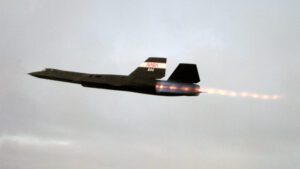 Lockheed Martin SR-72 Son of BlackbirdMach 6.0 [projected]
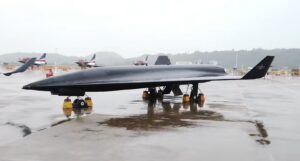 AVIC WZ-8Mach 3 · 3,704 km/h
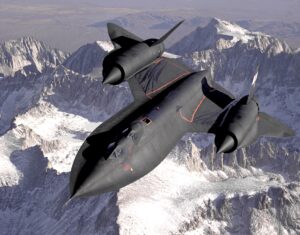 Lockheed SR-71 BlackbirdMach 3.3 · 3,530 km/hConvair KingfishConvair Kingfish never flew. Explore its Mach 3.2 design cruise, the difference from FISH...
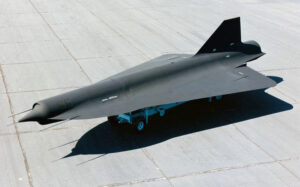 Lockheed D-21Mach 3.35 · 3,600 km/h
 North American A-5 VigilanteMach 2.0 · 2,123 km/h