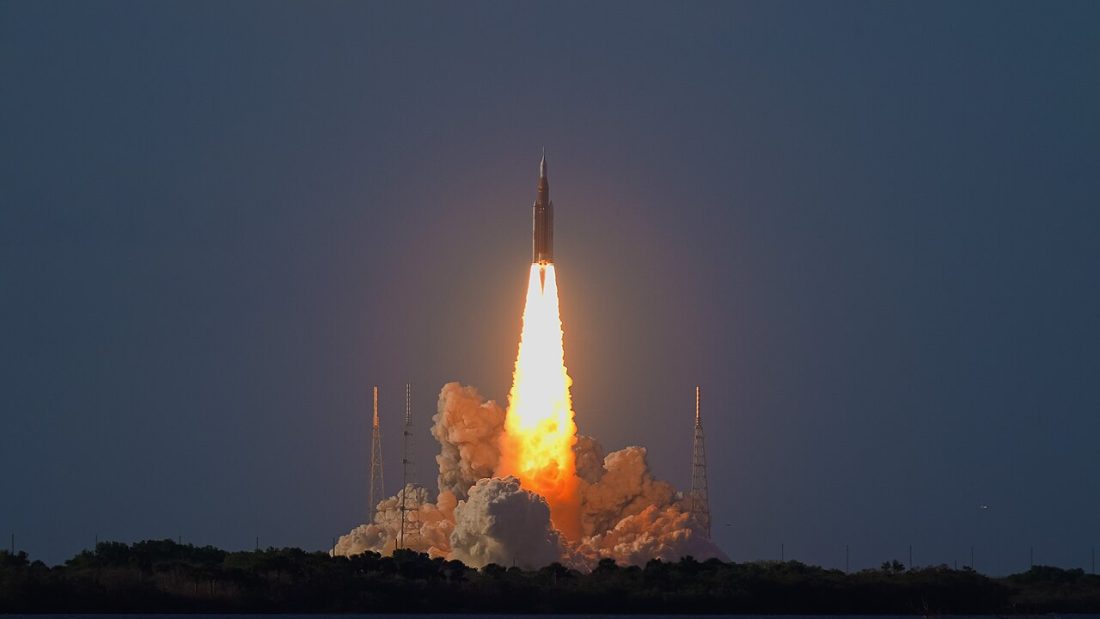
On April 1, 2026, NASA’s Artemis II lifted off from Kennedy Space Center carrying four astronauts — Reid Wiseman, Victor Glover, Christina Koch and Canada’s Jeremy Hansen — on a roughly ten-day flight around the Moon. It was the first crewed mission beyond low Earth orbit since Apollo 17 in 1972, and the crew splashed down safely in the Pacific on April 10, Pacific Daylight Time (April 11 UTC).
A record-setting loop around the Moon
Artemis II was a free-return flyby: the giant Space Launch System threw the Orion capsule onto a path that curved around the far side of the Moon and let lunar gravity sling it back home — no landing, no orbit insertion. At their farthest point the crew were 252,756 miles (about 407,000 km) from Earth, a new record for the greatest distance humans have ever travelled from home.
A crew of firsts
Commander Reid Wiseman led a crew that rewrote several records at once. Christina Koch became the first woman to travel beyond low Earth orbit, Victor Glover the first person of color, and Jeremy Hansen the first Canadian — the first time anyone but an American had flown so far from Earth. For all four, it was a journey no human had made in fifty years.
The dress rehearsal for a landing
The mission tested Orion’s life-support, navigation and communications systems in deep space, providing data for further assessment rather than certifying every future capability at once. NASA changed its architecture in February 2026: Artemis III is planned as an Earth-orbit systems demonstration in 2027, while Artemis IV targets the first landing in 2028. SpaceX’s Starship human landing system is part of the continuing development effort. Artemis II is a new milestone on our Space Timeline.
Image: NASA / Artemis II launch (public domain).
Explore the machines and milestones behind this mission in the Space Timeline and the full Spacecraft Encyclopedia.