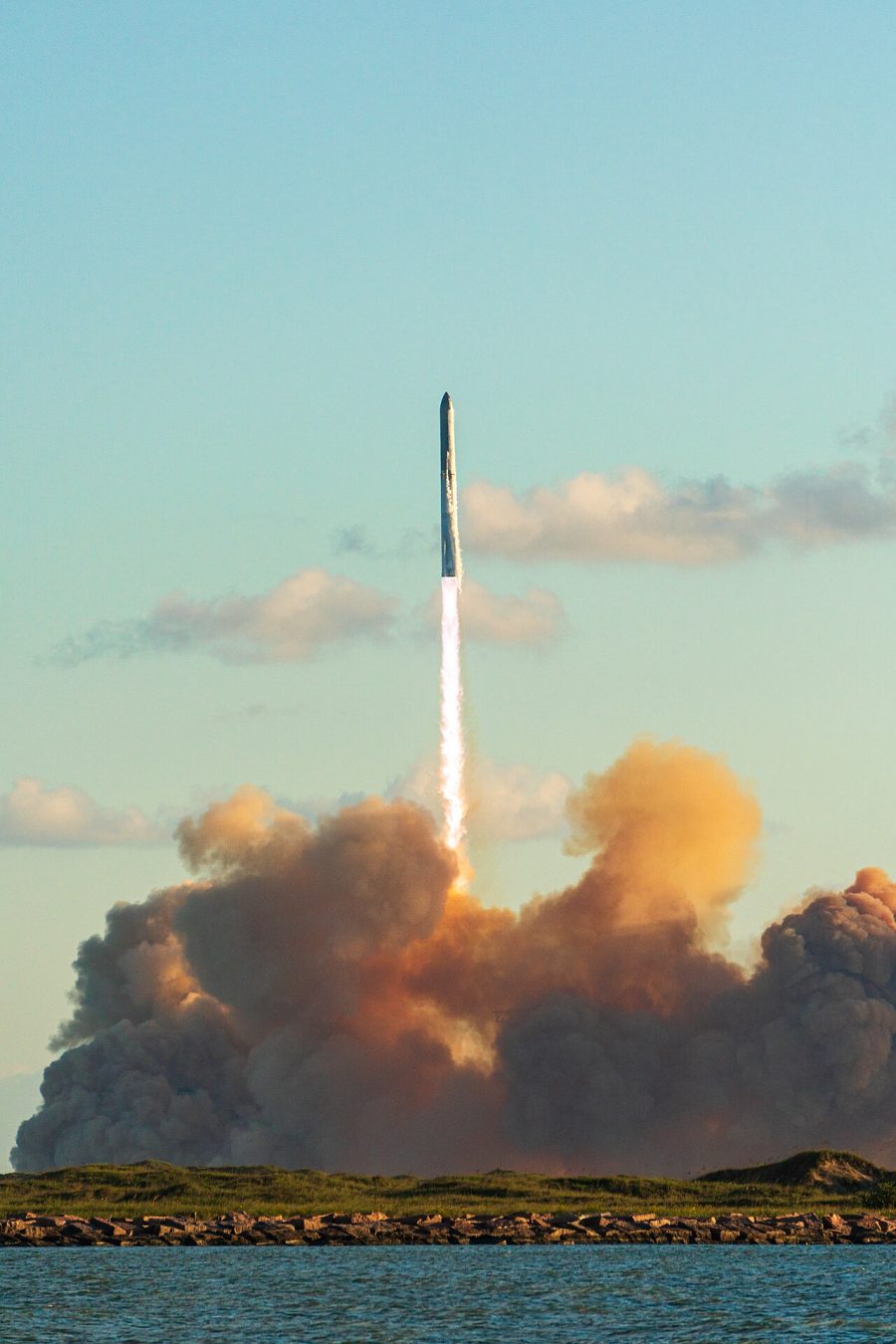
On May 22, 2026, SpaceX flew the first Version 3 of Starship — the biggest and most powerful iteration yet, standing about 124 metres (408 ft) tall — on Flight 12. The vehicle reached space, released 20 mock Starlink satellites, and came down under control in the Indian Ocean. The original report listed July 15 as a target for Flight 13. SpaceX’s later mission record confirms that the flight actually launched on July 24, 2026.
A bigger, hotter Starship
Starship V3 is the first version built around SpaceX’s new Raptor 3 engine — lighter, simpler and more powerful than the Raptors that came before. Fully stacked on its Super Heavy booster, Starship remains the largest and most powerful rocket ever built, dwarfing even the Saturn V that launched Apollo. The full story of how it works sits in our Rockets & Launch Vehicles guide and the Starship encyclopedia entry.
What Flight 12 achieved — and what it didn’t
The mission cleared several firsts for the new design: it flew halfway around the world, deployed its 20 dummy Starlinks, and splashed down upright before toppling over and igniting, as expected for an ocean landing. It was not flawless — not every engine lit as the booster attempted its controlled return, and the ship pressed on with fewer engines than planned. For SpaceX, that is the point: each flight is a test, flown to failure where necessary to learn fast and fix faster.
Why it matters
Starship is also part of NASA’s human landing system development through its HLS variant. Under NASA’s revised 2026 architecture, Artemis III is an Earth-orbit demonstration mission and Artemis IV targets the first lunar landing. SpaceX also aims to develop reusable cargo and crew transport to Mars. These ambitions require further reliability, propellant-transfer and mission-system demonstrations; the V3 flight test is one development step, not proof of an operational lunar or Mars transport system.
Image: Starship flight-test liftoff by Shujianyang, via Wikimedia Commons (CC BY-SA 4.0).
See how Starship stacks up against every major launch vehicle in our Rockets & Launch Vehicles guide, or read the How Rockets Work explainer.