Facts summary and sources
Boeing X-32: speed Mach 1.6 (source basis for this value has not been checked). First flight: 2000.
This is a secondary compilation. A source-check date applies only to the listed claim, not to the whole page or its translation. A page update is not a source check.
No claim-by-claim source checks are recorded yet.
✈️ Full Specifications
| Designation | X-32A / X-32B |
| Manufacturer | Boeing |
| Country | 🇺🇸 United States |
| First flight | 2000 |
| Retired | 2001 |
| Crew | 1 |
| Length | 13.72 m (45 ft) |
| Wingspan | 10.97 m (36 ft) |
| Height | 4.06 m (13.3 ft) |
| Empty Weight | 10,886 kg (24,004 lb) |
| Max Takeoff Weight | 22,680 kg (50,009 lb) |
| Max Speed (Mach) | 1.6 |
| Speed evidence basis | Published specification |
| Max Speed | 1,931 km/h (1,200 mph) |
| Service Ceiling | 15,240 m (50,002 ft) |
| Range | 1,389 km (863 mi) |
| Engine | 1 × Pratt & Whitney F119-PW-614 |
| Thrust (each) | Dry 116 kN · AB 191 kN |
| Production | 2 |
🌐 Operators
🔁 Variants
- X-32A — CTOL demonstrator
- X-32B — STOVL demonstrator with direct-lift propulsion
⚔️ Armament
Overview
The Boeing X-32 was a concept demonstrator aircraft developed for the U.S. Joint Strike Fighter (JSF) program. Boeing built two prototypes — the X-32A (Conventional Takeoff and Landing) and the X-32B (Short Takeoff and Vertical Landing) — to compete head-to-head against Lockheed Martin’s X-35. In October 2001, Lockheed Martin’s design was selected, and the X-32 program ended without entering production. The X-32 nonetheless remains historically important as the runner-up in what is arguably the most consequential fighter competition of the 21st century.
Design & Development
Boeing’s design used a single Pratt & Whitney F119 engine and a distinctive chin-mounted air intake that gave the prototype an unmistakable “smiling” appearance from the front. The original delta wing was intended to maximise commonality between the three variants (Air Force, Navy, Marines) and reduce production costs, a key JSF requirement. Late in the program Boeing was forced to redesign the wing into a more conventional planform, but the prototypes that actually flew retained the original delta.
For STOVL, the X-32B used a direct-lift system that diverted engine thrust through fuselage-mounted nozzles — fundamentally different from the X-35B’s shaft-driven lift fan. The direct-lift approach was simpler and lighter on paper but suffered from severe hot-gas reingestion during hover testing, which degraded thrust and made the aircraft difficult to control near the ground. This shortcoming proved decisive in the source-selection decision.
Program History
The X-32A first flew on September 18, 2000, at Edwards AFB. The X-32B followed on March 29, 2001, and demonstrated transition from vertical lift to horizontal flight in July 2001. On October 26, 2001, the Department of Defense announced that Lockheed Martin’s X-35 had won the JSF competition. Both X-32 prototypes were retired to museums — the X-32A is on display at the National Museum of the U.S. Air Force in Dayton, Ohio, and the X-32B at the Patuxent River Naval Air Museum.
Legacy
The X-32 remains a prototype from the Joint Strike Fighter competition. Its loss reshaped Boeing’s defense business and accelerated Lockheed Martin’s rise to dominance in the U.S. fighter market. The chin intake aesthetic continues to influence concept art and modelling communities, and the program remains a standard case study in defense procurement courses on how a technically interesting design can be beaten by a more operationally credible one.
References
- U.S. Air Force JSF program documentation, 2001
- Boeing X-32 flight test reports, 2000–2001
- National Museum of the U.S. Air Force exhibit notes
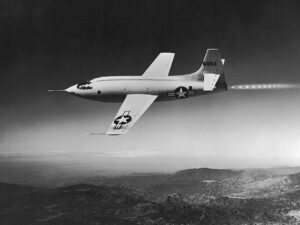 Bell X-1
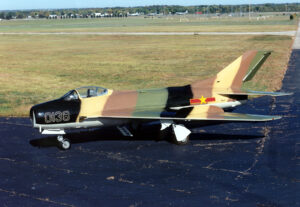 Mikoyan-Gurevich MiG-19 Farmer
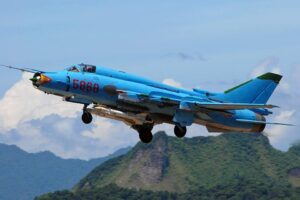 Sukhoi Su-17 Fitter (variable sweep)
 Sukhoi Su-75 Checkmate
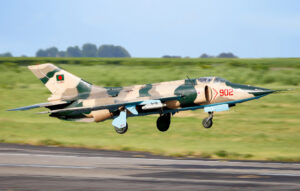 Nanchang Q-5 Fantan