Facts summary and sources
Convair F2Y Sea Dart: speed Mach 1.25 (source basis for this value has not been checked). First flight: 1953.
This is a secondary compilation. A source-check date applies only to the listed claim, not to the whole page or its translation. A page update is not a source check.
No claim-by-claim source checks are recorded yet.
✈️ Full Specifications
| Designation | F2Y-1 / YF2Y-1 |
| Manufacturer | Convair |
| Country | 🇺🇸 United States |
| First flight | 1953 |
| Retired | 1956 |
| Crew | 1 |
| Length | 16 m (52.5 ft) |
| Wingspan | 10.3 m (33.8 ft) |
| Height | 4.92 m (16.1 ft) |
| Empty Weight | 5,730 kg (12,635 lb) |
| Max Takeoff Weight | 7,480 kg (16,493 lb) |
| Max Speed (Mach) | 1.25 |
| Speed evidence basis | Published specification |
| Max Speed | 1,325 km/h (823 mph) |
| Service Ceiling | 16,800 m (55,121 ft) |
| Range | 826 km (513 mi) |
| Engine | 2 × Westinghouse J46-WE-2 turbojets |
| Thrust (each) | Dry 14.7 kN · AB 27.1 kN |
| Production | 5 |
🌐 Operators
🔁 Variants
- XF2Y-1 — Single prototype with single ski
- YF2Y-1 — Four pre-production aircraft with twin skis
⚔️ Armament
Overview
The Convair F2Y Sea Dart is the only seaplane ever to exceed the speed of sound. Developed in the early 1950s for the U.S. Navy as a potential answer to the problem of operating supersonic fighters from carriers whose decks were not yet long enough, the Sea Dart used retractable hydro-skis to take off and land from water. Only five aircraft were built before the program ended, but the design remains a one-of-a-kind achievement in supersonic aviation history.
Design & Development
The Sea Dart used a delta wing — Convair’s signature shape of the era — and twin Westinghouse J46 engines mounted high above the fuselage to keep their intakes out of spray. Underneath, two retractable hydro-skis extended for water operations and retracted into the fuselage for flight. The first prototype, BuNo 137634, was launched at San Diego Bay on January 14, 1953.
Hydrodynamic problems plagued the design. The original single-ski configuration vibrated violently during high-speed taxi, and the production-intent twin-ski layout was only marginally better. The J46 engines were also underpowered for sustained supersonic flight; the design speed of Mach 1.25 was never reliably achieved in operational testing.
Operational History
On August 3, 1954, test pilot Charles E. Richbourg pushed the second YF2Y-1 past Mach 1 in a shallow dive — making the Sea Dart the first and only seaplane ever to break the sound barrier. The flight is officially recognized but considered marginal: the airframe was not stable above Mach 1, and the Navy was already cooling on the concept by then. On November 4, 1954, the same airframe broke up in mid-air over San Diego Bay, killing Richbourg.
With angled flight decks and the steam catapult solving the supersonic-carrier problem, the Navy quietly cancelled the program in 1956. Two airframes survive — one at the San Diego Air & Space Museum and one at the Wings Over the Rockies Museum.
Legacy
The F2Y Sea Dart represents a road not taken in carrier aviation. Modern catapult and arresting-gear technology, combined with larger carriers, made the seaplane fighter concept obsolete almost as soon as the prototypes flew. The Sea Dart demonstrated that supersonic flight from water was possible, even if the operational case never materialised.
References
- U.S. Navy YF2Y-1 flight test reports, 1953–1955
- San Diego Air & Space Museum collection records
- “Convair Advanced Designs” by Robert E. Bradley
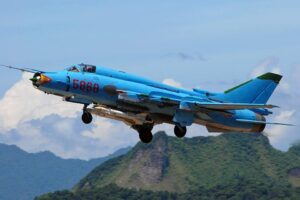 Sukhoi Su-17 Fitter (variable sweep)
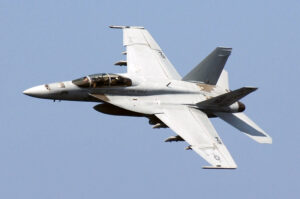 Boeing F/A-18E/F Super Hornet
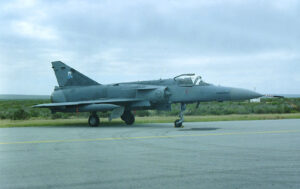 Atlas Cheetah
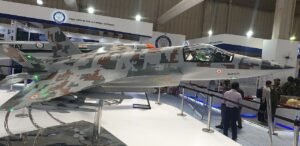 Hindustan AMCA
 TAI TF-X Kaan