✈️ Full Specifications
| Designation | X-51A |
| Manufacturer | Boeing (airframe), Pratt & Whitney Rocketdyne (engine) |
| Country | 🇺🇸 United States |
| First Flight | 2010 |
| Retired | 2013 |
| Length | 7.62 m (25 ft) |
| Empty Weight | 1,814 kg (4,000 lb) |
| Max Takeoff Weight | 1,814 kg (4,000 lb) |
| Max Speed (Mach) | 5.1 |
| Max Speed | 6,200 km/h (3,900 mph) |
| Service Ceiling | 21,300 m (69,885 ft) |
| Range | 740 km (460 mi) |
| Engine | 1 × Pratt & Whitney Rocketdyne SJY61 scramjet (JP-7 fueled), boosted by an MGM-140 ATACMS-derived solid rocket booster to ~Mach 4.5 |
| Production | 4 |
🌐 Operators
🔁 Variants
- X-51A — the only built variant; four flight-test vehicles were produced under the Scramjet Engine Demonstrator (SED-WR) program.
⚔️ Armament
Overview
The Boeing X-51A Waverider was an uncrewed experimental aircraft built to demonstrate sustained hypersonic flight using a supersonic-combustion ramjet, or scramjet. It was a cooperative effort of the United States Air Force, DARPA, NASA, Boeing and Pratt & Whitney Rocketdyne, taking its name from the “waverider” lifting-body shape that rides its own shock wave to generate lift. The vehicle was designed to cruise at about Mach 5 (roughly 5,300 km/h) at an altitude near 70,000 feet (21,300 m), and in its final flight it reached Mach 5.1.
Design & Development
The X-51A stack measured about 7.62 m (25 ft) in length and weighed roughly 1,814 kg (4,000 lb). It could not take off on its own: a modified MGM-140 ATACMS solid rocket booster accelerated it to approximately Mach 4.5, after which the interstage was jettisoned and the Pratt & Whitney Rocketdyne SJY61 scramjet ignited. Because a scramjet produces no static thrust and works only at high supersonic speed, the vehicle had no conventional turbine, afterburner or dry-thrust rating. It burned JP-7 fuel — the same fuel used by the SR-71 — carrying about 120 kg (270 lb) on board. The airframe used its own compression lift as a waverider, dispensing with conventional wings.
Operational History
Four vehicles were built, air-launched from a B-52 Stratofortress off the California coast. The first flight, on 26 May 2010, reached about Mach 5 and flew for over 200 seconds with roughly 140 seconds of scramjet power, then the longest scramjet burn achieved. The second flight (13 June 2011) ended early after an inlet unstart and a failed fuel-mode transition, and the third (14 August 2012) was lost when a control fin unlocked shortly after separation.
The fourth and final flight, on 1 May 2013, was a full success: the X-51A accelerated to Mach 5.1 and sustained scramjet-powered flight for 210 seconds — the longest air-breathing hypersonic flight on record — before the fuel was exhausted and the vehicle broke up on splashdown as planned. With no more test articles remaining, the program concluded, having validated scramjet technology that informed later U.S. hypersonic weapon and vehicle efforts.
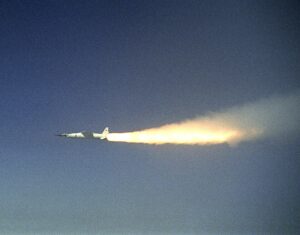 NASA X-43A
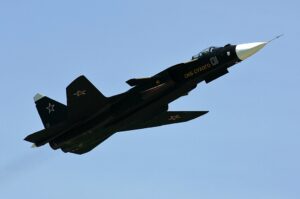 Sukhoi Su-47 Berkut
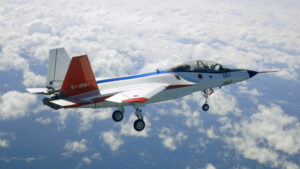 Mitsubishi X-2 Shinshin
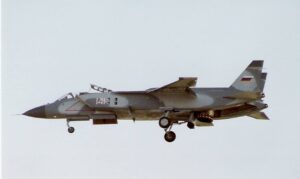 Yakovlev Yak-141 Freestyle
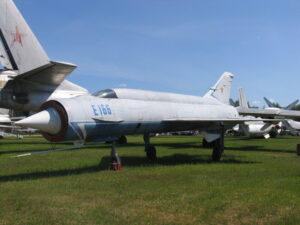 Mikoyan Ye-152 (MiG-21 variant)
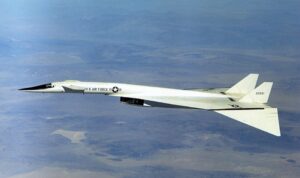 North American XB-70 Valkyrie