Facts summary and sources
KAI T-50 Golden Eagle: speed Mach 1.5 (source basis for this value has not been checked). First flight: 2002.
This is a secondary compilation. A source-check date applies only to the listed claim, not to the whole page or its translation. A page update is not a source check.
No claim-by-claim source checks are recorded yet.
✈️ Full Specifications
| Designation | T-50 / TA-50 / FA-50 |
| Manufacturer | Korea Aerospace Industries (KAI) |
| Country | 🇰🇷 South Korea |
| First flight | 2002 |
| Service Entry | 2005 |
| Crew | 2 |
| Length | 13.14 m (43.1 ft) |
| Wingspan | 9.45 m (31 ft) |
| Height | 4.94 m (16.2 ft) |
| Empty Weight | 6,470 kg (14,266 lb) |
| Max Takeoff Weight | 13,500 kg (29,768 lb) |
| Max Speed (Mach) | 1.5 |
| Speed evidence basis | Published specification |
| Max Speed | 1,837 km/h (1,141 mph) |
| Service Ceiling | 14,630 m (48,001 ft) |
| Range | 1,851 km (1,149 mi) |
| Climb Rate | 198 m/s (38976 ft/min) |
| Engine | 1 × General Electric F404-GE-102 |
| Thrust (each) | Dry 53.1 kN · AB 78.7 kN |
| Production | 220 |
| Unit Cost | $30.0M USD |
🌐 Operators
🔁 Variants
- T-50 — Lead-in fighter trainer
- T-50B — Aerobatic display variant (ROKAF Black Eagles)
- TA-50 — Light attack with gun and weapons hardpoints
- FA-50 — Multirole light fighter with radar and BVR upgrade path
- FA-50PL Block 20 — Polish standard with EL/M-2032 radar
⚔️ Armament
Overview
The KAI T-50 Golden Eagle is a family of South Korean supersonic trainer and light combat aircraft, developed by Korea Aerospace Industries (KAI) with Lockheed Martin as technology partner. Sharing significant DNA with the F-16 Fighting Falcon, the T-50 first flew in 2002 and has since spawned the TA-50 light attack, FA-50 Fighting Eagle multirole, and a growing list of export customers including Poland, the Philippines, Iraq, Indonesia, and Malaysia. The aircraft is the foundation of South Korea’s emergence as a serious fighter exporter.
Design & Development
The T-50 program was initiated in 1992 as a partnership between KAI (then Samsung Aerospace) and Lockheed Martin to provide a supersonic advanced trainer for the Republic of Korea Air Force (ROKAF) to replace ageing T-38 Talons and F-5 Tigers. Lockheed Martin contributed F-16 systems and design heritage — most visibly in the wing planform and the F404-GE-102 engine.
The T-50 first flew on August 20, 2002, with KAI test pilot Lee Yeong-hwan. The trainer entered ROKAF service in 2005, with the more capable FA-50 (with multifunction radar, hardpoints for AIM-9 Sidewinder, JDAM, and other weapons) entering service in 2013.
Operational History
By 2026, more than 200 T-50-family aircraft have been built. The aircraft is in service with South Korea (ROKAF aerobatic team Black Eagles fly the T-50B variant), Indonesia, Iraq, the Philippines, Thailand, Poland (which signed a $3 billion FA-50 contract in 2022), and Malaysia. The FA-50 has seen combat in the Philippines’ counter-insurgency operations against Abu Sayyaf and in Iraq against ISIS.
Capabilities
The T-50 is roughly equivalent in performance to early-block F-16s — it shares the wing planform, uses the same F404 engine family, and the FA-50 variant carries AIM-9 Sidewinder, AGM-65 Maverick, and a range of guided bombs. With the EL/M-2032 radar (Block 20 FA-50PL) the aircraft gains a credible BVR capability with AIM-120 AMRAAM integration in progress. The FA-50 is widely regarded as the most capable supersonic light fighter under $50 million flyaway.
References
- KAI T-50 program documentation, 2002–2024
- ROKAF T-50 / FA-50 operational summaries
- Polish FA-50 contract documentation, 2022
Related Aircraft
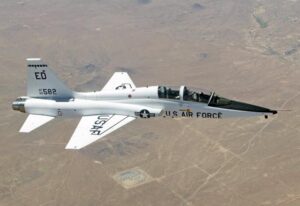 Northrop T-38 TalonMach 1.23 · 1,381 km/hMitsubishi T-2Mach 1.6 · 1,700 km/h
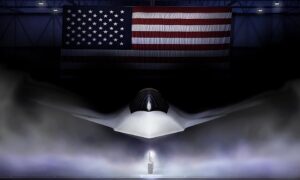 Boeing F-47 NGADHome › Aircraft › KAI T-50 Golden Eagle🇰🇷 SOUTH KOREAIN SERVICEKAI T-50 Golden EagleSupersonic...
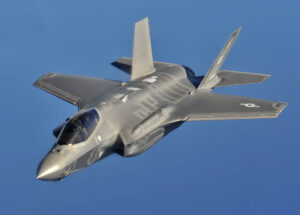 Lockheed Martin F-35 Lightning IIMach 1.6 · 1,931 km/h
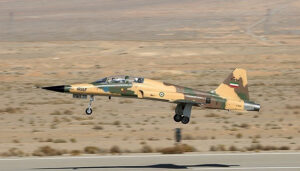 HESA KowsarMach 1.4 · 1,700 km/h
 Chengdu J-20 Mighty DragonHome › Aircraft › KAI T-50 Golden Eagle🇰🇷 SOUTH KOREAIN SERVICEKAI T-50 Golden EagleSupersonic...