Facts summary and sources
Sukhoi Su-37 Flanker-F: speed Mach 2.35 (source basis for this value has not been checked). First flight: 1996.
This is a secondary compilation. A source-check date applies only to the listed claim, not to the whole page or its translation. A page update is not a source check.
No claim-by-claim source checks are recorded yet.
✈️ Full Specifications
| Designation | Su-37 (Bort 711) |
| Manufacturer | Sukhoi |
| Country | 🇷🇺 Russia |
| First flight | 1996 |
| Retired | 2002 |
| Crew | 1 |
| Length | 22.18 m (72.8 ft) |
| Wingspan | 14.7 m (48.2 ft) |
| Height | 6.4 m (21 ft) |
| Empty Weight | 18,500 kg (40,793 lb) |
| Max Takeoff Weight | 34,000 kg (74,970 lb) |
| Max Speed (Mach) | 2.35 |
| Speed evidence basis | Published specification |
| Max Speed | 2,500 km/h (1,553 mph) |
| Service Ceiling | 18,000 m (59,058 ft) |
| Range | 4,000 km (2,484 mi) |
| Climb Rate | 230 m/s (45276 ft/min) |
| Engine | 2 × Lyulka-Saturn AL-31FP with thrust vectoring |
| Thrust (each) | Dry 83.4 kN · AB 142.2 kN |
| Production | 1 |
🌐 Operators
🔁 Variants
- Su-37 — Single thrust-vectoring prototype based on Su-27M
- Technology continued in Su-30MKI / Su-35S / Su-57
⚔️ Armament
Overview
The Sukhoi Su-37 Flanker-F was a thrust-vectoring derivative of the Su-27 Flanker family, developed in the early 1990s by Sukhoi as a technology demonstrator for super-manoeuvrability. Only one airframe was built — Bort 711 — but it became famous for the airshow displays that introduced Western audiences to the “Kulbit” (somersault) and “Pugachev’s Cobra Turn” manoeuvres. The Su-37 program ended after the single prototype was lost on December 19, 2002, but its technology lives on in the operational Su-35S and Su-57.
Design & Development
The Su-37 was built from the 11th Su-27M prototype (Bort T10M-11) by retrofitting it with new Lyulka-Saturn AL-31FP thrust-vectoring engines. The vectoring nozzles could deflect ±15° in the vertical plane, giving the aircraft pitch authority at angles of attack and airspeeds where conventional control surfaces ceased to function. The cockpit was upgraded with a side-stick controller (replacing the centre stick of earlier Flankers) and four colour multifunction displays — a then-radical layout for a Russian fighter.
The aircraft retained the basic Su-27 airframe but added canard foreplanes (inherited from the Su-30MKI development) and uprated avionics. The N011M Bars phased-array radar was integrated, giving Su-37 a multi-target tracking capability comparable to early AESA fighters.
Operational History
Bort 711 first flew on April 2, 1996, with test pilot Yevgeny Frolov at the controls. The aircraft made its Western debut at the Farnborough Airshow later that year, where Frolov demonstrated the “Kulbit” — a 360-degree pitch-up rotation performed in roughly the aircraft’s own length. The display demonstrated high-angle-of-attack maneuvering with thrust vectoring.
The single Su-37 served as a flying testbed for the next decade. It was lost on December 19, 2002, when a structural failure of one of the canard surfaces during a test flight forced the test pilot to eject. By that point most of the Su-37’s technology had migrated into the Su-30MKI for India and the Su-35BM (later Su-35S) for Russia, so the program was wound down rather than restarted.
Legacy
Later Sukhoi fighters use thrust vectoring with different engine models. UAC identifies AL-31FP engines on the Su-30SME and 117S engines on the Su-35. The engine designation and aircraft variant matter when comparing these systems; similar display manoeuvres alone do not establish a shared engine or design lineage.
References
- Sukhoi Design Bureau press releases, 1996–2002
- “Sukhoi Su-27 Flanker: Russia’s Air Superiority Fighter” by Yefim Gordon
- Farnborough Airshow flight programme notes, 1996
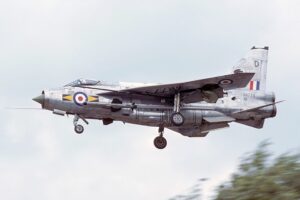 English Electric Lightning
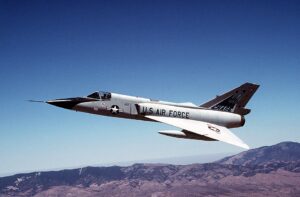 Convair F-106 Delta Dart
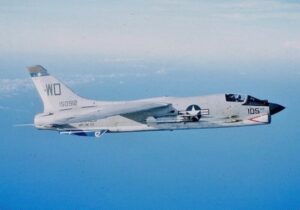 Vought F-8 Crusader
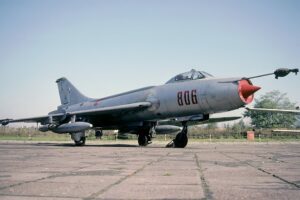 Sukhoi Su-7 Fitter
 General Dynamics F-111 Aardvark