Facts summary and sources
Xian H-20: speed Mach 0.85 (source basis for this value has not been checked). First flight: Not publicly confirmed.
This is a secondary compilation. A source-check date applies only to the listed claim, not to the whole page or its translation. A page update is not a source check.
No claim-by-claim source checks are recorded yet.
✈️ Full Specifications
| Designation | H-20 (轰-20) |
| Manufacturer | Xi'an Aircraft Industrial Corporation (XAC) |
| Country | 🇨🇳 China |
| First flight | Not publicly confirmed |
| Crew | 2 |
| Length | 20 m (65.6 ft) |
| Wingspan | 45 m (147.6 ft) |
| Max Takeoff Weight | 200,000 kg (441,000 lb) |
| Max Speed (Mach) | 0.85 |
| Speed evidence basis | Published specification |
| Service Ceiling | 14,000 m (45,934 ft) |
| Range | 8,500 km (5,279 mi) |
| Engine | 2 × Shenyang WS-10 derivative (non-afterburning) |
🌐 Operators
🔁 Variants
- H-20 — Initial production variant (in development)
- Reports of a possible H-20U unmanned variant remain unconfirmed
⚔️ Armament
Overview
The Xian H-20 (轰-20) is a Chinese flying-wing strategic bomber under development for the People’s Liberation Army Air Force (PLAAF). Officially acknowledged in 2018 by then-PLAAF commander Ma Xiaotian but never publicly displayed, the H-20 is widely understood to be China’s answer to the U.S. Northrop Grumman B-2 Spirit and B-21 Raider. Multiple Western intelligence agencies expect a public reveal between 2025 and 2028, with operational service to follow.
Design & Development
Photographic clues from official PLAAF promotional material — including the famous 2021 New Year’s greeting that featured a covered flying-wing silhouette — combined with leaked CGI renders, indicate the H-20 will be a subsonic flying-wing platform broadly similar in planform to the B-2 Spirit. Reported features include:
- Two non-afterburning turbofan engines, likely WS-10 derivatives
- S-shaped serpentine intakes to mask engine fan faces from radar
- Internal weapon bays sized for both nuclear and conventional standoff missiles
- A range of approximately 8,500 km without refuelling, giving it true strategic reach
Program History
The H-20 program has been under development at the Xi’an Aircraft Industrial Corporation since at least the mid-2010s. As of 2025–26, multiple sources report that a prototype has flown at the Xi’an / Yanliang test airfield, though China has not officially confirmed this. The bomber is expected to become a key element of China’s emerging nuclear triad, complementing the DF-41 ICBM and the JL-3 SLBM.
Capabilities
If specifications match Western estimates, the H-20 will give the PLAAF its first true intercontinental strike capability — extending Chinese nuclear and conventional reach to U.S. territory in the Pacific (Guam, Hawaii, the continental U.S. west coast) for the first time from a manned platform. Its arrival also pressures the U.S. to accelerate B-21 fielding and rethink Indo-Pacific air-defence posture.
References
- PLAAF official statements, 2018–2024
- U.S. DoD “Military and Security Developments Involving the PRC” annual reports, 2020–2025
- Janes Defence Weekly H-20 program coverage, 2022–2026
Related Aircraft
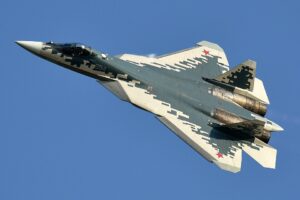 Sukhoi Su-57 FelonHome › Aircraft › Xian H-20🇨🇳 CHINAPROTOTYPEXian H-20Subsonic flying-wing strategic bomber — China's answer...
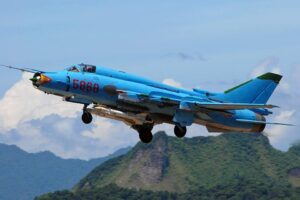 Sukhoi Su-17 Fitter (variable sweep)Mach 1.7 · 1,860 km/h
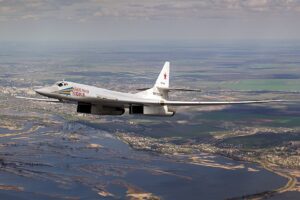 Tupolev Tu-160 White Swan2,200 km/h
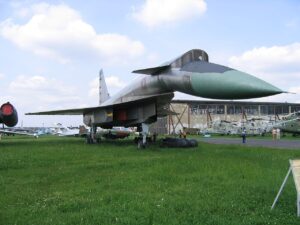 Sukhoi T-4 SotkaMach 3.0 · 3,200 km/h
 TAI TF-X KaanMach 1.8 [projected]
 Sukhoi Su-75 CheckmateMach 1.8 [projected]