Facts summary and sources
Boeing X-36 Tailless Agility Research Aircraft: speed Mach 0.5 (source basis for this value has not been checked). First flight: 1997.
This is a secondary compilation. A source-check date applies only to the listed claim, not to the whole page or its translation. A page update is not a source check.
No claim-by-claim source checks are recorded yet.
✈️ Full Specifications
| Designation | X-36 |
| Manufacturer | Boeing Phantom Works |
| Country | 🇺🇸 United States |
| First flight | 1997 |
| Retired | 1998 |
| Length | 5.6 m (18.4 ft) |
| Wingspan | 3.2 m (10.5 ft) |
| Height | 1.5 m (4.9 ft) |
| Empty Weight | 410 kg (904 lb) |
| Max Speed (Mach) | 0.5 |
| Speed evidence basis | Published specification |
| Max Speed | 370 km/h |
| Service Ceiling | 6,100 m (20,014 ft) |
| Engine | 1 × Williams International F112 |
| Thrust (each) | Dry 3.1 kN |
| Production | 2 |
🌐 Operators
🔁 Variants
- X-36 #1 — First airframe, 22 flights
- X-36 #2 — Backup, 9 flights
⚔️ Armament
Overview
The Boeing X-36 Tailless Fighter Agility Research Aircraft was a 28-percent-scale remotely piloted vehicle developed by Boeing Phantom Works and NASA to investigate whether a fighter without vertical or horizontal tails could match (and exceed) the agility of a conventional design. Two X-36 airframes flew 31 sorties between 1997 and 1998, validating the concept and feeding directly into modern stealth-fighter and sixth-generation aircraft design studies.
Design & Development
The X-36 was designed by the Phantom Works (the Boeing equivalent of Skunk Works) under a partnership with NASA Ames Research Center. The aircraft was 5.6 m long with a 3.2 m wingspan — a manageable size for unmanned operation and ground recovery while still representative of a manned fighter’s aerodynamics at scale.
Stability in pitch and yaw — normally provided by horizontal and vertical tails — was instead achieved through:
- Split ailerons that could open into drag rudders for yaw control
- Thrust vectoring on the single Williams International F112 turbofan
- A quadruple-redundant fly-by-wire flight control system
Stability augmentation software, based on neural network principles, gave the inherently unstable airframe carrier-quality handling.
Operational History
The first X-36 flight took place on May 17, 1997, at NASA Dryden Flight Research Center. Over the next year the two airframes flew 31 sorties accumulating 15 hours of test time. The aircraft demonstrated tailless flight at high angles of attack (up to 40°), validated thrust-vectoring nozzle control, and exceeded the agility benchmarks set by conventional configurations during simulator-based comparison runs.
Both X-36 airframes survived the test program. They are now in museum collections: one at the National Museum of the U.S. Air Force and one at NASA Dryden / Edwards AFB.
Legacy
The X-36’s data directly informed several follow-on programs:
- Boeing’s X-32 JSF entrant (which retained conventional tails but used X-36 stability research)
- The Boeing X-45 UCAV demonstrator (fully tailless attack drone)
- The U.S. Air Force’s Next Generation Air Dominance (NGAD / F-47) program, which is widely understood to use a tailless configuration
- The Chinese J-36 sixth-generation fighter, which is rumoured to be tailless
The X-36 is rarely flown today even in computer simulators, but its DNA is in every sixth-generation fighter concept now in development.
References
- NASA Ames / Boeing Phantom Works X-36 program reports, 1997–1998
- NASA Dryden flight test data, declassified 2002
- “Tailless Fighter Agility — Lessons from X-36” — AIAA conference paper, 1999
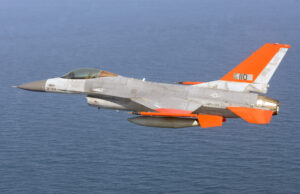 Boeing QF-16
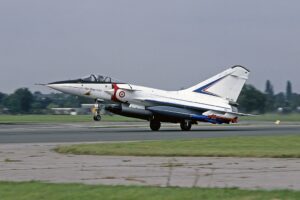 Dassault Mirage 4000
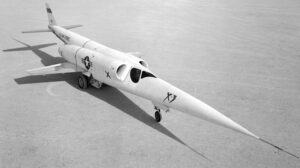 Douglas X-3 Stiletto
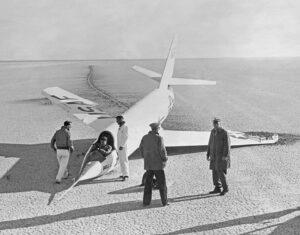 Bell X-2 Starbuster
 Douglas D-558-II Skyrocket