Facts summary and sources
Republic XF-103 Thunderwarrior: speed Mach 3.7 (source basis for this value has not been checked). First flight: Not publicly confirmed.
This is a secondary compilation. A source-check date applies only to the listed claim, not to the whole page or its translation. A page update is not a source check.
No claim-by-claim source checks are recorded yet.
✈️ Full Specifications
| Designation | XF-103 |
| Manufacturer | Republic Aviation |
| Country | 🇺🇸 United States |
| First flight | Not publicly confirmed |
| Crew | 1 |
| Length | 24 m (78.7 ft) |
| Wingspan | 10.7 m (35.1 ft) |
| Height | 5.5 m (18 ft) |
| Empty Weight | 11,340 kg (25,005 lb) |
| Max Takeoff Weight | 17,690 kg (39,006 lb) |
| Speed target / estimate (Mach) | 3.7 |
| Speed evidence basis | Design target / estimate; not a demonstrated record |
| Service Ceiling | 24,400 m (80,056 ft) |
| Range | 2,575 km (1,599 mi) |
| Engine | 1 × Wright XJ67-W-3 combined turbojet/ramjet |
| Thrust (each) | Dry 89 kN |
🌐 Operators
🔁 Variants
- XF-103 — Full-scale mockup completed 1954
- No prototype built
⚔️ Armament
Overview
The Republic XF-103 Thunderwarrior was a paper-only Mach 3 interceptor designed in the early 1950s to defend North America against Soviet supersonic bombers. Built around a then-novel Wright XJ67 combined turbojet-ramjet engine, the XF-103 would have been the fastest interceptor in the world — but the program was cancelled in 1957 before any prototype was built. No XF-103 ever flew, but the design influenced multiple later supersonic projects.
Design & Development
The XF-103 originated from a U.S. Air Force 1949 requirement for a Mach 1.5+ interceptor (the 1954 Interceptor program). Republic’s response — driven by chief designer Alexander Kartveli, who had also led the F-84 and F-105 designs — was vastly more ambitious: a Mach 3 long-endurance interceptor with combined-cycle propulsion.
The XJ67 engine, developed by Wright, would operate as a conventional turbojet at takeoff and subsonic cruise but transition to ramjet operation at Mach 2.5+ by bypassing the compressor and turbine sections. This enabled sustained Mach 3 flight in a way that conventional afterburning turbojets of the era could not match. The airframe was sleek and slender, with a deeply waisted area ruling and twin ventral fins for high-speed stability. The pilot sat in a downward-ejection capsule rather than a conventional seat — necessary because high-speed bailout above Mach 2 was lethal.
Program History
Republic won the 1954 Interceptor contract in October 1951. A full-scale wooden mockup was completed in 1954 and inspected by Air Force officials. The first flight was projected for 1957. However, the program ran into severe problems:
- The XJ67 engine consistently failed to meet performance specifications
- The complex combined-cycle system was unreliable in ground testing
- The MX-1179 fire-control system was years behind schedule
- Cost projections were escalating well beyond the budget
In August 1957, the Air Force cancelled the XF-103 program. By then $104 million (1957 dollars) had been spent without producing a single flyable airframe.
Legacy
The XF-103 is the great unbuilt American interceptor of the 1950s. Its combined-cycle propulsion concept — turbojet for low-speed, ramjet for hypersonic — has reappeared periodically since, most notably in the SR-71’s J58 (which is itself a turbo-ramjet variant) and the modern Hermeus Quarterhorse program. Republic’s frustration with the XF-103 cancellation pushed the company toward the F-105 Thunderchief, which became one of the workhorse aircraft of the Vietnam War.
References
- USAF System Development Decision, 1957
- “American X-Vehicles” by Dennis R. Jenkins (NASA SP-2003-4531)
- Republic XF-103 program documentation, declassified 1980s
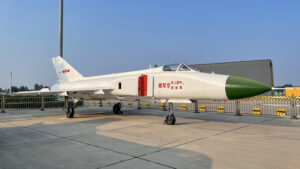 Shenyang J-8 Finback
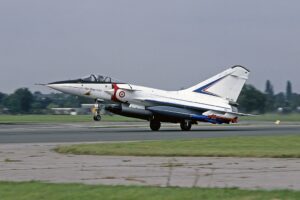 Dassault Mirage 4000
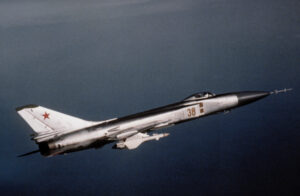 Sukhoi Su-15 Flagon
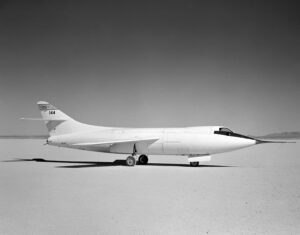 Douglas D-558-II Skyrocket
 Sukhoi T-4 Sotka
 Bell X-1