Facts summary and sources
Lockheed XF-90: speed Mach 1.12 (source basis for this value has not been checked). First flight: 1949.
This is a secondary compilation. A source-check date applies only to the listed claim, not to the whole page or its translation. A page update is not a source check.
No claim-by-claim source checks are recorded yet.
✈️ Full Specifications
| Designation | XF-90 / XF-90A |
| Manufacturer | Lockheed |
| Country | 🇺🇸 United States |
| First flight | 1949 |
| Retired | 1950 |
| Crew | 1 |
| Length | 17.1 m (56.1 ft) |
| Wingspan | 12.2 m (40 ft) |
| Height | 4.8 m (15.7 ft) |
| Empty Weight | 8,030 kg (17,706 lb) |
| Max Takeoff Weight | 14,150 kg (31,201 lb) |
| Max Speed (Mach) | 1.12 |
| Speed evidence basis | Published specification |
| Max Speed | 1,078 km/h (670 mph) |
| Service Ceiling | 12,345 m (40,504 ft) |
| Range | 2,300 km (1,428 mi) |
| Engine | 2 × Westinghouse J34-WE-15 with afterburner |
| Thrust (each) | Dry 13.8 kN · AB 19.6 kN |
| Production | 2 |
🌐 Operators
🔁 Variants
- XF-90 (46-687) — First prototype, later used as nuclear test target
- XF-90A (46-688) — Improved engines, scrapped in 1953
⚔️ Armament
Overview
The Lockheed XF-90 was a 1940s long-range penetration fighter prototype designed to escort the new generation of jet bombers (B-45, B-52, etc.) deep into Soviet airspace. Two XF-90 prototypes were built, but the design lost the Penetration Fighter competition to the McDonnell XF-88 (which became the F-101 Voodoo). The most famous XF-90 was used as a target during Operation Tumbler-Snapper nuclear weapons tests at Frenchman Flat, Nevada, in 1952 — making it perhaps the only manned aircraft ever to survive (in degraded condition) a direct nuclear blast.
Design & Development
The XF-90 was designed by Kelly Johnson’s Lockheed Advanced Development Projects team (the future Skunk Works), with the goal of a long-range escort that could match the performance of contemporary day-fighters at long range. The aircraft used a then-novel “thin wing” 35° sweep design and twin Westinghouse J34 turbojets in the rear fuselage. At 17.1 m long it was substantially larger than the F-86 Sabre of the same era.
The two prototypes — 46-687 and 46-688 — first flew on June 4, 1949, and on July 30, 1949, respectively. Test pilots reported good handling but mediocre performance: the J34 engines, even with afterburners, did not produce enough thrust to push the heavy airframe past Mach 0.95 in level flight. Eventually one prototype (46-687) made it past Mach 1 in a dive.
Operational History
The Penetration Fighter competition selected McDonnell’s XF-88 in mid-1950, citing the XF-88’s better short-field performance and growth potential. (Ironically, the XF-88’s eventual production form — the F-101 Voodoo — also disappointed and was rerolled multiple times in service.) Both XF-90 prototypes were retired.
In 1952, airframe 46-687 was shipped to the Nevada Test Site as a target for nuclear effects testing during Operation Tumbler-Snapper. It was placed at varying distances from three different test shots. The airframe was badly damaged but did not completely disintegrate, providing data on airframe survival in nuclear-blast environments. Decades later, after sitting outdoors at the test site, the wreckage was recovered, decontaminated, and is now held by the National Museum of the U.S. Air Force.
Legacy
The XF-90 did not enter production. Its data on transonic handling fed into the F-104 Starfighter (also designed by Lockheed under Kelly Johnson). The nuclear-test airframe is one of the few surviving direct artefacts of the 1950s above-ground atomic testing era.
References
- USAF flight test reports, XF-90, 1949–1950
- Operation Tumbler-Snapper test documentation, declassified 1981
- “Kelly: More Than My Share of It All” by Kelly Johnson and Maggie Smith
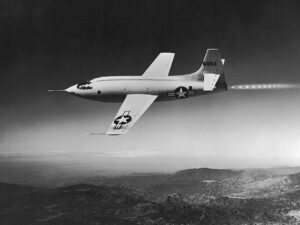 Bell X-1
 NASA X-43A
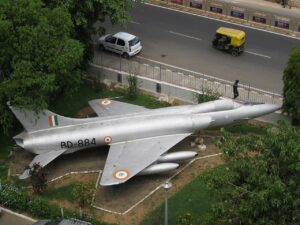 HAL HF-24 Marut
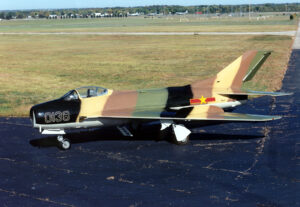 Mikoyan-Gurevich MiG-19 Farmer
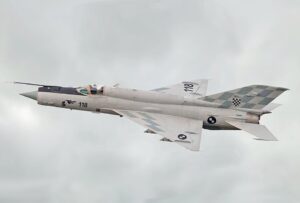 Mikoyan-Gurevich MiG-21 Fishbed