Facts summary and sources
Convair Kingfish: Design cruise speed: Mach 3.2 (Design cruise specification; not a demonstrated record). Proposal only; never flown. First flight: Never flown. Cancelled proposal; radar models were built, but no flying aircraft.
This is a secondary compilation. A source-check date applies only to the listed claim, not to the whole page or its translation. A page update is not a source check.
Sources and check records
- CIA: Archangel (2012), pp. 4–6 — Kingfish was a separate ground-launched proposal; the July 1959 drawing specifies cruise Mach 3.2 and cruise altitude 85,000–94,000 ft. [Design cruise conditions; not a flown maximum] · Source checked for this claim: 2026-10-10
- CIA: GUSTO selection history — The selection panel chose the A-12 on 29 August 1959; Kingfish did not become an operational aircraft. [Historical selection outcome] · Event date: 1959-08-29 · Source checked for this claim: 2026-10-10
- Code One: Convair Kingfish final design — The final proposal measured 73 ft 7 in long, 60 ft in span and 18 ft 4 in high; radar-test models, including a seven-tenths-scale model, were built. [Manufacturer history based on Convair final report; proposed dimensions and models] · Source checked for this claim: 2026-10-10
✈️ Full Specifications
| Designation | Kingfish |
| Manufacturer | Convair (General Dynamics) |
| Country | 🇺🇸 United States |
| First flight | Never flown |
| First-flight context | Cancelled proposal; radar models were built, but no flying aircraft. |
| Crew | 1 |
| Length | 22.43 m (73.6 ft) |
| Wingspan | 18.288 m (60 ft) |
| Height | 5.588 m (18.3 ft) |
| Design cruise speed | Mach 3.2 — Proposal only; never flown |
| Speed evidence basis | Design cruise specification; not a demonstrated record |
| Engine | 2 × Pratt & Whitney J58 / JT11 (proposed) |
🌐 Operators
🔁 Variants
- Kingfish — Final self-launching proposal
- FISH — Earlier, separate air-launched design
⚔️ Armament
How fast was the Convair Kingfish designed to fly?
Kingfish was designed to cruise at Mach 3.2; it never flew. This is a proposal specification, not a measured maximum. The CIA’s July 1959 drawing lists cruise altitudes of 85,000–94,000 ft. The earlier FISH was a different, air-launched design associated with Mach 4-class ambitions. CIA: Archangel, pp. 4–6.
Design and development
Convair proposed Kingfish for the CIA’s GUSTO competition to replace the U-2. Unlike FISH, it would take off under its own power. The final single-seat delta design placed two afterburning Pratt & Whitney engines in the fuselage; the CIA identifies them as J58s, while Code One uses the JT11 designation.
Code One’s account, based on Convair’s final report, describes steel structure and radar-reducing materials. Radar-test models were built, including a seven-tenths-scale model; no flying Kingfish was constructed. Its proposed length was 73 ft 7 in, span 60 ft and height 18 ft 4 in. Code One: final design and test models.
Why did the A-12 win?
The selection panel chose Lockheed’s A-12 on August 29, 1959. The CIA history describes the decision as a balance of radar signature, performance, cost and confidence in delivery—not simply a race for the highest speed. Kingfish remained a cancelled proposal.
Frequently Asked Questions
Did Kingfish reach Mach 4?
No Kingfish flight occurred. Its documented cruise target was Mach 3.2; FISH and Kingfish must not be treated as the same design.
Who designed Kingfish?
Convair designed the proposal. Test models existed, but it did not enter aircraft production or operational service.
Can its speed be compared with an SR-71 record?
Only with the evidence identified: Kingfish has a design cruise target, whereas a flight record describes a completed flight. They answer different questions.
Sources and further exploration
- CIA: Archangel, second edition (2012), pp. 4–6 — competition, proposed configuration and cruise conditions.
- Lockheed Martin Code One: Convair Kingfish — final design and models; the article identifies its underlying Convair report.
Explore the A-12 OXCART, SR-71 and temperature-aware Mach converter.
Related Aircraft
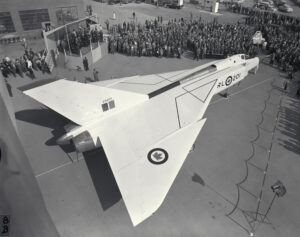 Avro Canada CF-105 ArrowHome › Aircraft › Convair Kingfish🇺🇸 UNITED STATESCONCEPTConvair KingfishCancelled reconnaissance proposal; Mach 3.2 design...Sukhoi Su-37 Flanker-FMach 2.35 · 2,500 km/hNorthrop Tacit BlueMach 0.6 · 463 km/h
 Mitsubishi X-2 ShinshinMach 1.6 · 2,000 km/h
 Tupolev Tu-123 YastrebMach 2.3 · 2,700 km/hConvair F2Y Sea DartMach 1.25 · 1,325 km/h