Facts summary and sources
Dassault Mirage F1: Manufacturer’s high-altitude maximum: Mach 2.10 (Published manufacturer specification). Dassault’s support specification. ATAC separately lists Mach 2.2 for F1B/CT/CR without equivalent altitude and loading conditions. First flight: 1966. 23 December 1966: prototype. First production flight was 15 February 1973; first French delivery was 14 March 1974.
This is a secondary compilation. A source-check date applies only to the listed claim, not to the whole page or its translation. A page update is not a source check.
Sources and check records
- Dassault Aviation: Mirage F1 history — The Mirage F1 prototype first flew on 23 December 1966. The first production aircraft flew on 15 February 1973 and was delivered to the French Air Force on 14 March 1974. [Prototype flight, production flight and delivery are distinct dates. The prototype used an Atar 9K31; the reference production engine is the Atar 9K50.] · Event date: 1966-12-23 · Source checked for this claim: 2026-10-19
- Dassault Aviation: Mirage F1 military support specifications — The manufacturer lists Mach 2.10 at high altitude, 15 m length, 8.40 m span, 4.49 m height, 7,400 kg empty weight and 16,200 kg maximum takeoff weight. It lists 473 export aircraft. [Manufacturer reference; the 55,000 ft figure is explicitly a sustained supersonic ceiling, not the practical ceiling. Export deliveries are not the whole production total.] · Source checked for this claim: 2026-10-19
- ATAC: Mirage F1 aircraft fact sheet — ATAC’s fact sheet for F1B, F1CT and F1CR lists Mach 2.2, a 60,700 ft ceiling and range above 1,700 nautical miles. [Operator-specific figures differ from Dassault’s high-altitude Mach 2.10. The operator does not provide matching speed conditions; its range is a lower bound, not an exact numeric range.] · Source checked for this claim: 2026-10-19
- Dassault Aviation: Mirage F1 history — The historical specification lists an Atar 9K50 engine and an 18,500 m practical ceiling. F1 variants included interceptor, attack, reconnaissance and two-seat versions. [Practical ceiling is distinct from the support page’s sustained supersonic ceiling. Weapon and avionics configurations depend on variant and operator.] · Source checked for this claim: 2026-10-19
- French Ministry of Defence: Mirage F1 final flight, 14 July 2014 — The Defence audiovisual archive records the French Mirage F1 final flight at the 14 July 2014 parade. [French-service event only; it is not a worldwide last flight or a statement about later contractor operations.] · Event date: 2014-07-14 · Source checked for this claim: 2026-10-19
- ATAC: air-to-air training mission — ATAC lists Mirage F1 aircraft in its fleet used for air-to-air training and adversary support. [Current operator webpage inspected on 19 October 2026. It supports continued contractor use, not a verified global inventory or military fleet count.] · Source checked for this claim: 2026-10-19
✈️ Full Specifications
Reference: Dassault’s single-seat Mirage F1 data. High-altitude maximum is Mach 2.10; ATAC’s F1B/CT/CR sheet gives Mach 2.2 without matching conditions. No exact km/h value is inferred. Dassault’s 18,500 m practical ceiling is separate from its 55,000 ft sustained supersonic ceiling. ATAC range >1,700 nmi is only a lower bound, so numeric range remains blank. Dimensions and weights follow the manufacturer’s metric table. Its 473 export aircraft are not a total production count; exact total and comparable unit cost remain blank. Thrust is not filled from an unqualified engine rating. French service ended in 2014; ATAC’s current page supports continued contractor use, not a global fleet count.
| Designation | Mirage F1 single-seat (manufacturer reference) |
| Manufacturer | Dassault Aviation |
| Country | ✈️ France |
| First flight | 1966 |
| First-flight context | 23 December 1966: prototype. First production flight was 15 February 1973; first French delivery was 14 March 1974. |
| Crew | 1 |
| Length | 15 m (49.2 ft) |
| Wingspan | 8.4 m (27.6 ft) |
| Height | 4.49 m (14.7 ft) |
| Empty Weight | 7,400 kg (16,317 lb) |
| Max Takeoff Weight | 16,200 kg (35,721 lb) |
| Max Speed (Mach) | 2.1 |
| Manufacturer’s high-altitude maximum | Mach 2.10 — Dassault’s support specification. ATAC separately lists Mach 2.2 for F1B/CT/CR without equivalent altitude and loading conditions. |
| Speed evidence basis | Published manufacturer specification |
| Service Ceiling | 18,500 m (60,699 ft) |
| Engine | 1 × SNECMA Atar 9K50 afterburning turbojet |
🌐 Operators
🔁 Variants
- F1C — interceptor
- F1A — day attack development
- F1B — two-seat version
- F1CR — reconnaissance
- F1CT — attack conversion
- Export variants — operator-specific equipment
⚔️ Armament
Overview
The Dassault Mirage F1 uses a high-mounted swept wing and a separate tailplane. It followed the delta-wing Mirage III but developed into its own family of interceptors, attack aircraft, reconnaissance aircraft and trainers.
First flight and delivery
The prototype first flew on 23 December 1966. The first production aircraft flew in February 1973 and reached the French Air Force on 14 March 1974. A production test flight and a service delivery are different milestones.
Manufacturer and operator figures
Dassault’s support table lists a high-altitude maximum of Mach 2.10. ATAC’s F1B/CT/CR sheet separately lists Mach 2.2, without an equivalent set of altitude and loading conditions. The comparison data follows the manufacturer’s reference.
Dassault gives an 18,500 m practical ceiling in its history, while its support page lists a sustained supersonic ceiling of 55,000 ft. Those headings describe different limits. Its 473 export aircraft also represent a delivery category, not the entire production run.
Service after French retirement
France’s final Mirage F1 flight took place during the 14 July 2014 parade. ATAC now lists the type among aircraft used for air-to-air training and adversary support. Contractor configurations and national military variants have different equipment and roles.
Video
Frequently Asked Questions
How fast is the Mirage F1?
Dassault lists Mach 2.10 at high altitude. ATAC separately gives Mach 2.2 for F1B/CT/CR without equivalent altitude and loading details; the comparison reference uses Dassault’s figure.
Did the Mirage F1 enter French service in 1973?
The first production aircraft flew on 15 February 1973; Dassault records delivery to the French Air Force on 14 March 1974. The prototype had flown in December 1966.
Is the Mirage F1 ceiling 55,000 ft or 18,500 m?
Dassault labels 55,000 ft as sustained supersonic ceiling, while its history lists 18,500 m practical ceiling. They measure different limits.
Are Mirage F1s still flying?
Yes. ATAC lists them for contractor air-to-air and adversary training. France’s final military Mirage F1 flight was on 14 July 2014; that date does not apply to every operator.
Primary Sources
- Dassault Aviation: Mirage F1 history
- Dassault Aviation: Mirage F1 military support specifications
- ATAC: Mirage F1 aircraft fact sheet
- French Ministry of Defence: Mirage F1 final flight, 14 July 2014
- ATAC: air-to-air training mission
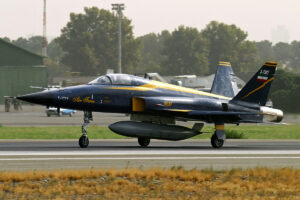 HESA Saeqeh
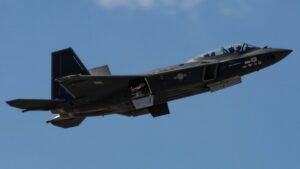 KAI KF-21 Boramae
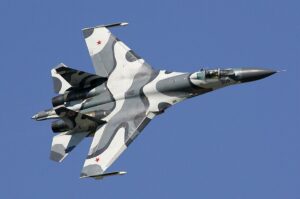 Sukhoi Su-27 Flanker
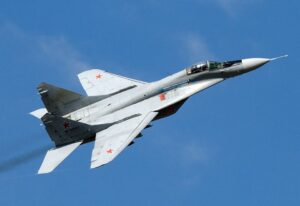 Mikoyan MiG-29 Fulcrum
 Lockheed F-104 Starfighter
 Hindustan AMCA